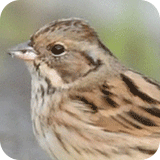
Finders-in-the-field: Pallas's Grasshopper Warbler, Burnham Overy, Norfolk

BOU/IRBC Status: A
RBA status: Extremely Rare Vagrant
Accepted British records: 54
Accepted Irish records: 2
Most recent accepted record:
2015-10-19 - Wirvie Burn, Fair Isle, Shetland
Prime month(s) to occur: October
The weather chart for Sunday afternoon 17th September looked interesting, NNE winds coming from the continent and potentially some rain showers, hmmm tasty. I don’t get to go birding as much as I used to, having a desk job and a young family curtails my birding somewhat. Apart from one very quick local twitch I don’t think I’d been out ‘birding’ since July, though having had a very stressful week at work I was “allowed” out.
I dropped the family at my mother-in-law’s (with the engine still running) and made a mad dash to the north coast. Decision time, do I head for the woods to twitch an arctic warbler found earlier in the day (and maybe find something else) or do I head for bushes hoping for fresh arrivals? Luckily I chose the latter and headed for my favourite spot, Burnham overy marsh and dunes.
Walking from the road to the sea wall was pretty uneventful - I heard my first pinks of the autumn overhead and hit the sea wall around 2.45pm. As I climbed to the top of the bank and gave the salt marsh a cursory glance for waders a group of walkers flushed a bird from near the path, it promptly flew away from me down into the nearest sueda clump. The bird was clearly a warbler and had an obvious rounded tail, hmm, looked good for a locustella.
What to do now, I couldn’t see a single other birder anywhere along the sea wall or in the dunes, so I dropped down the bank and crouched down and waited for it to come out. The bird then scurried along the floor into the weeds, maybe I stood more chance of seeing it on the ground now, or not?
Anyone whose found a migrant locustella will know how devilishly hard they can be. Over the next hour I slowly pieced it together with flight views and brief views on the deck, but it was frustratingly elusive and the Sunday afternoon walkers were coming thick fast and very loudly along the bank. One family pretty much camped next to me shouting at each other and their dog!
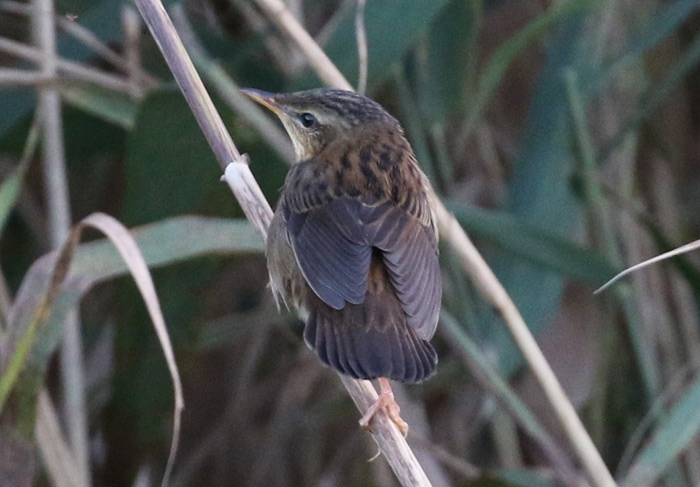
In this time I managed to piece together an obvious locustella with a big broad rounded tail, the streaks on the upper breast got me excited as in my experience they are rarely that bold or extensive on a grasshopper warbler, which can show fainter streaks confined to the sides of the breast in first year autumn birds. When seen side-on, the dark cap made the pale supercilium look very bold, giving the impression of a bold facial pattern unlike that of grasshopper warbler.
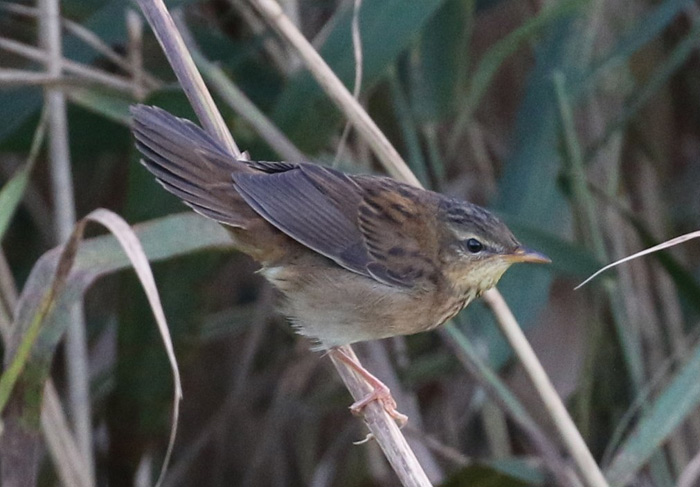
The bird showed a rufous vent with no dark centres to the undertail coverts, which you would expect to see on its commoner relative. In flight the tail looked dark and contrasted well against the warmer back, uppertail coverts and rump. Also the back had bold looking dark tramlines against a warmer mantle colour and the breast had a yellowish wash. Overall the bird had a very ‘contrasty’ feel to it.
Being pretty useless with a camera (and due to its elusive nature) I thought I could do with some help, PG Tips was a big call to make.
I texted a few people I knew would either be out or lived locally, Paul Eele was the first to arrive and calmed the situation somewhat; maybe it was just a strange looking grasshopper warbler after all. However, the more he saw of it the more he warmed to it. We still had no photograph, but thought we had possibly seen the white tips to the tail (but we couldn’t be sure). We decided to wait for Ashley Saunders to turn up as we knew he was nearby.

... What are the chances of the first bird I see on an afternoon jolly being a Pallas’s Grasshopper Warbler?
We were then treated to probably the best views either of us had had of it on the deck, plus more flight views. Ashley’s reaction was all I needed. It really was clearly a PG tips. Big grins all round and a few choice words too!
We were now ready to put the news out, but a cursory look at the news services said there was a possible PG Tips in the dunes. I honestly thought this must be a different bird because we were on the marsh. Reading further, this had now even been upgraded to a probable and I quickly realised this was our bird. Strangely, only the three of us had seen it and the news hadn’t come from any of us, most odd?!
Unfortunately, the bird had subsequently flown over the bank to the fresh marsh side, where the vegetation is much thicker. We waited for a while and rechecked its favoured sueda spot again but it did not reappear. We checked the fresh marsh side several times but it seemed to have disappeared into the much deeper cover and possibly onto the wrong side of the dyke, where it would probably be lost forever, aaggghh!
The three of us had to get home for various reasons so promptly left, I had dinner waiting for me at my in-laws and apparently my children’s behaviour was becoming feral! Having now lost the bird for 30-40 minutes, the fact that it was on the news services and there were now 10-15 people present I thought it best to leave it, not wanting people to waste a journey if it had actually vanished.
For those lucky enough to be there later the bird properly gave itself up to the camera, and the rest as they say is history.
I sometimes muse over the key ingredients to finding rare birds, I think in no particular order they are luck, time in the field, not giving up and noticing something different even from the briefest of views. I think this one sits squarely in the first category! What are the chances of the first bird I see on an afternoon jolly being a Pallas’s Grasshopper Warbler?!
Stuart White
22 September 2017
Share this story