Why are Bearded Vultures being reintroduced in Germany?
By Vulture Conservation Foundation
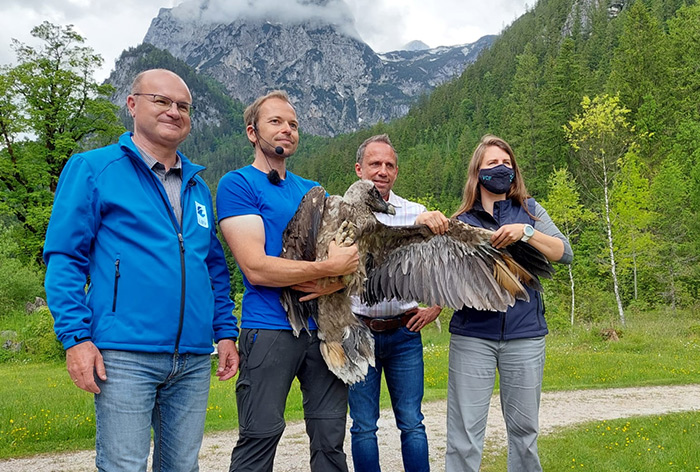
An important milestone has taken place yesterday [10th June] in the heart of the Bavarian Alps in Germany — for the first time Bearded Vultures were in the country as part of the ongoing Alpine reintroduction project.
The most spectacular species conservation project in Germany this year
Following the successful reintroduction of the Bearded Vulture in other Alpine countries and regions, the time has come to bring back the species to Germany's skies after more than 100 years since the species extinction. To reintroduce the Bearded Vulture in Germany, a long and challenging road lies ahead. It will take time and perseverance since Bearded Vultures only successfully reproduce when they reach around 8-10 years old, with one chick surviving per year in the wild. Still, the first steps towards its return has begun.
This year, ten Bearded Vultures chicks hatched in Andalusia at the Bearded Vulture Captive Breeding Centre of Guadalentín, which is managed by the Vulture Conservation Foundation (VCF) following an agreement with the Junta de Andalucía. The Bearded Vulture Captive Breeding Network, coordinated by the VCF on behalf of EAZA's EEP, has assigned two of these chicks, "BG1112" and "BG1113", to the new project in Germany! The two young vultures that saw the light of day in mid-March are not so little anymore, and the time has come for them to live in the wild.
About a week ago, the two birds left Spain to arrive in Germany in advance to spend some days in quarantine at Nuremberg Zoo. A VCF team is also present on-site to equip identification rings and GPS tags on the birds, as well as mark unique feather patterns to be able to closely monitor them in the wild. LBV released the birds to their new home, a remote hacking cave in the Klausbach Valley in the Berchtesgaden National Park (BNP), using the hacking method. There, the local team will feed the vultures daily, without human contact to avoid imprinting, and observe their progress to ensure they are adapting well to their new life in the wild. If all goes well, we expect the birds to take their first flights into freedom by the end of June!
Why are we reintroducing the Bearded Vulture in Germany?
Misinformation and misconceptions are what led to the demise of the Bearded Vulture in the Alps. The species was poisoned and hunted to extinction in the Alps as it was wrongly accused of killing sheep and even stealing babies. To avoid history from repeating itself, the Alpine reintroduction project focused on targeted awareness and education actions to improve the image of the Bearded Vulture. For example, from lammergeier, which translates to lamb vulture, the name in both English and German changed to Bearded Vulture and Bartgeier respectively. The return of the Bearded Vulture in Germany is not only good news for the species itself, but also for the ecosystem as a whole in which Bearded Vultures play an important role thanks to their scavenging behaviour and unique feeding specialization, since they mostly feed on bones.
Furthermore, the new reintroduction site within the Alpine project is important to achieve the geographical expansion of the species towards the east. The inclusion of a fifth Alpine country within the ongoing reintroduction efforts will further boost conservation measures in the region as a whole.
Finally, what's interesting historically is that the feasibility study done in the late 80 to early 90s identified the BNP as a suitable release site, and a recent similar study confirmed this once again.
11 Jun 2021
Share this story