Three new species added to the British List
The British Ornithologists’ Union Records Committee (BOURC) has added White-chinned Petrel, Yellow-bellied Flycatcher and Ruby-crowned Kinglet to the British List, taking the total to 626.
White-chinned Petrel Procellaria aequinoctialis
One, first-calendar-year or older, Scapa Flow, Mainland, Orkney,
25 May 2020.
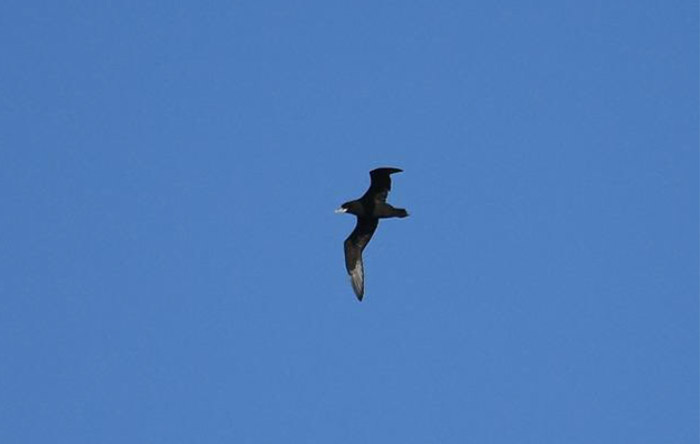
The extraordinary observation of a Procellaria seabird flying over a beach on Mainland Orkney by a resident during his Covid-19 exercise walk was captured with a series of excellent photographs, taken because he recognised the bird as being ‘different’, which allowed it to be identified as White-chinned Petrel. Though widespread in the Southern Oceans this is only the second North Atlantic observation. The probability of this individual being an escape from captivity or ship-assisted was judged to be minimal and so the record was accepted as having a wild origin. Thus the species was added to Category A.
It should be placed after Black-capped Petrel Pterodroma hasitata on the British List.
White-chinned Petrel is widespread in the Southern Oceans where it nests on islands and can disperse large distances during the non-breeding season.
Yellow-bellied Flycatcher Empidonax flaviventris
One, first-calendar-year, Balephuil, Tiree, Argyll,
15-23 September 2020.

A predicted trans-Atlantic vagrant, this individual appeared after an autumn westerly weather system on an island off the west coast of Scotland, and is the first record for the Western Palearctic. Thus it was considered to be a naturally occurring Nearctic vagrant and the species was accepted to Category A.
It should be placed after Eastern Phoebe Sayornis phoebe on the British List.
Yellow-bellied Flycatcher breeds from west and central Canada to south-east Canada and north-east USA, migrating to winter in southern Mexico and Central America.
Ruby-crowned Kinglet Regulus calendula
One, first-calendar-year or older, Cuithir, Barra (Barraigh), Outer Hebrides,
12-27 November 2020.

A Nearctic species that has demonstrated trans-Atlantic vagrancy with previous records in Iceland, Ireland and the Azores, this individual appeared after a late autumn anticyclonic weather system on a west coast Scottish island. Thus it was considered to be a naturally occurring vagrant and the species was accepted to Category A.
It should be placed after Goldcrest Regulus regulus on the British List.
Ruby-crowned Kinglet is polytypic with three subspecies, two of which occur on mainland North America: nominate R. c. calendula breeding in central and eastern Canada and south-west, west-central and eastern USA moving distances south, wintering in USA to northern Central America; and grinnelli, breeding in Alaska, south-west Canada and north-west USA, migrating to winter in western USA.
The following subspecies has been added to the British List:
Eastern Yellow Wagtail Motacilla tschutschensis tschutschensis
One, first-calendar-year to second-calendar-year, Sedgeford, Norfolk, 23 December 2019 to 1 March 2020.

That this bird remained for an extended period from December to early March meant that it developed into breeding plumage. This aided its identification to the nominate subspecies M. t. tschutschensis of Eastern Yellow Wagtail. The likelihood of this individual being an escape from captivity was judged to be minimal, and so the subspecies was accepted to Category A.
Another record of an Eastern Yellow Wagtail of the subspecies M. t. taivana observed at Pelistry and Kittydown, St Mary’s, Isle of Scilly from 14 November 2018 to 17 April 2019 was found to be not proven as this subspecies, although it was accepted as M. tschutschensis. The record was returned to the British Birds Rarities Committee (BBRC) for reconsideration.
Eastern Yellow Wagtail is polytypic with four subspecies (plexa, tschutschensis, macronyx and taivana) breeding in the central and eastern Palearctic which migrate to winter from Southeast Asia to Australia and the Greater Sundas.
Other decisions:
Collared Pratincole Glareola pratincola
New first record: one, North Meols, Lancashire, April 1805 is accepted as the first British record.
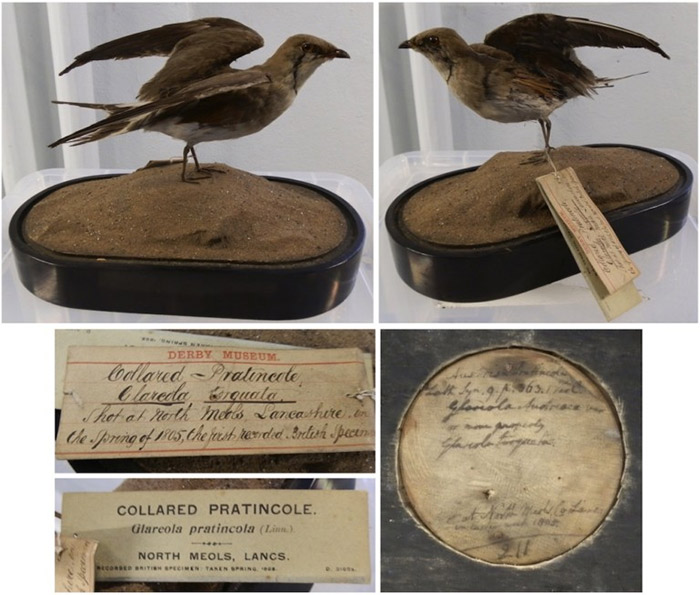
The previous first British record of Collared Pratincole from Bowness-on-Solway, Cumbria, October 1807 was reevaluated following published BOURC criteria for considering historical records (IBIS 160, 936-942). A number of inconsistencies including the location and year, with no existing description or museum specimen, resulted in the record being rejected
Instead, a North Meols, Lancashire, 1805 record was researched with a specimen located at the World Museum, National Museums Liverpool (Fig. 1). The specimen allowed the identification to be confirmed, and the labels established its provenance, location and date. Together these allowed it to be accepted as the first British record.
Collared Pratincole is polytypic with two subspecies: nominate G. p. pratincola breeding in southern Europe and northern Africa to Pakistan, migrating to winter in northern tropical Africa; and the other resident in sub-Saharan Africa from Senegal to southern Somalia and South Africa.
Upon publication of these changes, the British List stands at 626 species (Category A = 608; Category B = 8; Category C = 10).
1 July 2021
Share this story