Spanish sheep farmer jailed for 18 months for killing vultures
By Vulture Conservation Foundation
A Spanish sheep farmer in the province of Cáceres in Eastern Spain has been jailed for 18 months and fined €18,000 — €6,000 for each Griffon Vulture he killed.
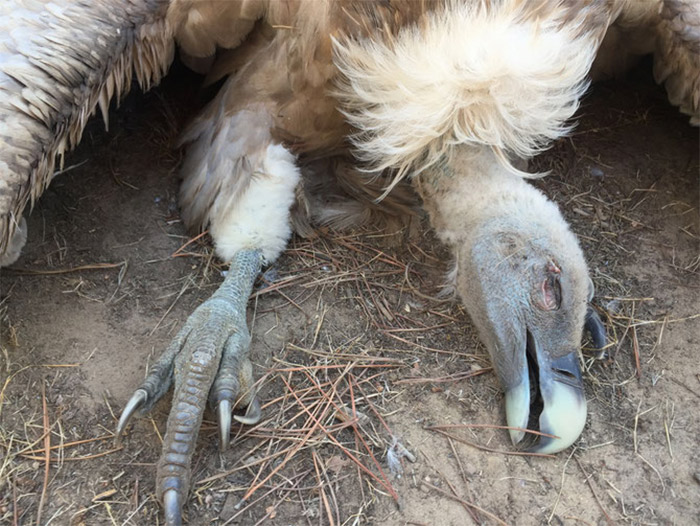
Spanish authorities lead the way in the fight against wildlife crime once again. Thanks to their investigation, a farmer from Cáceres who intentionally left several poisoned sheep carcasses at the disposal of scavenging birds, which resulted in three Griffon Vulture deaths, recently received a hefty penalty.
Serious poisoning case launches thorough investigation Back in the spring of 2019, Nature Protection Service officers (Seprona) discovered two dead Griffon Vultures near a sheep farm in the province of Cáceres, and with the help of the Junta de Extremadura, they discovered a third carcass of the same protected species. Following the troubling findings, the competent authorities took urgent and decisive action. They suspected the head of the farm and launched an investigation that uncovered approximately 200 carcasses of sheep stacked on top of each other, and also found a bucket with 2 litres of poison. Upon further examination, they realised that the offender systematically sprayed his sheep with poisonous substances, mixing the lethal and prohibited insecticides “chlorpyrifos” and “sulfotep” with corn, feed, oats and chickpeas, killing the three vultures and at least four domestic pigeons.
Farmer receives conviction for poisoning vultures and other animals
The Cáceres Criminal Court No1 found the farmer responsible for continuous crimes against wildlife and domestic animals.
The investigation into the farmer's activities showed that 244 sheep had died in the past few years “without them showing any trace of injury or disease according to the necropsies”, although, in the judgment of the judge, “it cannot be established with certainty that the death of the sheep was the result sought by the accused”. However, the farmer had reportedly systematically sprayed his sheep with the toxic substance, resulting in at least 200 of them dead, to place them in the dunghill near the farm with the intention of killing all vultures that came to feed. Therefore, the judge also held him responsible for a continuous offence of poison use against wildlife.
Due to these offences, the Court sentenced him to 18 months in prison and to pay a fine of €3 daily, for 21 months. The farmer must also compensate the General Directorate of Rural Environment of the Junta de Extremadura €18,000 — €6,000 for each Griffon Vulture he killed.
This sentence is a rare example that needs to be followed up elsewhere. Wildlife poisoning is a destructive environmental crime that should be treated as such. The support and involvement of the government, law enforcement and criminal-judiciary is essential to tackle this threat.
Spain leading the fight against wildlife poisoning
Based on the findings of a report, in Spain alone, between 1992 and 2017, 21,260 animals died due to poison baits from a total of 9,700 crimes against wildlife. This figure is just the tip of the iceberg, because in reality there may be more than 200,000 animals affected since only a fraction of the total number of cases are ever detected. The Griffon Vulture is the most poisoned bird of prey in Spain, with 1,757 individuals falling victim to this damaging practice, corresponding to 23.4% of all raptor species affected.
Poison is the main threat to vultures worldwide, according to the Vulture Multi-species Action Plan (Vulture MsAP) and continues to be one of the most destructive illegal practices for biodiversity in Spain, killing precious wildlife. Spain, however, can be seen as a best practise example in Europe when it comes to tackling illegal wildlife poisoning. Thanks to decades of work and enforcement, this destructive practice drastically decreased in the country. However, even in Spain, only around 5% of the poisoning incidents are resolved and arrive at a conclusion.
VCF
June 2021
Share this story