Mark Avery's Book Review: Beak, Tooth and Claw
By Mary Colwell
- Butterflies
- ISBN: 9780008354763, available now
- Buy from WildSounds & Books). 10% of each sale though RBA and WildSounds will be donated to the World Land Trust
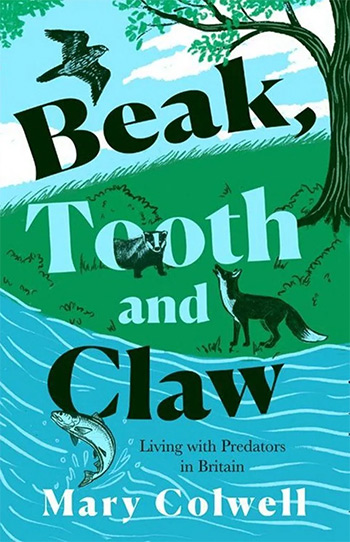
I have found this book a difficult one to review because I like and admire the author but I dislike and don’t admire the book. What follows is a review of the book, not of the author.
It’s a book about predators in the UK – so raptors, Red Foxes, Badgers, seals get lots of words but the fact that almost everything is a predator of some other species hardly gets a mention and the biology of predator-prey relationships is barely touched on.
I found this a very irritating book because the author steps into areas of high controversy and doesn’t really seem to have understood them very well. And, therefore, although it’s all very entertaining the book doesn’t reach many conclusions about anything, and, in my view, it doesn’t do a good enough job in synthesising the information so that readers can make up their own minds. I don’t feel the author has interpreted the evidence well enough. And so I felt like throwing this book across the room several times as I was reading, and re-reading, it. My reaction may act as a recommendation for the book for some.
I could just leave it there and then move on, but I feel that I ought to back up my assessment with some examples. So let me take you through some examples and you can judge whether you think I am being fair.
Let’s go to the passages which deal with Hen Harriers and driven grouse shooting on pages 152-167 in the chapter ‘Buzzards and Hen Harriers’.
On page 152 as we get into this tricky subject there is a howler when we are told that 12 August marks the opening of the 6-month grouse shooting season – the season ends after just under 4 months. Not the most terrible mistake in the world but one which immediately makes one wonder how the book will deal with the less easily checked and more intellectually tricky subjects which are bound to follow.
On the next page we are told that grouse shooting is ‘thought’ to be worth nearly £100m to the economy according to the industry’s own figures. We are not told that that estimate has been roundly criticised by economists on a range of levels; the figures are supplied by those who have a vested interest in making that total look large, are unchecked and they include expenditure enabled by agricultural subsidies which ought to be removed from consideration. But more importantly, those figures are not estimates of ‘worth’, they are simply gross spend. If one were to estimate ‘worth’ then one would have to take into account the costs imposed on society by driven grouse shooting such as floods, higher water treatment costs and carbon emissions for example (see yesterday’s Guardian piece for example). Check out what a real economist says about grouse shooting – click here.
On page 154 there is a good, short, account of the findings of the Murgatroyd et al. study of Hen Harriers but the book does not put the roughly 550 UK pairs of Hen Harrier in any context such as that provided by this statutory sector report which lays out evidence and analysis for why we might expect around five times that number to exist in the absence of illegal persecution. And the same report also, famously, although it is slightly difficult to find in the long report (it’s on page 54), states that ‘However, in 2008, there were records of only 5 successful hen harrier nests across the UK extent of driven grouse moors, yet estimates based on habitat area indic[a]ted that there should have been almost 500 pairs‘.
On page 155 we are told that Hen Harriers ‘…breed very successfully on [grouse moors], but the same moors are also the site of their persecution. As ground-nesting birds hen harriers benefit from the same management as red grouse, namely intense control of predators such as foxes, stoats and crows and the patch-burning of of heather…’. This gives the impression that grouse moors are great places for Hen Harriers and is in rather stark contrast to the quote above about how few grouse moors have successful Hen Harriers nests. The studies of Etheridge et al. back in 1997 (The effects of illegal killing and destruction of nests by humans on the population dynamics of the Hen Harrier Circus cyaneus in Scotland. JApplEcol 34: 1081-1105) and the Natural England progress report on their Hen Harrier study (‘A future for Hen Harriers in England?‘ of 2008) both indicate that Hen Harriers have lower breeding success on grouse moors than non-grouse moors. This book gives a palpably inaccurate, indeed untrue, picture of the success of Hen Harriers on grouse moors – it’s as simple as that.
It’s also on page 155 that we are told that because Hen Harriers can be sociable nesters ‘Numbers can build up rapidly, and in just a few years a moor can find itself hosting a dozen or more hen harrier pairs‘. You’ll notice that the word ‘can’ is used twice in that sentence It gives the impression that this is a fairly common occurrence and yet the truth is that it hardly ever happens and has, as far as I can recall, only happened at Langholm. That’s one occasion, lasting just a few years, in the last 40 years or so.
On pages 156-7 there is a description of diversionary feeding, and how brilliantly it reduced the numbers of Red Grouse fed to Hen Harrier chicks. But this book says it wasn’t taken up because the cost of it would be ‘prohibitively expensive, time-consuming and impractical’ if Hen Harrier numbers rose too high. I don’t know where this came from but it isn’t born out by the actual figures – even DEFRA say that feeding a brood of Hen Harriers only costs £1150/yr. That’s a snip – even if you had half a dozen pairs on a moor, when you consider the income to be gained from paying customers at £2-3000/day/gun for a middling grouse moor. And in any case, moving from a business model dependent on criminality to one based on hard work must be worth something to the shooting community. In this book, the industry line simply seems to be accepted as true.
Actually there are two other reasons why diversionary feeding is not taken up by the criminal classes associated with grouse shooting. The first is, in my view, the lesser reason – that it isn’t proven to work. Although Hen Harriers stop bringing Red Grouse chicks to the nest when fed artificially there didn’t seem to be more Red Grouse available for shooting in August. This remains quite puzzling but would certainly be a reason for caution in relying on diversionary feeding. But it’s an approach that needs more testing rather than simply discarding on the say so of industry. And it is being deployed at some Hen Harrier nests so there are probably more data out there now. Most reasonable people, in a situation of conflict, would surely think it was worth a proper try! Even DEFRA says that it should be tried and Natural England issue a licence every year so that it can be tried. Those are views that were surely worth mentioning here? However, I suspect that the main reason that diversionary feeding is not taken up by the grouse shooting industry is that they have a less expensive, less time-consuming and entirely practical solution to hand and that is continuing criminality and taking care not to get caught.
Moving on to pages 158-9 we are told ‘…intensive management also benefits other species, apart from red grouse and hen harrier. Grouse moors provide food and habitat for golden eagle, peregrine, merlin, short-eared owl as well as lapwing, golden plover, curlew, meadow pipit and skylark. If heather moorland disappeared, these species may also decline‘. Well, we can’t argue that grouse moor management benefits Red Grouse to the extent that they live in artificially very high densities before being shot at, although those high densities must be part of the reason for the high incidence of disease in Red Grouse and the need to attempt to keep them going until they face the guns with the provision of medicated grit on the moors. But it certainly doesn’t benefit Hen Harriers overall. Nor does it benefit Golden Eagles (see here for the review of evidence) nor Peregrines (see here for a very good review of the evidence for northern England). Lapwings, Golden Plover and Curlew? Yes, up to a point and this is a fair point. But how this book can leap from purported benefits of intensive management for Red Grouse to the alternative of heather moorland disappearing is ludicrous. Talk about a straw man and a false dichotomy!
Also on page 159 we are told that if current mismanagement for grouse shooting can’t continue then the most likely alternatives are Sitka plantations, windfarms and intensive sheep grazing – this is far from the case. Those things would happen in some places, and they would have a mix of impacts on species – some bad, but some quite possibly good. But they couldn’t happen everywhere because conservation designations and current landscape policies wouldn’t let them. Things might change but the prospect of heather disappearing and plantations and windfarms replacing it in our National Parks and designated landscapes is a great example of project fear. It just isn’t going to happen. Whereas, the rewilding option, which this book quickly skates over, really is a live option for nature conservation, landscape, carbon storage and many other reasons. It deserves to be given more space and more credence here.
Pages 160-64 provide a perfectly fair acount of brood meddling and what people think of it. They were still irritating pages, but that’s because the whole subject is irritating.
Page 164 also quotes the Natural England blog that stated in July 2020 that ‘over 20 successful [Hen Harrier] nests recorded in England so far this year‘ whereas the truth was that 19 nests were successful which is a number under rather than over 20. It’s a small error, and I recognise that it’s a tricky world where the statutory conservation agency gets things, like the true numbers, wrong in its own blog and in its press releases but now the erroneous figures are embedded in this book too. How irritating.
Pages 165-66 irritatingly gives the impression that if only everyone would sit down and be sensible then a compromise would be found and ignores the fact that loads and loads of that went on years ago. It is because talking failed that some of us are determined to sweep driven grouse shooting away completely. This book, like most other books and articles and discussions, does not suggest what that new future might be if not banning driven grouse shooting, or licensing as a first step, and so it plays into the hands of the unsustainable status quo. In these pages there is little mention of the quite different approach to driven grouse shooting’s impacts on the environment including protected raptors, that is taken by the government in Scotland. This book has a very English focus.
But, this book hints at walked up shooting being the way forward. Many of the supporters of a ban of driven grouse shooting, would be happy with that. I would be happy with that. Indeed, that’s why every move I’ve made has targetted driven grouse shooting, not grouse shooting. But the book doesn’t come down very firmly for walked-up shooting – and if it did, then, of course, the quickest way to get there would be to ban driven grouse shooting.
On page 167 we return to the wider impacts of burning on the environment, although only some of them, where we can read ‘The burning of heather moorland, opponents say, produces bare ground which increases rainwater run off which affects towns and villages below the moors‘. It’s an interesting way of putting it. Because those effects include flooding people’s houses then yes those people have become opponents of driven grouse shooting – that’s hardly surprising is it? They weren’t born as opponents of this land use, they have come to loathe it because they’ve seen water pouring off burned hills and into their homes and businesses. And they haven’t invented those impacts they have been arrived at by science (see here and here for when that science was published back in 2014 but many papers and discussions have followed which have not dented its relevance or value). So it isn’t ‘opponents’ who came up with the idea of increased flood risk, increased greenhouse gas emissions and increased water treatment costs, it was a whole bunch of scientists who carried out large-scale and intensive studies – the EMBER study of Leeds University is the main such study but it is not the only one. And the Committee on Climate Change don’t get a mention here, either as opponents or supporters of driven grouse shooting, but they too want an end to burning on peatlands on driven grouse moors and other places. As I have written before, the future of driven grouse shooting and of the Hen Harrer may depend more on the growing realisation of what driven grouse shooting does to ecosystem services than to what they do to each other. And just a word on ‘opponents’ of driven grouse shooting – I’m one, but I haven’t always been one. I’ve got to that position over several decades. And that’s what I’ve seen in many others too. I’ve known very many people who have started as mildly pro grouse shooting and over time become distinctly anti. Interestingly, I can’t recall anyone who has moved strongly in the other direction, but I know many who haven’t moved at all.
Can you see why I was irritated? As someone who knows a bit about this subject I think this book is rather sloppy in its treatment of this subject. And note, that its sloppiness is always in the direction of favouring driven grouse shooting in the examples I’ve given: the economic value of grouse shooting (and not the counter examples), failing to mention the science that sets out the scale of the impact of illegal persecution, the repetition that intensive grouse moor management favours Hen Harriers (when the data have long shown it doesn’t overall), the parading of a long (and in this case wrong) list of species benefitting from grouse moor management (fair enough if you get the details right), the down-playing of diversionary feeding as a useful approach to resolving conflict, holding up the prospect of sheep, conifers and windfarms as the almost inevitable alternatives to grouse moor management, the longing for more talking as the right way to spend the future rather than acting now to solve the environmental harm, the playing down or ignoring of the wider ecological and societal disbenefits of the management necessary for driven grouse shooting. These are all arguments from the grouse shooters’ manual – there actually more or less is such a manual (see here) although that isn’t in the references in this chapter of this book. In fact, the section on Hen Harriers is rather short of references altogether.
This chapter of this book won’t change my mind on the subject of driven grouse shooting, not with its treatment of the evidence, but my irritation rises because it may start a few people off in the wrong place and we’ll just have to persuade them of the error of the arguments over time. And they’ll say that they read it in a book (so it must be true!).
But I was irritated throughout the book for similar and extra reasons. The chapter on Ravens and Crows is pretty irritating and has quite a lot of errors too. Of course I’ll spare you an analysis of other chunks of text but I did not find this book a useful analysis. There is not enough attention to the science and little synthesis. Each chapter is a bit like a radio slot – the issue is raised and a couple of people on either side of the argument are quoted but not necessarily in the way they would most want or in the way that is most helpful to the listener, in this case the reader, to get a clear view of the facts of the matter and come to a conclusion that is firmly based.
I wouldn’t put you off reading this book but I cannot recommend it much at all.
Beak, Tooth and Claw: living with predators in Britain by Mary Colwell is published by William Collins.
Mark Avery - markavery.info
May 2021
This book review was first published on Mark Avery's blog and is reproduced here with permission
Share this review