Finders in the Field: Rock Thrush, April 2021
This is the 22nd year of walking St Mary’s Airfield in the evening in April and May hoping to find a Calandra Lark. On April 26th at 6.30 pm after dinner, I set off on the well-trodden route around the perimeter, scanning as I went. By 6.50 pm I’d reached near to the end of the southern runway by the turning circle at the coast. There was a handful of Northern Wheatears on the runway and a continual stream of Manx Shearwaters passing close inshore.
At that moment, I saw a thrush-like bird flying straight toward me from beyond the turning circle and land in some bramble. I lifted my binoculars and focused them on the bird and as I did the blur turned into a pin-sharp image of a female Rock Thrush. It was an awesome moment. I watched it for 30 seconds looking at details of the plumage and structure, as far as possible. The remiges and all greater coverts looked particularly brown and I suspected a 2CY bird. The photo on page 274 (bottom left) in Shirihai & Svensson’s Handbook of Western Palearctic Birds, volume 1, of a 2CY female taken in May, with all juvenile greater and primary coverts and remiges, is a dead ringer for the Scilly bird.
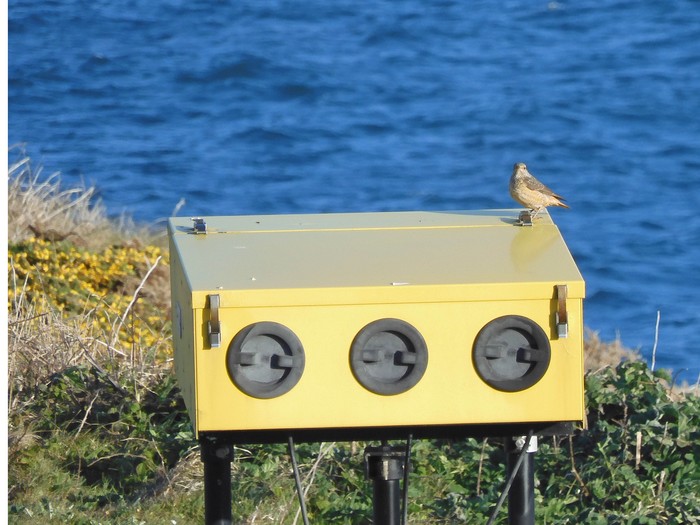
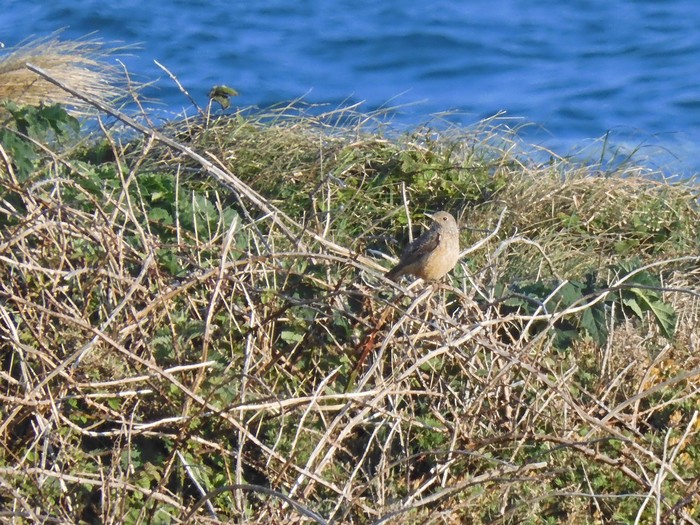
I then hastily turned to my new investment, a matchbox-size Nikon coolpix, and snapped a few shots. It’s a tool for record shots. The Rock Thrush sat motionless for a while, flipped onto a yellow airport light where it stayed for several minutes, and then dropped onto the side of the runway where it stood motionless for some time. I got the impression that the bird was very tired.
It was urgent to spread the news. The local network system in Scilly has been brilliantly designed to create blackspots at the main rarity finding sights and this includes the turning circle. So, I hastened up the inclined runway searching for a signal, while trying to keep an eye on the Rock Thrush. The signal wouldn’t click in and my excitement turned to frenetic frustration. I reached the windsock at the crossroads of the runways when, finally, the mobile registered a signal and I rang my pal Ashley Fisher, but the signal dropped out again! This part of story goes on a bit so I’ll fast forward…
Ashley answered and instantly went into turbo drive as he needed Rock Thrush ‘bad’ having missed two previous birds. Rob Lambert jumped in Ashley’s car and others raced to the turning circle with only 90 minutes good light left. Scott Reid was first on the scene with Andy Holden, Joe Pender and John Higginson not far behind. About 20 birders arrived in total. Just one problem, the bird had vanished.
A frantic search ensued with the sun sinking ever lower. No sign and time was running out. Ashley went into bird-brain mode and said, if I were a Rock Thrush, I would be sunning on rocks like Blue Carn. So, we headed that way and ‘bang!’ there it was sitting near the top of Blue Carn. No signal again and so hand waves alerted Lucy McRobert, who hand-waved to people further along the coastal track, who in turn hand waved to the remainder by the turning circle, completing the chain wave. Thankfully, everyone was alerted and arrived in time to get decent views.
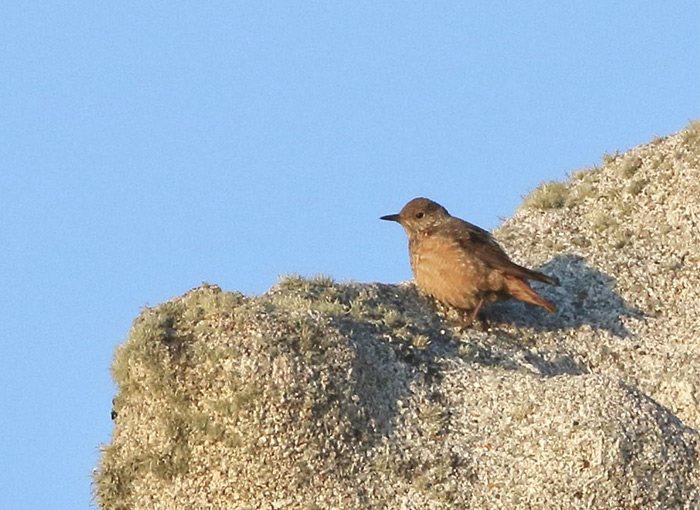
Next morning, birders searched early doors from 6.30 but there was no sighting. The only consolation was the Nightingale that has been around for several days.
I remember a few years ago reading with great envy Adam Hutt’s gripping finders account of a Rock Thrush at Spurn. As I read through it I dreamt that one day I might share a similar experience. Lady Luck took care of that.
Well, now on to the next 22 years of walking the Airfield for a Calandra Lark…
Bob Flood
29 Apr 2021
Share this story