Discovery of the oldest wild Egyptian Vulture
By Vulture Conservation Foundation
Conservationists have discovered the oldest known living Egyptian Vulture in the wild thanks to long-term monitoring efforts!
Longevity record verification of wild Egyptian Vulture
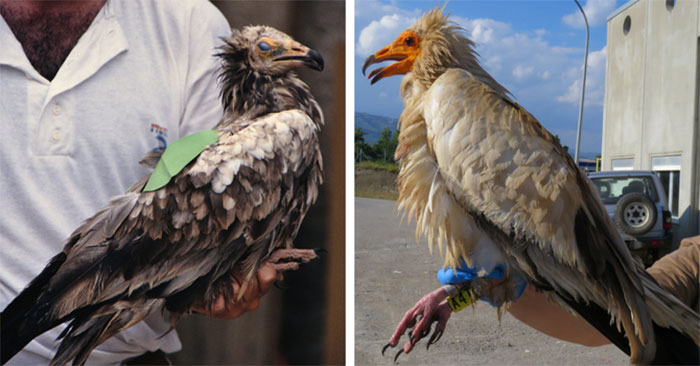
Long-term monitoring plays a crucial role in understanding the ecology and conservation of long-lived endangered species, like the Egyptian Vulture, the only true long-distance migratory vulture species in Europe. Thanks to monitoring efforts that began a couple of decades ago, a conservation team managed to identify the oldest Egyptian Vulture in the wild. They first captured the male vulture in July 1993 in Bardenas Reales, northern Spain, where he was probably two years old based on the plumage patterns. In June 2020, the same individual was recaptured as a territorial adult in the Catalan Pyrenees, 200 kilometres away. According to a recently published article, this bird's age, 29 years old, breaks the previous longevity record for an Egyptian Vulture in the wild.
Egyptian Vultures in Spain
All European vulture species live in Spain, Europe's vulture stronghold. The Egyptian Vulture has two subspecies in Spain; the Peninsular subspecies is currently listed in the Spanish Catalogue of Threatened Species in the category of Vulnerable and the Canary Islands subspecies in the category of Endangered. Periodic censuses are carried out for these two subspecies by the Autonomous Communities in compliance with the Law on Natural Heritage and Biodiversity. Spain is home to the largest European population of Egyptian Vultures and is a global stronghold for the species with 1,490-1,567 pairs.
20 April 2021
Share this story