Young gulls' brown plumage acts a ‘no-threat signal’ to adults
A study of American Herring Gulls has found that the mottled plumage of young birds reduces aggression from territorial adults within breeding colonies.
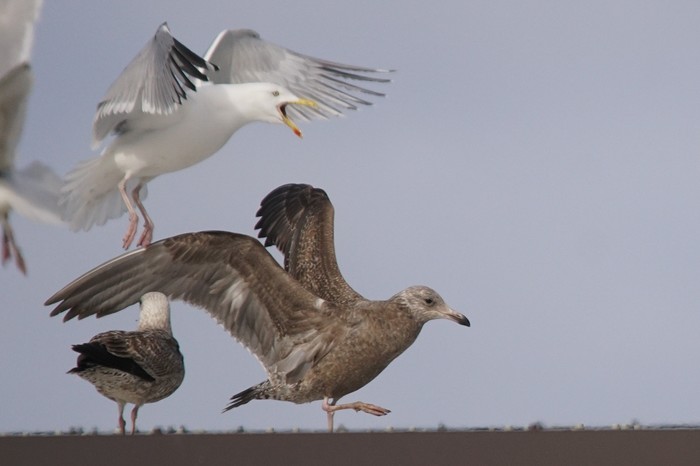
The mottled brown plumage of young gulls appears to act as a signal of low social status, making territorial adults less likely to treat them as rivals, according to new research.
Many large gull species take several years to acquire their familiar adult plumage. During this period, their appearance changes gradually from predominantly brown juvenile feathers to the white and grey plumage of mature birds.
Scientists have previously suggested that this delayed plumage maturation may help younger birds avoid conflict by advertising that they are not yet competitors for mates, nest sites or breeding territories.
A study reported by Phys.org has now provided experimental evidence supporting this explanation in American Herring Gulls.
Researchers studied a colony of up to 6,000 breeding gulls on Kent Island in Canada, selecting 120 nests where adults were incubating eggs.
Plastic gull decoys were placed near the nests, allowing the team to test whether plumage alone influenced the response of territorial birds without the behaviour of a live intruder affecting the results.
The decoys represented three different age classes: a first-cycle bird with mottled brown plumage, a roughly three-year-old gull with mostly adult plumage but some remaining brown markings, and a fully mature bird with white and grey plumage.
A Canada Goose model was also used as a control because it would not normally be regarded by the gulls as a rival for a breeding territory.
Adult gulls were 48% less likely to attack models resembling first-cycle birds than those wearing adult plumage.
When adults did respond aggressively to a young-looking decoy, they also took longer to reach their highest level of aggression. Peak aggression was recorded after an average of around 44 seconds towards first-cycle models, compared with 37 seconds for adult-plumaged models.
Overall aggression towards the brown, first-cycle decoys was also lower.
However, the researchers found no significant difference between the responses to models resembling three-year-old gulls and those representing fully mature adults.
This suggests that the protective benefit of immature plumage may largely disappear once a young gull begins to resemble a breeding adult.
The results support the idea that the mottled plumage of young gulls functions as a visible badge of lower social status.
By showing territorial adults that they are unlikely to compete for mates or nesting space, first-cycle gulls may be able to enter breeding colonies, search for food and interact with other birds while facing a reduced risk of attack.
Delayed plumage maturation occurs in numerous bird species, although the length of time required to reach adult plumage varies considerably. Previous research has shown that immature plumage can reduce aggression in some songbirds, but its role in colony-nesting seabirds has been less clearly understood.
The study, led by Molly M. Hill and colleagues, was published in the journal Animal Behaviour.
July 2026
Get Breaking Birdnews First
Get all the latest breaking bird news as it happens, download BirdAlertPRO for a 30-day free trial. No payment details required and get exclusive first-time subscriber offers.
Share this story