Vultures as Sentinels: Tracking Technology Could Prevent Mass Poisoning Events
New research in Namibia shows that GPS-tagged vultures can act as early warning systems for poisoning, potentially saving nearly half of a population with rapid response, but raises questions about cost, scalability, and global application.

The crisis facing vultures
Vultures, the world’s only obligate avian scavengers, are disappearing at an alarming rate. Across Africa, nine of the 11 species are now threatened, with poisoning - deliberate or accidental - identified as the leading cause of mortality. Carcasses laced with agricultural pesticides can kill dozens to hundreds of vultures at a time, driving catastrophic declines. Such events are difficult to detect and respond to quickly, especially across vast, remote landscapes.
Current anti-poisoning measures, such as ranger patrols and carcass decontamination, struggle to keep pace. There is an urgent need for faster and more effective systems to prevent mass mortality. A new study published in the *Journal of Applied Ecology* explores whether vultures themselves could provide the solution.
Turning vultures into sentinels
Researchers from the Leibniz Institute for Zoo and Wildlife Research and colleagues used GPS data from White-backed Vultures (Gyps africanus) in Etosha National Park, Namibia. By combining bio-logging with agent-based modelling, they tested how different foraging strategies influenced poisoning risk, and whether a small number of tagged vultures could act as sentinels to alert conservationists to poisoning incidents.
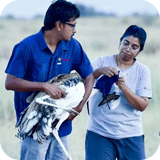
The team fitted vultures with solar-powered GPS units, monitoring their daily movements and behaviour. Machine-learning algorithms trained on accelerometer data could distinguish feeding from other activities with 93% accuracy. When tagged birds lingered at carcasses, rangers could be alerted to investigate and remove poisoned remains before further birds arrived.
Findings: a small investment, big returns
The modelling showed that social foraging - vultures following each other to carcasses - sharply increased the risk of mass poisoning. Yet tracking just 5% of a population (around 25 birds in this case) proved enough to detect events early and prevent major losses, provided rangers could respond within hours.
With a rapid response time of under two hours, up to 45% of poisoning-related deaths could be avoided. Even with a six-hour delay, roughly a third of vultures could be saved. The cost of equipping and monitoring 25 individuals was estimated at around USD 60,000 - a sum the authors argue offers excellent conservation value compared with the loss of an entire population.
Applications and limitations
The study highlights how technology can transform conservation practice in remote areas where traditional monitoring is impossible. Sentinel tracking not only benefits vultures but also protects other scavengers - eagles, jackals and hyenas - that share poisoned food sources.
However, the authors caution that effectiveness depends on fast response and adequate ranger capacity. Results are most applicable to highly social, wide-ranging vultures; solitary scavengers may require higher proportions of tracking to achieve the same results. Costs, data transmission speed, and the practical challenges of reaching poisoned sites also limit implementation.
Looking ahead
Despite these challenges, the sentinel approach offers a powerful new tool for conservationists fighting Africa’s vulture crisis. By providing clear estimates of cost and benefit, the research strengthens the case for funding and scaling up anti-poisoning systems.
As the authors note, protecting vultures has wider ecosystem benefits: their role in cleaning carcasses limits the spread of disease and supports healthy ecosystems. In the words of lead author Teja Curk, “tracking just a few sentinel individuals can prevent substantial mortality - and may be the difference between persistence and collapse of entire populations.”
August 2025
Share this story