Vineyard fungicides pose a threat to survival of wild birds
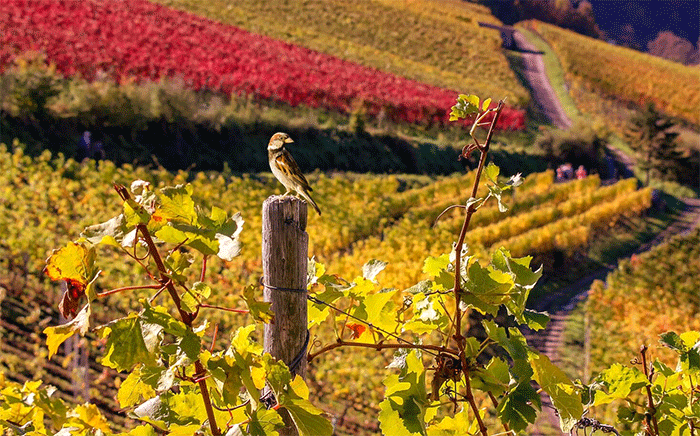
New research reveals that wild birds living in vineyards can be highly susceptible to contamination by triazole fungicides, more so than in other agricultural landscapes. Exposure to these fungicides at a field-realistic level were found to disrupt hormones and metabolism, which can impact bird reproduction and survival. The research will be presented at the SEB Centenary Conference 2023, taking place in Edinburgh, UK, from 4–7 July.
"We found that birds can be highly contaminated by triazoles in vineyards," says Dr. Frédéric Angelier, Senior Researcher at the French National Center for Scientific Research, France. "This contamination was much higher in vineyards relative to other crops, emphasizing that contaminants may especially put birds at risk in these specific agroecosystems."
Triazoles are commonly used fungicides that are applied to agricultural crops such as wheat to remove fungal pests by disrupting their cell membranes.
While previous studies of wildlife declines have assessed the impact of various agricultural industries, the role of vineyards have been largely overlooked. "However, vineyards cover a large proportion of lands in some European countries and, importantly, they are associated with a massive use of fungicides (up to 5–7 times more than in other crops)," says Dr. Angelier. "Therefore, vineyards are very relevant agroecosystems to assess the impacts of fungicides on wild birds."
For this study, Dr. Angelier and his team combined field experiments to measure real-world fungicide levels, with controlled laboratory experiments to test the impact of these levels of fungicides on specific aspects of bird health.
Laboratory investigations into the effects of pesticides on wildlife often use higher concentrations of the pesticide than are usually seen in real-world scenarios to illicit stronger reactions. However, Dr. Angelier and his team measured the real contamination of fungicides in birds living in vineyards, as well as birds from other ecosystems such as forests, cities and crop fields.
They then accurately mimicked the fungicide concentrations found in vineyards under lab conditions to examine their sub-lethal effects on bird physiology and health. "In that respect, our research helps to better understand how wild birds are affected by pesticides in a realistic world," says Dr. Angelier. "Impacts to reproduction and survival could lead to a loss of biodiversity or services (such as birds eating other pests)."
7 Jul 2023
Share this story