Two new taxa added to the British list
The British Ornithologists’ Union Records Committee (BOURC) has added the following subspecies to the British List
Taiga Merlin Falco columbarius columbarius
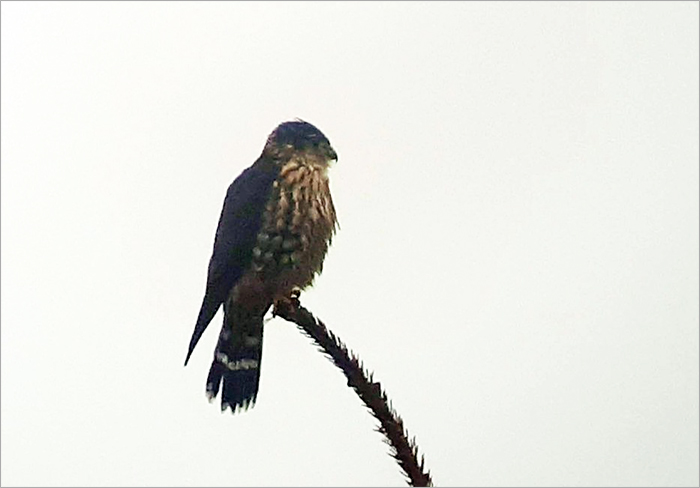
Merlin is polytypic, breeding across the Palearctic and Nearctic regions, with northern populations moving south during winter.
North American’ Horned Lark Eremophila alpestris (alpestris/praticola/hoyti)
Plumage features indicate that the Outer Hebrides individual was one of the North American subspecies of Horned Lark, and not a European Shore Lark E. a. flava. Key features included the reduced amount of yellow in the ear coverts and face which distinguishes such birds from E. a. flava.
The probability of this individual being an escape from captivity was judged to be very low, and the subspecies group has been recorded previously elsewhere in the Western Palearctic as a trans-Atlantic vagrant.
Of the many North American subspecies, three have a north-east distribution and display movements between breeding and non-breeding areas: E. a alpestris, E. a. praticola and E. a. hoyti.
Of these only nominate E. a. alpestris has an east Canadian breeding range and makes large movements along the east coast to winter in south-east USA, and so seems the most likely as a trans-Atlantic vagrant. However, E. a. praticola and E. a. hoyti also have an eastern range and so cannot be discounted with certainty. Thus the subspecies group (alpestris/praticola/hoyti) was accepted to Category A.
Horned Lark is polytypic, breeding across North America south to Central and northern South America. Some populations, particularly in the north of the range, are migratory with significant movements between summer breeding and winter areas; others are either resident or partially migratory. Shore Lark is also a polytypic breeding species across the Palearctic region.
Upon publication of these changes, the British List remains at 620 species (Category A = 602; Category B = 8; Category C = 10).
15 January 2020
Source: BOU
Share this story