Two Cinereous Vultures Electrocuted on Power Lines in Portugal
The latest deaths come as a stark reminder of infrastructure risks as conservationists rush to retrofit deadly lines
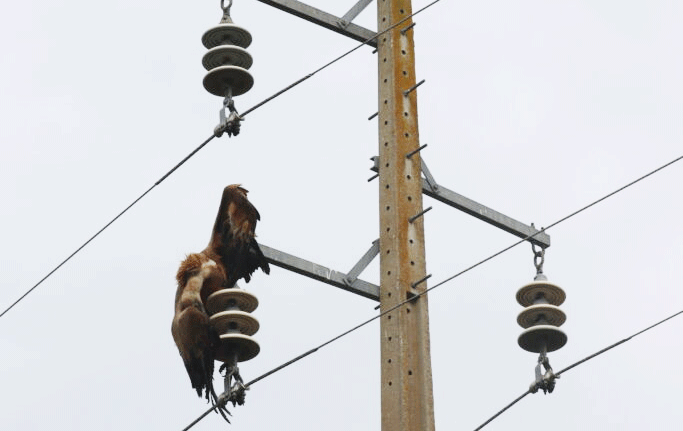
Terrible losses in Portugal’s borderlands
In February, under the monitoring work of the Portuguese NGO Quercus in the Tejo Internacional region, 26 cases of mortality due to electrocution were detected on power lines. Among the victims were two Cinereous Vultures (Aegypius monachus).
One of the power lines being monitored, spanning roughly 25 km, accounted for 17 mortalities: 13 Griffon Vultures (Gyps fulvus), two Short-toed Eagles (Circaetus gallicus), one Cinereous Vulture, and one unidentified raptor. The high concentration of deaths along that line exposed the acute risk for large birds.
Why vultures are so vulnerable
The risk arises when birds perch on parts of pylons or cross-arms and simultaneously touch two conductors, or a conductor and a grounded element, allowing current to pass through their bodies. In the case of the Cinereous Vulture, their size, wing span and perching behaviour make them especially exposed. The species is among the most threatened by electrocution and collision.
In Portugal, despite the relatively small breeding population, nine cases of electrocution mortality have been recorded since 2010. Collision with lines has also caused fatalities, compounding the pressures on recovery.
Swift mitigation under LIFE projects
In response to these alarming fatalities, the LIFE PowerLines4Birds project moved quickly to help correct the identified power line. In early July, the installation of anti-electrocution devices – insulating cables near the poles – began.
These combined solutions aim to prevent birds from bridging dangerous contacts. Meanwhile, field crews from Quercus continue to monitor these lines to ensure the corrective measures are effective.
Collaboration across conservation efforts
Although LIFE Aegypius Return does not act directly on power lines, it cooperates closely with PowerLines4Birds and SafeLines4Birds, contributing surveillance, GPS tracking and stakeholder liaison. The project partners congratulated the PowerLines4Birds consortium for its swift action in correcting the dangerous lines in Tejo Internacional.
The Aegypius Return initiative, co-financed by the EU’s LIFE programme, relies on local partners including Quercus, SPEA, LPN and Palombar to engage landowners, grid operators and national authorities.
Broader lessons and the path forward
This incident underscores a grim reality: as we expand and maintain power infrastructure, the hazards to large birds remain grave unless mitigation is prioritised. The vultures’ deaths are not isolated; they reflect structural design choices and lack of preventive measures.
Mitigation strategies include insulating critical zones, installing physical barriers, marking lines to improve visibility, and employing species-aware siting of new lines. Solutions for electrocution often go hand in hand with measures against collision.
Perhaps most importantly, rapid identification of mortality hotspots, effective coordination with utility companies, and funding mechanisms for retrofit are essential for preventing further needless losses. In Tejo Internacional, the recent corrective work offers hope that infrastructure can coexist with sensitive species – but only if vigilance, resources and sustained collaboration remain in place.
September 2025
Share this story