The threat to Coul Links is back
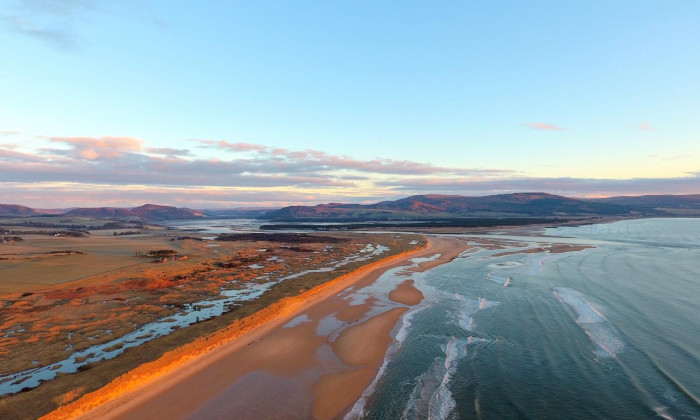
Coul Links is a protected unspoilt dune system that lies immediately to the north of the village of Embo, in East Sutherland and is home to a wide variety of rare habitats and species. This is recognised by the fact that it has National (Site of Special Scientific Interest), European (Special Protection Area) and International conservation designations (Ramsar site). However, despite this protection proposals to build a golf course on the site were submitted to Highland Council in 2018 posing great detriment to the wildlife.
The Scottish Government called-in the 2018 application resulting in a Public Inquiry in February 2019 to examine the proposals in detail. This included Mark Young standing as our Expert Witness to highlight our concerns over the threat the development posed to the site’s important Lepidoptera assemblage. The Inquiry’s Reporters’ came to the conclusion that there was an unusually rich assemblage of butterflies and moths at Coul, and that the proposed development has the potential to have a significant adverse impact on the important invertebrate assemblage. Scottish Ministers agreed with their conclusion and planning permission was refused.
In March 2023 a new planning application for an 18-hole Golf Course was submitted to Highland Council. This new application is not sufficiently different from the original and the applicant has not sought to address any of our concerns the development poses to the site’s Lepidoptera; they have simply been ignored. This has been highlighted by the complete lack of survey work in the intervening years to better understand the distribution and thus impact on these rare and scarce species.
246 species of butterfly and moth have been recorded from Coul Links, this includes Small Blue, Northern Brown Argus (114 recorded on a single day in 2016 denoting a considerable colony), Grayling and thirteen Nationally Scarce moths including Marsh Pug, Scotch Annulet, Lyme Grass, Portland Moth and Coast Dart. It is also home to Northern Barred Groundling Caryocolum blandelloides a provisional Red Data Book species that is restricted in the UK to around a handful of coastal dunes on the eastern side of northern Scotland and was first discovered in Britain in 1994, at Coul Links. Other rare and threatened species including Fonseca’s Seed Fly (Botanophila fonsecai), one of the UK’s rarest endemic invertebrates, restricted globally to a short stretch of coast in northern Scotland and highlights, along with the Lepidoptera assemblage, the uniqueness and conservation significance of Coul Links.
The applicant is claiming that by careful planning of the location of the holes, much of the damage to the site can be avoided, but this would still mean that about 15ha (15 football pitches) would no longer be able to support the wildlife as it currently does. They also propose to create new habitat or improve existing habitat elsewhere on site, including claiming that Burnet Rose is scrub and needs control. Yet Burnet Rose at Coul supports a healthy population of an exceptionally rare moth, Plain Rose Dot, Stigmella spinosissimae. Clearing its habitat is not acceptable.
This proposal also echoes the devastating Trump development at Menie Dunes a similarly protected site in Aberdeenshire which has recently lost this status across part of the site due to direct damage from establishing a new golf course.
Due to the importance of the site for other wildlife we have again teamed up with other organisations including RSPB, Buglife, Plantlife and Scottish Wildlife Trust to strongly oppose the development.
What you can do to help - it only takes 5 minutes!
Please help us to stop this development happening. The developer has so far gained a lot of support for the application so we need as many objections as possible. If you would like to help, please take 5 minutes to object to this application by either sending an email to Highland Council at eplanning@highland.gov.uk or through the Highland Council website, or a letter to Highland Council:
- Please put the application reference: (23/00580/FUL) in the subject line of your email/letter.
- Include your name and home address.
- Make it clear that you are writing to OBJECT to the application because of its impact on wildlife.
- Please let the council know if you have visited and are familiar with the site.
- Please also encourage friends and family to do the same. Local objections are by far the best so we’re particularly keen to encourage anyone with an address in the Highland Council area to object.
A short response still counts, but if you have time, a more thorough objection would be fantastic. Please, in your own words, include any or all of the points we have made above. The current closing date for objections to the application is Sunday 9th April.
Please feel free to contact us if you want more information at scotland@butterfly-conservation.org.
With your help, we can once again save Coul Links.
Many thanks
Butterfly Conservation Scotland
3 April 2023
Share this story