


The man who made caterpillars glow in the dark
An amateur lepidopterist's discovery is changing how conservationists search for some of Britain’s most elusive butterflies.
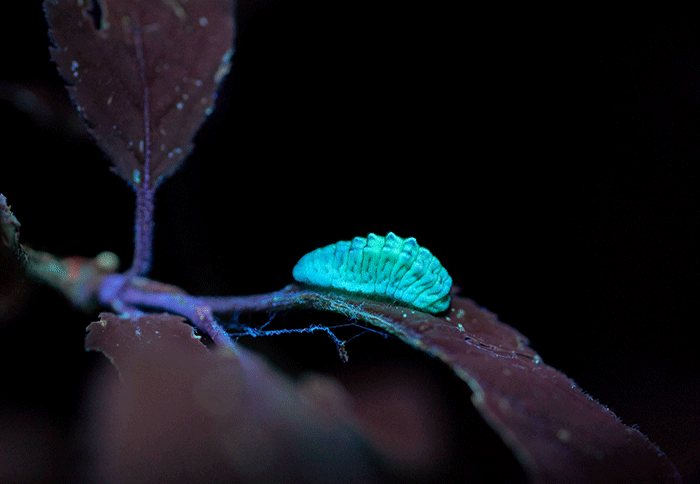
A chance discovery in Surrey has helped reveal a hidden population of one of Britain’s rarest butterflies - and could change how conservationists monitor some of the country’s most elusive species.
Six years ago, amateur lepidopterist Gareth Tilley found that the caterpillars of some rare UK butterflies glow brightly when viewed under ultraviolet light. The discovery has since become a valuable new survey method for Butterfly Conservation volunteers working on hairstreak butterflies across the country.
The breakthrough began after Gareth, who lives in Epsom, saw a Black Hairstreak during a lockdown walk in 2020. The species had not been recorded locally, and some doubted whether a true colony could be present. But Gareth knew the butterfly’s habits made it easy to miss.
Black Hairstreaks are around the size of a 2p coin and usually fly for only two or three weeks a year. Adults spend much of their time high in blackthorn and other scrub, while the eggs and larvae are extremely well camouflaged.
The species is also in serious decline. Since 2002, its UK distribution has fallen by 33 per cent, largely because of habitat loss. Today it is found almost entirely in woodlands between Oxford and Peterborough, making the discovery of a Surrey population especially significant.
Gareth set up a working group with Butterfly Conservation’s Surrey and South West London branch, the local council and Professor Alan Stewart from the University of Sussex. The following year, further adult butterflies were recorded, confirming that the original sighting was not simply a one-off.
But proving the strength of the population was difficult. Gareth said the species is among the hardest butterflies to survey because every stage of its life cycle is so well hidden.
“The caterpillars look like leaves, the chrysalis looks like bird droppings, and the adults are only out for two weeks and stay at the tops of trees, so it’s a hard butterfly to spot,” he said.
The key moment came when Gareth heard that American entomologist David Moskowitz had discovered that some butterfly caterpillars in the United States fluoresce under UV light. Gareth bought a UV torch online and tested the idea on a warm night in May 2022.
He said he had been doubtful that it would work on such a difficult species. But when he shone the torch into the vegetation, the caterpillars glowed so brightly that they could be seen from several metres away.
“When I found a caterpillar I was just amazed: it didn’t just glow, it glowed so brightly that I could immediately see this could be good enough to do some proper surveying with and actually monitor the species,” he said.
The contrast with traditional searching was dramatic. During daytime surveys Gareth had once spent ten hours searching and found a single Black Hairstreak caterpillar. Using UV light, he found 46 in one evening.
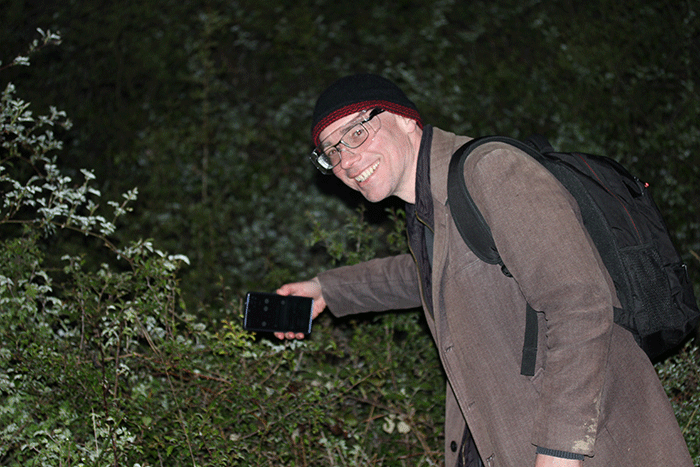
Butterfly Conservation quickly recognised the value of the technique and is now promoting UV surveys for hairstreak species among its volunteers across the UK.
Steven Lofting, Butterfly Conservation’s South East Conservation manager, said Gareth’s work had already made a significant contribution to lepidoptery and to the charity’s conservation work.
“We are finding much higher numbers of hairstreaks using UV surveys and it’s a new, fun way to engage volunteers,” he said. “His ongoing research is now shaping the way we look at rare and endangered species and the methods we use to record and conserve them.”
Gareth is now a committee member of Butterfly Conservation’s Surrey and South West London branch and is working towards a self-funded doctorate at the University of Sussex on glow-in-the-dark caterpillars, supervised by Professor Stewart and co-supervised by Professor Dave Goulson.
His work has also taken him to Australia to support the conservation of endangered species, and he is now helping to develop guidance for the use of UV survey techniques internationally.
One major question remains unanswered: why do some caterpillars glow under ultraviolet light at all? Gareth said the process involves UV light being absorbed by the caterpillar’s body chemistry and converted into visible light. But the reason for the fluorescence is still unknown.
Possible explanations include reducing predation, or the fluorescence having no direct benefit to the caterpillar itself, with the compounds involved perhaps being used later in the butterfly’s adult stage.
Whatever the cause, the discovery has drawn new attention to a stage of butterfly life that is often overlooked. For conservationists, it has also provided a practical new tool for finding and monitoring rare species that might otherwise remain hidden in plain sight.
Gareth said the caterpillar stage deserves far more attention in butterfly conservation.
“I would argue that the caterpillar is actually more important than the adult stage in many ways - if you focus on the butterfly you miss a really big part of the life-cycle, and this new area of study shows just how important that stage can be.”
June 2026
Get Breaking Birdnews First
Get all the latest breaking bird news as it happens, download BirdAlertPRO for a 30-day free trial. No payment details required and get exclusive first-time subscriber offers.
Share this story





