Talking Birds: Mark Pearson interviews Paul French
As chairman of British Birds Rarities Committee (BBRC) and a hot shot at unearthing gems from all corners of the globe, Paul French is well known to those at the sharp end of the UK's rare bird finding and adjudicating scene. Further afield, Paul is known to many more as a international bird guide, and has recently settled at Spurn in Yorkshire, one of the UK's prime migration hotspots.
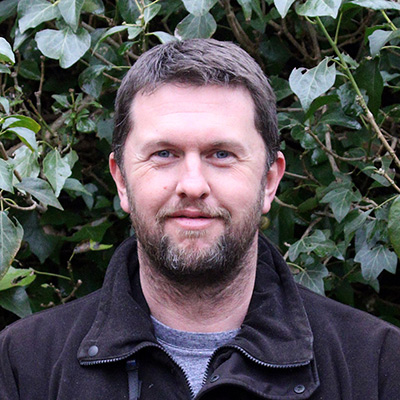
Can you remember a particular event or time which pointed your compass in the direction of birding?
I must have been about 8 years old, or possibly younger. I was watching the birds in the garden and my Dad put up a Blue Tit box which was used in its first year. I kept a diary on the comings and goings of the parents. He also put up a feeder and I was amazed to see a bright green and yellow bird land on the nuts. I remember being genuinely thrilled to use the AA book of the countryside to identify it as a Greenfinch. In those days, my parent’s small council estate garden had two apple trees and a pear tree, and was surrounded by other gardens with lots of vegetation cover, mature silver birches and a few sycamores. They’ve all been cut down now, and sadly the birds have disappeared with them.
Were you lucky enough to have a mentor when you were learning the ropes, or were you out on your own to begin with?
My Dad was my biggest mentor, and took me around many great spots in south Staffordshire and when we were on holiday in Mid-Wales. He always had a broad interest in the countryside, and was happy to let that turn to birds when I showed an interest. We also joined the Wolverhampton RSPB members group and went on their monthly field trips. On these we met local birder and twitcher John Gulley, and he became my mentor throughout my early teens, and basically introduced me to the world of twitching. I did miss out on having many birding mates my own age though, which is something social media has completely changed nowadays.
High profile migration at Spurn doesn't just involve birds, but birders too. What's it like to be part of that particular influx?
The birding scene at Spurn now is one of, if not the strongest in the UK. I didn’t realise the number of birders who were moving there, although I knew several who already lived there and a few more who had caravans. There are also many regulars who go there most weekends, whatever the weather. Socially, it’s excellent, and all the locals have been incredibly warm and welcoming, and made us feel part of the Spurn family from the start. I don’t think the influx is over, as another two houses in the village have just been brought by birders, and I can see more coming here in future. Birders and our families are an important part of the local community, and have been for many years now. Spurn is becoming a real magnet for young birders too, which is a fantastic position to be in. With events such as MigFest and competitions like Young Birder of the Year and an exchange program set up between Spurn, Falsterbo and Cape May, the future is really bright.
What's your best house tick so far?
The Pallas’s Warbler was very nice, and the Yellow-browed Warbler was expected, but the best was undoubtedly the Night-heron that flew over in the spring of 2016. It was tracked coming in off the Humber at Kilnsea, then flew north via Willow Cottage. I’m glad we raced back to wait for it, and seeing it fly low over the garden was pretty awesome. A sight probably not to be repeated! I shan’t mention the ones that I know would have been seen from the garden, had we been in it at the time, and being a mere 280m from the Siberian Accentor still hurts! We have plans for a modest extension that should enable us to view from the roof. That would certainly change things!
You've been a member of the British Birds Rarities Committee for nine years and Chairman for the last two years, and have seen various modernisations there. What do you consider the most positive BBRC developments in recent years?
It’s hard to overestimate the impact that Nigel Hudson had on the way the Committee works. He completed the transition from postal circulations to the current system, where the voting is carried out solely online. In addition, he also introduced an automated system for producing the report, which not only improved its accuracy, but has also reduced the workload for those involved in producing and editing the finished article. These efficiencies allowed the report to be published earlier than had been the case for several years prior to Nigel’s appointment. The target had been to restore the annual BBRC report to the November issue of BB, but Nigel’s determination exceeded this schedule every year, with the report now appearing in October every year. Nigel also ensured that the Committee regularly reviewed its working practices, checking and testing the constitution and using the AGM as an opportunity for robust debate on our operating procedures. He took a keen interest in the rarity threshold and which species should be retained or removed from the list of those considered, coming up with the modern definitions of what constitutes a rarity.
As well as this, he was determined to improve BBRC’s external communications and was instrumental in developing the Work in Progress (WIP) updates and the BBRC Twitter feed that enabled news of the Committee’s decisions to be shared more effectively. These have been very popular and well received, and probably contribute to our continued high submission rate. However, the WIP file and the Twitter feed, while getting news out there more quickly, did not feel to me as if they made the committee more ‘open’, which was a criticism often levelled at us. So on becoming Chairman, I instigated a policy of writing to all observers of Not Proven records to explain the reasons for the decision. This had never been done as routine before, mainly due to the high workload it entails, but it was something I felt strongly about. Feedback on it so far has been overwhelmingly positive, and by and large I have managed to avoid protracted debates with observers over their record, which was the one thing that I was apprehensive about.
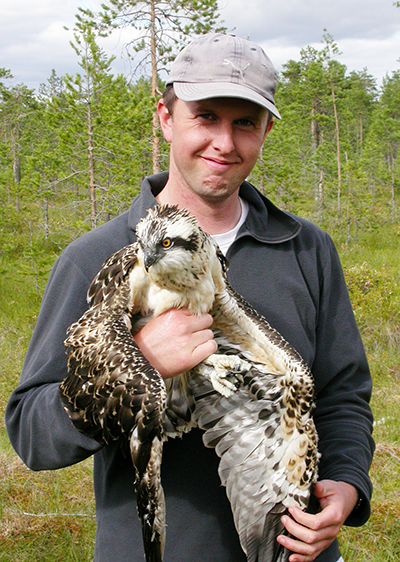
Despite technological improvements which have simplified and quickened some of the processes, the BBRC workload must be daunting. Do you ever feel overwhelmed and/or underappreciated?
Not usually overwhelmed, although the annual report seems to come around with an alarming rapidity. Most of the hard work is done by the Secretary, I just add an introduction and make confusing comments on drafts of the report! Now I have given up voting, I can concentrate on other things, such as getting reviews underway more effectively and communicating with observers. I’ve also looked at and considered other options and systems for the recording of rarities, but always come back to the committee system as being the fairest, most open and most democratic. Despite occasional vocal opposition and/or criticism, I think there is a genuine appreciation of the committee by most birders.
Talking of which: technology, the internet, social media and various other elements have irrevocably changed the face of birding in the modern era. What are your thoughts on these changes, and what do you think the next big developments could be?
Social media has been, in birding terms, a hugely positive thing. Young birders now realise that they are not alone in their weird passion and can connect with others. The way we get and distribute bird news has changed, and the potential for learning from others has increased dramatically. We have also become accustomed to getting answers to difficult questions in short spaces of time, and there is always a new ID challenge online that is being discussed by recognised experts in the field.
Despite limited encouraging signs of more gender and ethnic diversity, birding is still very much a white male dominated world. How do you think this can be changed, and what should we, as white male birders, be doing about it?
That is a really difficult one, and I guess I can only offer my own observations. However, I think it is changing. It’s certainly changed from when I was younger. There are several young female birders at Spurn alone, and these have been warmly welcomed by the regulars. I guess the best way to encourage young female birders is to just ignore the fact they are female. It’s different in the US and Canada I think, but I’m not sure why. I guess as more women take up birding at a younger age, both professionally and as a hobby, there will be more role models to look up to. Maybe that’s the answer? I have no answers to the ethnic diversity issue unfortunately.
How do you react to criticisms that BBRC upholds the status quo in this respect?
Every time we seek a new member (which should be once a year), we advertise this and ask for external nominations. We struggle to get any. Nominations are open to anybody who can get nominated and seconded by their peers. At no point in our constitution does it say “no women or ethnic minorities”. As far as internal nominations go, we can only nominate people that we know and we know are good enough, and in that case I refer you back to your previous question.
You've travelled far and wide in pursuit of birds and wildlife. If you had to pick one favourite place on the planet for the whole experience – birds, nature generally, culture, landscapes, etc. - where would it be?
That is a very difficult question. I love travelling and have been to some amazing places, and a few of them I think I could probably live in. I’d like to do more in Africa and South America, and New Guinea is incredible in so many ways. I guess Japan is my favourite overall place, one that would fulfil all of my birding and cultural needs. It’s visually stunning and has some truly amazing birds, plus great potential for migrants and vagrants. However, it’s very telling that I always want to come back home to Spurn. It took me a long time to finally lay down roots and find a place to lay the Tilley, but Spurn is it. I can’t see myself ever leaving. Not permanently, anyway.
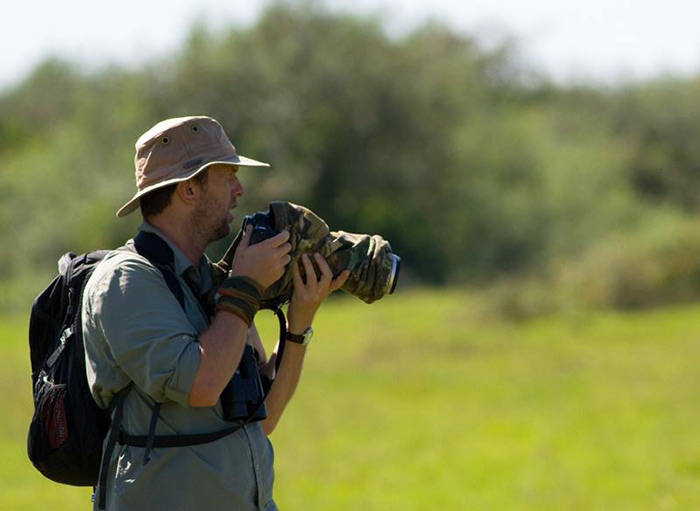
Have you ever had a record rejected by BBRC, and if so, what?
Oh yes. My first ever submission was of a Little Shearwater (as it was then) past Porthgwarra on my first real seawatching venture. It was a terrible description of a bird seen a long way away and quite rightly received short shift from the committee. I struck that one off my list a long time ago! Then I found two Great Snipes in consecutive years while on North Ronaldsay, both of which were rejected (ahem, Not Proven!). I can understand why the second was rejected (brief, single observer views), but the first was multi-observed over a couple of days by experienced birders, and that one is still firmly on my self-find list. The rejections never once made me think about stopping submitting records however.
How much do you twitch (or have you twitched in the past), and what are your thoughts on the nature of modern twitching culture?
I used to twitch a fair bit, especially when I was at University in East London. I nearly chucked the pager away a couple of times though, the worst one being twitching a Sociable Plover at Minsmere when the Siberian Blue Robin was found, but not hearing about it until driving back home past Ipswich. I’d actually walked past and said hi to the finder on the sluice. That hurt! These days I go for 3-4 birds a year I guess, but they have to be of some identification interest other than being simply a British tick. I’ll also go for World and Western Palearctic ticks if possible, and any Spurn ticks of course. So I guess I’m not really a part of the modern twitching culture anymore, and therefore it’s difficult to comment on it. Is modern twitching any different to what it always used to be? I think there are still the same characters, the same controversies, the same dilemmas and the same adventures. I guess the main difference now is that with social media, everyone can see everyone else, their thoughts and their mistakes. Nothing is really sacred anymore, but I find those longing for the good ol days of Nancy’s Café a bit over the top!
Without wanting to be too negative, in terms of our national avifauna and biodiversity in general, we live in somewhat dark and difficult times. How hopeful are you that positive change can and will come, and where do you see those changes coming from?
I’m not too hopeful, unfortunately. Too many people don’t seem to care one little bit about the World around them, and I struggle to see that changing. Not many realise that the changes they want to see start with themselves. There are also people in power with vested interests in taking as much from the environment as possible. Too many of our political and industrial leaders see climate change as an opportunity to make money rather than a global catastrophe. The archaic way that power is distributed in Britain means that things are very unlikely to get any better without drastic and fundamental changes. I was against Brexit, and still think it’s going to be a huge disaster overall, but the one glimmer of hope is provided by perhaps a very unlikely source - Michael Gove. As Secretary of State for Environment, Food and Rural Affairs, he will be in the driving seat to reshape our conservation policies once we leave the EU. What little I have heard from him on the subject of farming subsidies sounds amazingly positive, with talk of a “green brexit” and that future subsidies will concentrate on delivering public and environmental benefits rather than simply being a benefit payment to those with land. If that actually happens, then our countryside may start to see the return of some of our lost species. However, the landed ones have had a lot of practice in gilding the system to their advantage, and actually getting the people to think that is the way things should be, so I’m not holding my breath.
There's nothing quite like the buzz of a killer self-find – how about rubbing it in and sharing a few of your best (and their circumstances) with us?
There have been nowhere near as many good ones as I would like, and doing a couple of years on Fair Isle certainly helps chivvy the ol’ self-found list along quite nicely. My best on there was undoubtedly the Black-faced Bunting in 2001. At the time it was the 4th for Britain, and it was a right bugger! I flushed it from the path at the Auld Haa, and it flicked over a wall. I remember seeing it briefly and thinking ‘I don’t know what that is’, which was pretty puzzling to be honest. Views were brief and terrible, but even so, to not have a clue what bunting it was took me by surprise. Creeping around, I managed to see it feeding at the base of a wall, head down facing away. It then lifted its head and looked over its shoulder at me, and suddenly it all fell into place. The grey hood and bold submoustacial all screamed Black-faced Bunting. Being late October on Fair Isle, the small soon assembled crowd consisted of one visitor and the wardening team. It proved to be incredibly difficult to get views of, and would simply vanish, presumably through the walls. Eventually everyone was happy with it, and that was me firmly on the Shetland birding scene.
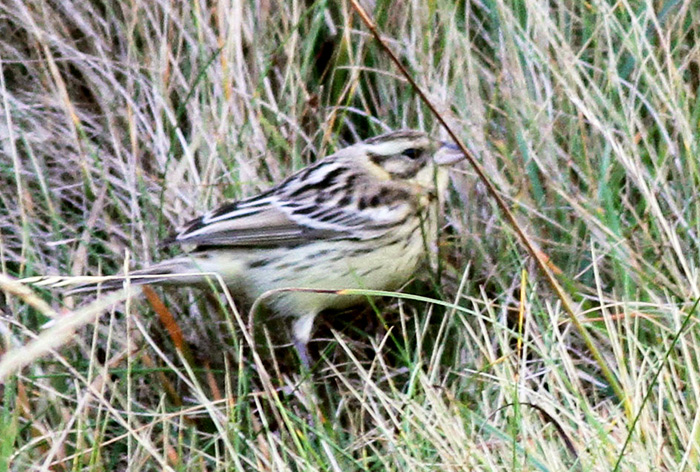
My other ‘mega’ was the Frampton/Wyberton Buff-bellied Pipit. It was a species I had often thought about, especially while on the cliffs of Fair Isle, as Kenneth Williamsons bird in 1953 had always struck me as one of the greatest finds in British rarity hunting, being the first ‘field’ record. I never expected to find my own in a muddy field in mid-winter in Lincolnshire, but that’s what happened, proving that anything really can turn up anywhere. Being only the 5th for the UK, it attracted a lot of attention. Again though, that initial buzz was slightly dampened by early scepticism and, this time, a local landowner refusing us permission to broadcast the news. Happily it was all resolved in time for a great twitch. If only Buff-bellied Pipit hadn’t then gone and devalued itself by becoming common! Finding my first Fea’s Petrel (from the Scillonian crossing) was also pretty special, but again slightly marred by not having my camera ready, so that now languishes as Fea’s/Zino’s officially. After that, I think my favourites are a couple of Pechora Pipits on Fair Isle and a Yellow-breasted Bunting on Foula. I’m yet to find anything of major note at Spurn, but hopefully that will change…
Aside from the above, what personal birding experiences have given you the greatest buzz – at home and abroad?
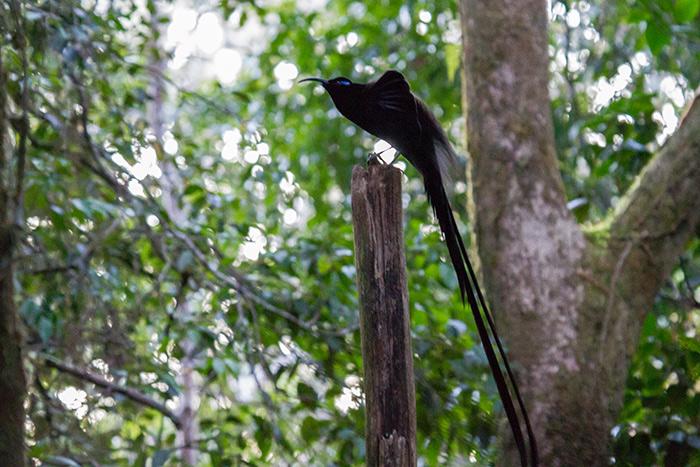
Crikey, that’s tough. I’m lucky enough to get to travel a fair bit with my role as a leader for Sunbird, but some birding arenas excite me more than others. I get a major thrill every time I see the Honey Buzzard migration at Batumi, and I’ve been lucky enough to go there four times now. In fact, raptor migration is pretty special wherever it is, and I’ve seen some fantastic sights along the Arava Valley too. I love October on the east coast, especially the Goldcrests. Seeing them come in off the North Sea, then having several of them within inches of you is simply amazing, and if you’re quiet, still and lucky they might even land on you! Elsewhere, seeing the dance of the Western Parotia in the Arfak Mountains of West Papua was incredible, as was the display of the Black Sicklebill with its explosive laser canon-like call. That trip also delivered the exquisite bower of the Vogelkop Bowerbird, and sitting next to probably the finest erection in all of birding thrilled me more than I thought it would. I could watch Steller’s Sea Eagles every winter for the rest of my life if I got the chance, simply the best raptor I’ve ever experienced, and seeing one barrel through a flock of White-tailed Eagles to steal their fish blew me away. More recently, seeing a displaying Oriental Plover in Mongolia was very special and high on my list of birds to see, especially as the insect-like calls it was making were completely new to Mongolian veterans. Other highlights include working with seabirds and Red-necked Phalaropes on Shetland, and my first ever unusual sighting; finding a male Brambling in July in Staffordshire while out birding with my Dad.
If you could choose to live somewhere else in the UK purely from a birding perspective, where would it be?
I thought about this a lot before moving to Easington, and I’d like to state now that Spurn is still my number one choice. However… With my life as a freelance ornithologist I could live pretty much wherever I wanted, house prices being the only real issue! I almost settled on Northumberland, and I think that Holy Island would be a perfect combination of migrants, all year round interest and beautiful scenery. I also love everything about Shetland, but if you happen to be working on the one or two occasions in the average autumn when the wind is favourable, you could feel kinda screwed for the year. However, the birding community is strong, and there are plenty of opportunities to find your own birds all year round, even with an influx of birders in the autumn. Scilly and west Cornwall are of course stunning and great in the spring and autumn, but I’d just get annoyed by the huge influx of tourists all summer. Perhaps living in Porthgwarra would be bearable in that respect, as long as Tesco delivered! The Seawatching potential is awesome, and working the St Leven - Nanjizal area would turn up good birds on a regular basis. However, for the combination of all year round birding, the opportunities for finding my own birds and not being totally overrun by tourists on a regular basis, I think that North Ronaldsay would take some beating. A small community of birders, varied habitats producing all year round entertainment, great seawatching and potential for anything to turn up. So yes, if there were no other considerations, probably North Ron. Or Porthgwarra…
18 September 2017
Share this story

Mark Pearson
Mark is an obsessive birder, natural history writer, field ornithologist, speaker, guide and passionate conservationist. Originally from Flamborough, Mark recently returned to his beloved Yorkshire coast after many years elsewhere, and now calls Filey Bird Observatory home (where he juggles various roles for the Obs).
He has travelled extensively in pursuit of birds and wildlife but remains especially passionate about his native area. His writing is widely published, much of which is archived here, while his photographic nature journal Northern Rustic can be found here.
In Talking Birds Mark interviews some of the most well-known (and not so well known) birders from Britain and around the world. You can read previous interviews in the series here.
Other Talking Birds
 |
 |
 |
 |
|||
| Dawn Balmer | Kim Kaufmann | David Le Puma | Paul French | |||
 |
 |
 |
 |
|||
| Bob Flood | Jonathan Meyrav | Brett Richards | Jonny Rankin | |||
 |
||||||
| Andy Roadhouse | ||||||