Spurn Motus Network - 'Project Yellow-browed'
Following a meeting in March this year at SBO, in which it was decided to launch Project Yellow-browed, a project steering group was established comprising the British Trust for Ornithology, the University of Hull and the British Bird Observatories Council. July saw the group meet again at Spurn to look at plans to take the project forward.
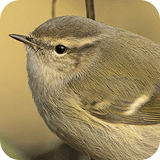
The overall ‘quest’ for now is to learn more about the movements from Europe, into, across and onwards from Britain of bird species such as Yellow-browed Warbler and other so-called reverse migrants. The project intends to use various tracking technologies, including (but not only) fixed radio telemetry, the method used by the Motus system to great effect in North America and continental Europe. The Bat Conservation Trust has now also joined the project steering group, demonstrating the versatility the system offers.
This summer and autumn have seen some good progress in developing the network of Motus receivers in Britain for the pilot phase of the project. Four receiver stations were installed at East Anglian coastal sites including at Landguard Bird Observatory, the first bird observatory in Britain to host this new technology. Thanks are due to our new friends at Waginengen University in Holland and on Heligoland in Germany who worked so hard alongside Ewan Parsons from the Bat Conservation Trust and Adham Ashton-Butt from Hull University (now at the BTO) on those first British stations.
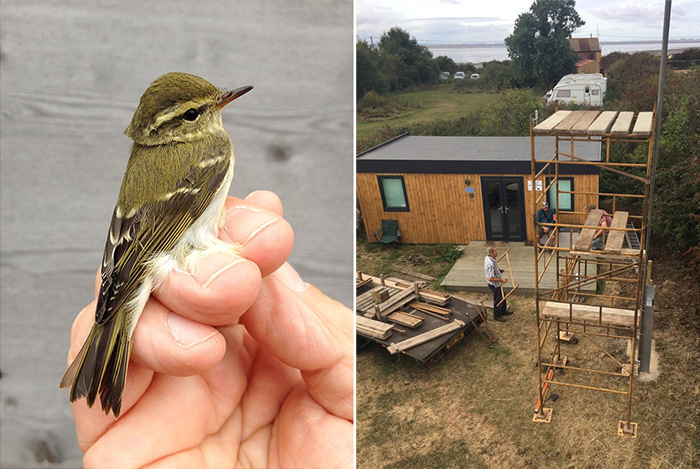
In September, our very own Spurn Bird Observatory Motus receiver was installed in the garden of the Obs. Many thanks to all those from the Spurn community who helped Ewan with that work. The Spurn system was ‘switched on’ on 18th September and is quietly monitoring the air-waves for signs of birds (and bats) tagged on the continent, including thrushes, Wheatears, Robins and a few trial Yellow-browed Warblers (the latter processed on Heligoland and the Dutch coast).
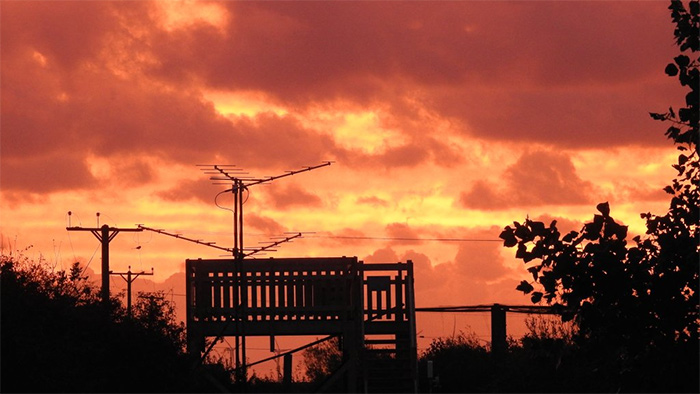
Dungeness and Sandwich Bay Bird Observatories are installing their Motus receivers in October, and it is hoped Fair Isle, North Ronaldsay, the Isle of May and Portland will follow suit very soon. As this is potentially a decade long project, the aim in the first year or so is to have a number of receivers up and running, so we can learn as much as we can about the system. Our friends at Long Point Bird Observatory in Canada tell us it was a few years before they really gained momentum in using the system. Now they’re tracking Grey-cheeked Thrushes back from Columbia and Kirtland’s Warblers back from the Bahamas – so it works. We will require corresponding patience and perseverance for the project to come to maturity here in Britain.
The project group is keen to ensure the highest standards of field practice and ethics, and so will be developing a training accreditation package for ringers who will then be able to fit the nanotags. It will be 2020 before we can undertake the application of nanotags here in Britain. For the time being we must listen for the receivers to detect an incoming bird or bat that has been tagged overseas. Data is downloaded each month so there is a time lapse before a ‘hit’ can be analysed and results made known. Eventually we hope to provide more real time updates. Other work on DNA sampling from material collated whilst processing the birds is also being factored into the project.
We are delighted to announce that the University of Hull has appointed Dr Lucy Mitchell to the staff at the Zoology Department. Dr Alastair Ward with whom SBOT already works closely says that Lucy will start her ‘post-doc’ work in November and a major part of that will be to support Project Yellow-browed and the wider scientific study of animal movements. We aim to see all the data from the British network feed into Hull who together with the BTO can analyse, interpret and disseminate the information. Lucy’s appointment is a major boost for the project nationally and we extend a warm welcome to her and very much look forward to working with her.
Interest is high in continental Europe, with bird observatories and other institutions in Sweden, Norway, Denmark, Belgium, Holland, Germany, Russia and Bulgaria are seeking to join us in the ‘quest’. Such collaborations are very exciting but will require lots of hard work and the ability to see no problem (inevitably there will be some) as insurmountable with strong joint working.
From the pilot phase installations that have taken place, we would now like to see the network grow. Imagine if all bird observatories had a receiver, all RSPB visitor centres, all WWT centres, each county Wildlife Trust centres, all University Natural Science department field centres, bat conservation groups and so forth. Then there’s ringing groups, private groups or individuals who would like to take part and have their own Motus station. The array of receivers could be quite significant across Britain potentially. The wider and more concentrated the network, the more effective will be information we can gather. If the initial investment costs are spread over ten years or more, then hopefully more groups and institutions will be tempted by the value for money the technology offers. Once the network is in place, it is not just YBWs or other reverse migrants that can be studied. The movements, local or long range, of a whole range of different species could be studied. The system could be used in conservation work around the breeding areas or migratory staging areas of threatened species or in bird protection work. Our vision is that the system will provide an excellent chance to introduce real ‘citizen science’ to grass roots ringing groups and others and advance the important work already undertaken by them and their predecessors in the last 100 years or so. But for now, it’s one step at a time.
On 21st Oct a Robin affixed with a Motus tag on Helgoland, Germany, in late September has been recorded via a Motus receiver antennae at Landguard Bird Obs, Suffolk, on the 20th October, just hours after it was recorded passing another Motus receiver antennae in the Netherlands, more details here.
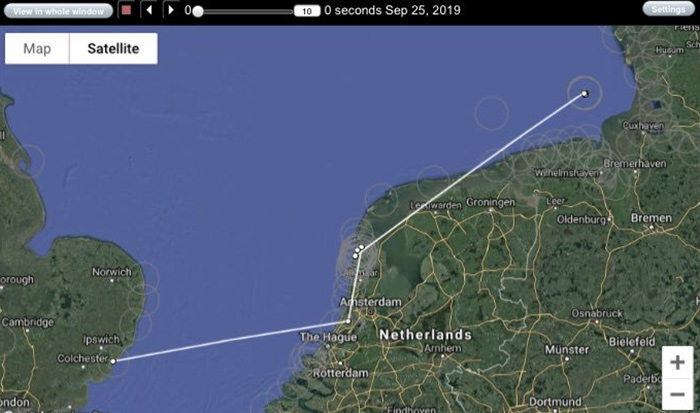
Really exciting and the first Motus detection in the UK! With such a relatively low sample size of tagged birds on the continent this autumn, it demonstrates the potential power of the system. Looking forward to seeing more recoveries and surely it's only a matter of time before the first 'ping' on the Spurn Motus receiver!
Nick Whitehouse
Spurn Bird Observatory
October 2019
Share this story