Spotted Flycatchers Begin to Abandon Africa for Mediterranean Winters
New research shows that Europe’s milder winters are reshaping the migration strategy of the long-distance migrant.

Changing migratory boundaries
Once a classic trans-Saharan migrant, the Spotted Flycatcher Muscicapa striata is beginning to change its ways. A new study by researchers at the University of Málaga has found growing evidence that this familiar European songbird is increasingly wintering north of the Sahara, taking advantage of the Mediterranean’s increasingly mild winters.
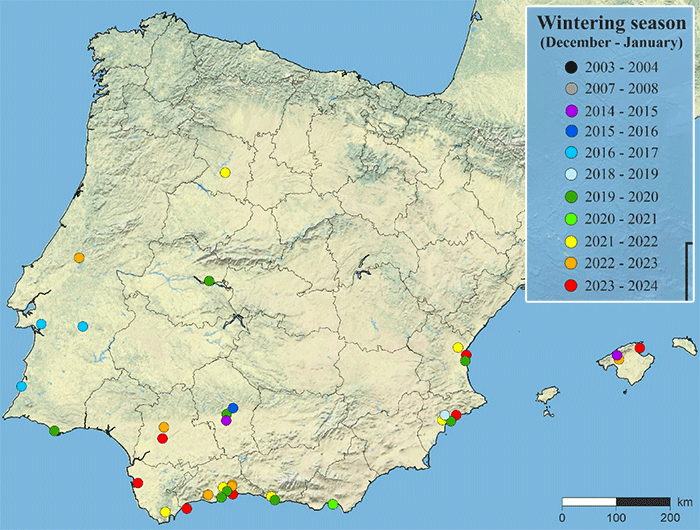
Using data from the citizen-science platform eBird between 2000 and 2024, the researchers identified 42 wintering records across the Western Palaearctic, over 80% of them from the Iberian Peninsula and the Balearic Islands. The findings mark the first systematic evidence that a formerly sub-Saharan species is now overwintering regularly in southern Europe.
Climate models point to new wintering zones
By combining winter records with 21 climatic and topographic variables, the team modelled the conditions most favourable for the species’ survival through the cold months. They found that temperature - especially the warmth of the coldest quarter and the range between day and night temperatures - was the key driver in determining where the birds can now persist.
The models highlighted the Mediterranean basin, southern Iberia, southern Italy, the North African coast, and large islands such as Sardinia, Sicily, Crete, and Cyprus as highly suitable wintering regions. These areas correspond to parts of Europe that have experienced the greatest positive temperature anomalies in recent decades.
While some of these regions have yet to record wintering Spotted Flycatchers, the study predicts they may soon do so if current warming trends continue. “Temperature has become the main environmental factor influencing the winter distribution of the species,” the authors note, suggesting that many long-distance migrants may now be adjusting their strategies to stay closer to home.
A shorter journey with big advantages
Migration is one of the riskiest phases in a bird’s life, and shortening that journey offers clear survival benefits. Individuals that remain north of the Sahara avoid the hazards of crossing the desert, face fewer energetic demands, and can return to breeding grounds earlier in spring to secure the best territories.
The researchers argue that if mild winters persist, these birds could gain a significant advantage over their more traditional long-distance counterparts. “A shorter migration means lower mortality and potentially higher reproductive success,” they write. The study also found that the pattern of wintering north of the Sahara has become consistent since 2014–15, with records increasing each year except for one winter without sightings.
Spotted Flycatcher as a bellwether
The Spotted Flycatcher may be just the beginning. Other species such as the Reed Warbler Acrocephalus scirpaceus and the Barn Swallow Hirundo rustica have already shown similar shifts, wintering more frequently in southern Europe than in Africa. The researchers believe the flycatcher could serve as a model for understanding how other trans-Saharan migrants are likely to respond to a warming world.
However, the change may not be without risks. Sudden cold snaps or climatic extremes could devastate these new wintering populations, particularly if their survival now depends heavily on temperature stability and insect availability. Continued monitoring is needed to track how these populations fare in future winters.
Climate change rewriting migration maps
As Europe’s winters warm and insect prey remains available for longer, the age-old rhythms of bird migration are being redrawn. The study’s lead author, Sandro López-Ramírez, suggests the spotted flycatcher’s flexibility could become a defining trait for many migratory species in the Anthropocene.
“This species shows how quickly migration strategies can change,” the authors conclude. “If current warming continues, more trans-Saharan migrants are likely to join it, wintering around the Mediterranean instead of in Africa.”
October 2025
Get Breaking Birdnews First
To get all the latest breaking bird news as it happens, download BirdAlertPRO for a 30-day free trial – no payment details required – and access exclusive first-time subscriber offers.
Share this story