Scilly Pelagics 2019: a windy series
Jim Almond looks back a memorable 12 days spent on St. Mary’s when he took part in 10 Scilly Pelagic sessions from the 8th to 18th August 2019. All images taken with Canon 7D MkII camera and Canon EF 100-400mm f/4.5-5.6L IS II USM lens.
------
To say Scilly Pelagics has become an addiction is something of a cliché, yet I’m not alone in my need for a seabird fix during the prime mid-August period. The locals and several veteran shipmates would probably testify that based on the middle two weekends, this wasn’t up to the spectacular heights of 2017/18. The first weekend was certainly one of the windiest periods I can recall! One participant joked that it was in danger of becoming a contact sport but despite the wild conditions, Joe Pender steered us safely out and back in free from incident.
Tickets had been booked for the middle two (long) weekends in August once more, always hoping for a real mega but taking whatever would come our way. The BIG 3 target birds for each trip: Wilson’s Petrel, Cory’s Shearwater and Great Shearwater continue to be the gold standard for ‘success’ and with Wilson’s Petrel featuring earlier than normal in the current passage season, hopes were truly high!
My camera bag for the trip was much lighter and the Canon 100-400mm f/4-5.6L IS USM Mk II lens, having been impressed with results the previous two years, has now become my ‘go to’ lens for Pelagics. It’s perfect for use during ‘walkabout’ sessions on land, equally suitable for both birds and insects.
The Scillonian crossing on Thursday 8th August in calm conditions was a fairly quiet affair with just 200 or so Manx Shearwater for company. My appetite for more was whetted with the prospect of an evening shark fishing trip on Sapphire. These shark fishing trips act as an extension to the weekend of ‘Birder Special’ Pelagics and whilst fishing takes precedence, the target bird species usually turn up. Sadly, they didn’t today and whilst Storm Petrels were always a joy to see, a single Sooty Shearwater was the only seabird of note. By the time we came in, the wind had freshened to 25mph and was forecast to increase overnight!
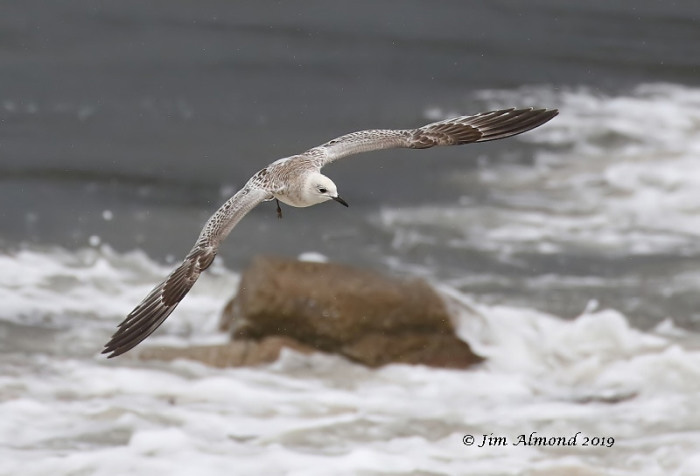
Friday 9th daytime was spent wandering around St Mary’s but little of note seen. The reflexes and panning technique were honed for capturing birds in flight whilst watching the gulls feeding in the shore break at Porthloo beach. This first winter Mediterranean Gull was the highlight.
The south westerly wind had increased to gale force for the 5pm evening pelagic and with 6 metre waves awaiting us, Joe wisely opted to play safe. We headed out east passing the naval vessel HMS Enterprise which had moored in the lee of St Mary’s to shelter from the storm. We then drifted up to 3 miles in the wind shadow of St Mary’s. It was another quiet trip producing 50 Storm Petrels, 1 Bonxie, 1 Sooty Shearwater and c100 Manx Shearwater but the special seabirds we were hoping for, were nowhere to be seen. It was a slow, hour-long ‘bumpy uphill’ ride home and as we passed Enterprise in near darkness, the crew must have wondered what we were up to and at times, so did we! Bob Flood remarked over the tannoy: “You’ve not been on a pelagic until you’ve tasted salt” – we certainly tasted some this evening!
A sleepless night followed with the wind howling /windows rattling and by Saturday morning, the wind had veered westerly, still 40mph+ announcing we were in for a rollercoaster ride in the 5 metre swell. Our options were limited once more, the open sea was not an option once more so we steamed out slowly in the lee of St Martins and put the chum bags out to see ‘what would happen’. Apart from Manx Shearwater and a Bonxie, the key birds were the ever-present Storm Petrels, revelling in the conditions and giving some incredibly close views down to 5m. There was no shortage of image possibilities but tracking them and keeping the focus locked on was never easy! The 100-400mm zoom lens came into its own during the closer passes, enabling a better chance of keeping the bird in the viewfinder!
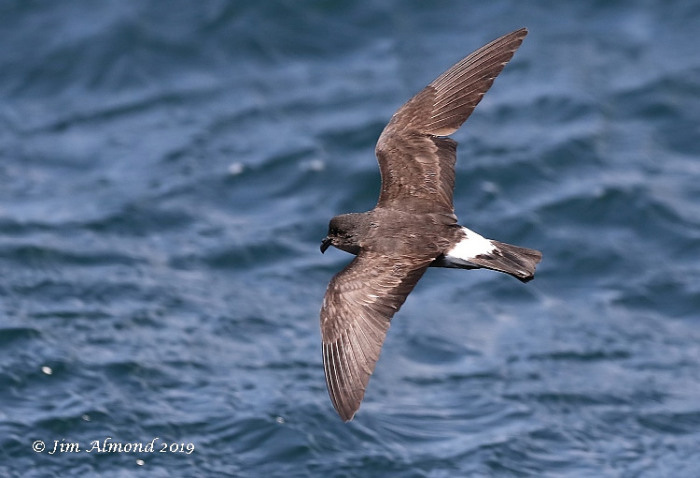
The wind had eased overnight, now south westerly again and averaging 20mph with a clear day forecast. Sunday Pelagics involve an 8.00am start allowing seven hours on the water, whilst ensuring Scillonian passengers are back in time for the boat. The conditions were more comfortable although a 2.5m swell persisted. For the first time, we were to be in control of proceedings, rather than the conditions requiring ‘survival mode’. After heading south 6 miles, we started to drift and chum, it wasn’t long before a cry of ‘Wilson’s’ went out!
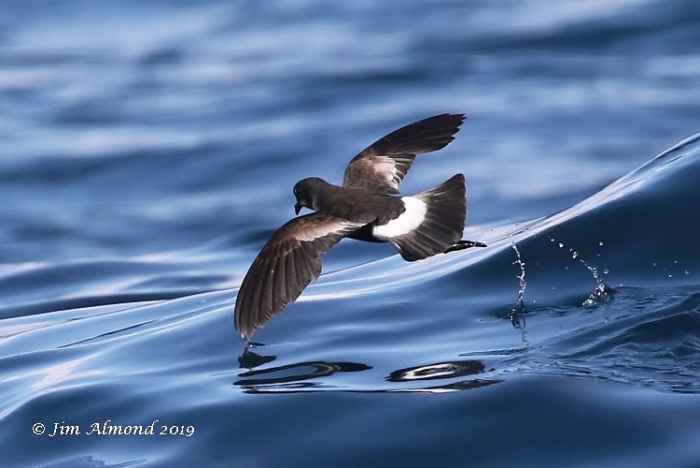
Yes, at last we were in business with one of the BIG 3 target birds. We eventually attracted a second Wilson’s particularly photogenic in the good light, putting on a spectacular show! We didn’t see our second target bird fly in but we were delighted to find a Great Shearwater, simply loafing on the water! It was only in view for a few seconds and despite taking flight almost immediately, everyone had close range views!
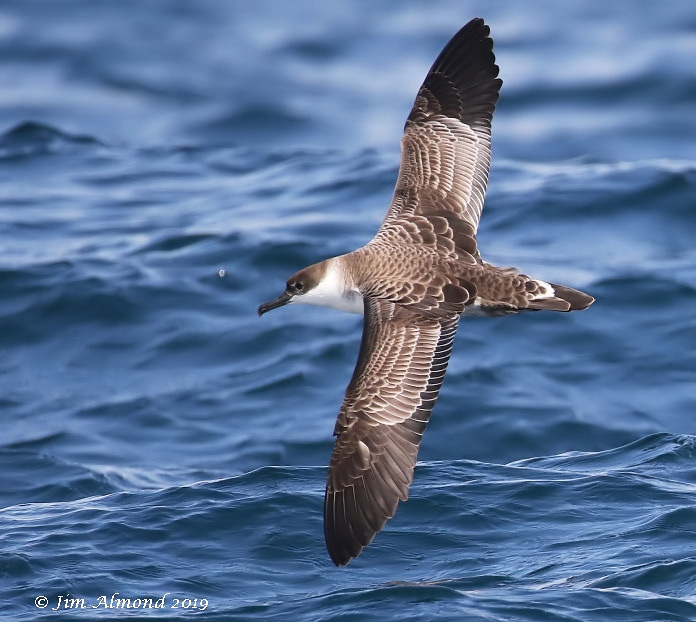
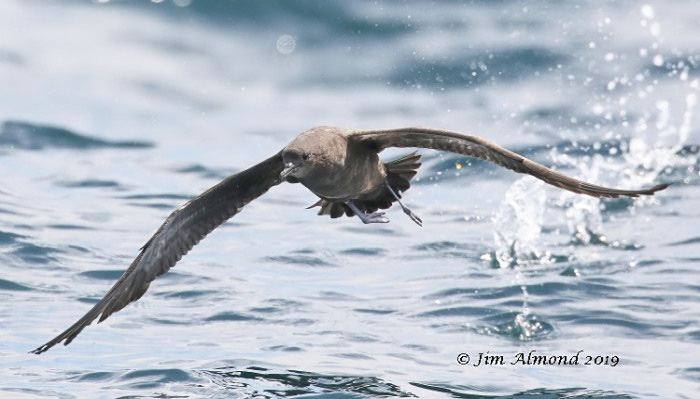
There was also a support act of 2 Balearic, 300 Manx and 24 Sooty Shearwaters. This was to be the best count for Sooty during the trip and with a Wilson’s Petrel putting in an appearance too, the winds had clearly been favourable, assisting these passage birds on their journey northwards from the Southern Ocean.
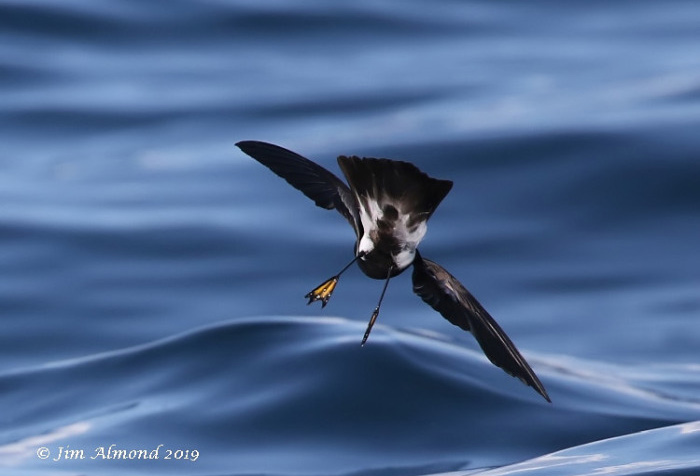
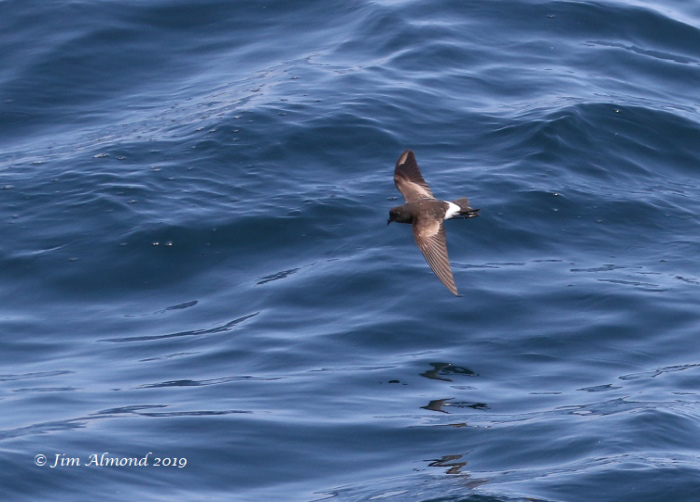
The views of Wilson’s Petrel were simply amazing and we were treated to the ‘pogo dance’ as they simply bounced in the same spot feeding. The perfect moment to lock focus onto them and come away with a glimpse of those yellow webs on the feet! How often do you see this feature from land? Time to anticipate whether Bob would soon be reminding us “You haven’t seen Wilson’s properly until”…
Three Bonxies put in a sustained appearance and at one stage all three were in view around the boat, time for the Gulls to be terrorised into disgorging their stomach contents. These sessions aren’t always about the keynote birds as within the overall spectacle, there’s nearly always something else going on and this is what makes them so interesting and special.
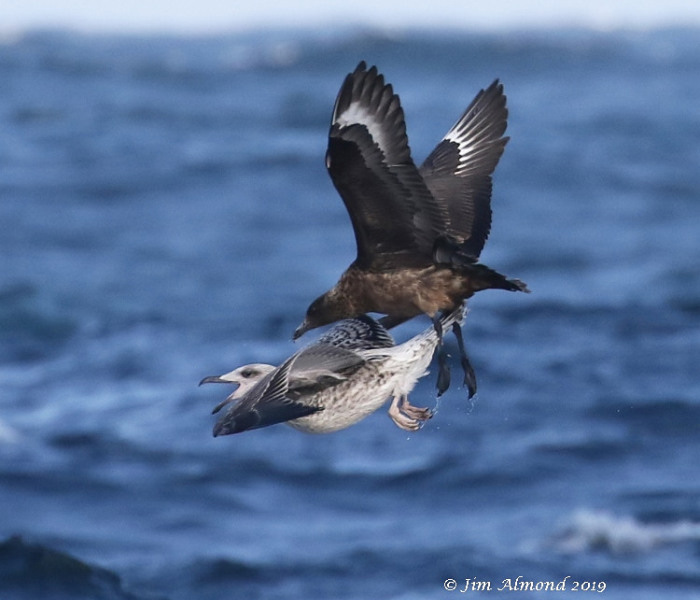
The wind had eased to 16mph by Monday afternoon and with blue skies beckoning, the evening participants assembled on the quay before heading six miles south once more. The Manx Shearwaters dominated proceedings with well over 1,000 on view, reminding us that every trip is different – the maximum count had been 300 until this evening. Some will be local birds, others from farther afield joining in the frenzies. Speaking of which, these were inspired not just by Dolphins, we had now found Tuna for the first time, roughly 20 Atlantic Bluefins. Once again, apart from a couple of Sooty’s no large Shearwaters were in evidence.
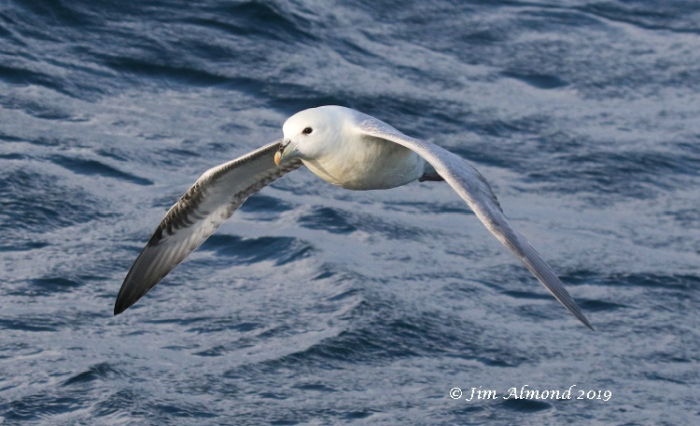
The reasons why the large Shearwaters, apart from a handful of Cory’s and Great’s went missing for 2019 remain obscure. They are passage birds and with Great Shearwaters, the route taken or time spent off the coast of the USA will vary from year to year. Satellite tagged individuals were recorded off the coast of Maine during mid-August 2019 and something seems to have inhibited their passage across the Atlantic to Scillonian waters. Fortunately, the ever-present and dependable Fulmar can provide image opportunities on just about every trip!
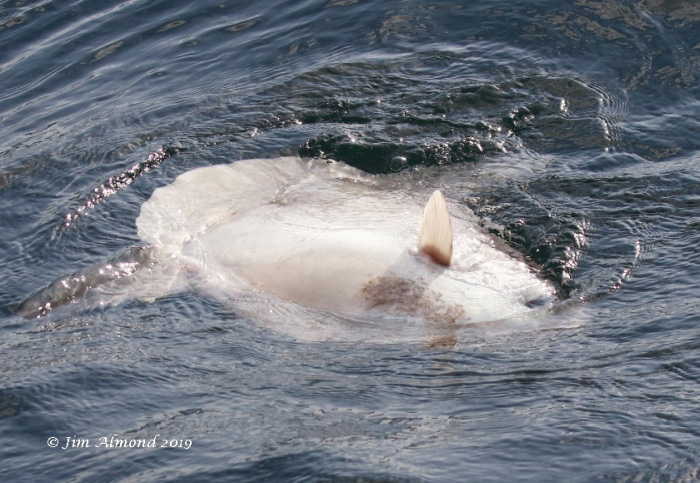
Not quite so dependable but always popular are Ocean Sunfish. This has to be one of the weirdest inhabitants of these waters and when fully grown, one of the largest bony fishes in the world (up to 1,000kg!) Needless to say, there are unlikely to be monsters of this size locally and this one was a mere tiddler, approximately 24” across! They simply bask under the surface of the water feeding on tiny morsels using their fins and the wind to manoeuvre themselves about
I joined Sapphire on two shark fishing trips organised by Joe every Tuesday and Thursday. Wilson’s Petrel were seen on both of these but it was the Thursday 15th session which proved to be the most productive with firstly a Sabine’s Gull followed by an amazing haul of 10+ Wilson’s Petrels seen. Whilst there is always a risk of duplication, the seabird counts are made with care and often an underestimate. Put simply, the maximum number of birds seen together at one time plus any additional birds separable by plumage or other differences is the basis for the count. The fresh plumaged juveniles are readily separable from adults.
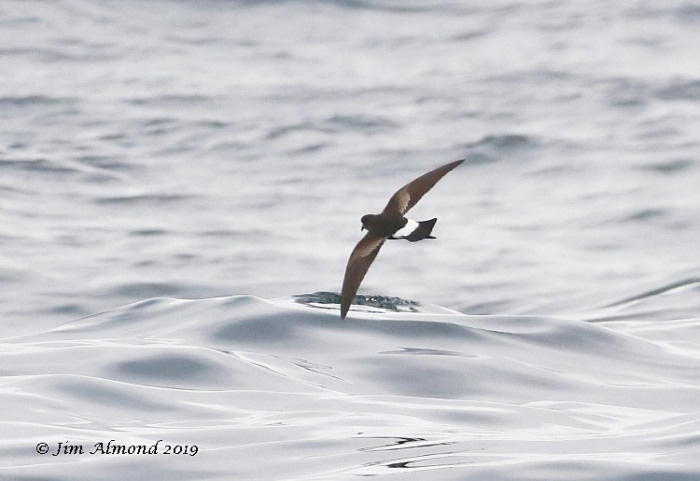
A damaged wing feather or other feature can assist even further in identifying individuals. Photographs assist greatly and Joe Pender rarely misses one. The rest of us contribute to the ‘cause’ and naming birds from images helps to eliminate duplication – see ‘Nick’ below who was instantly recognisable by the damaged primary feather. Experience has proven that Wilson’s Petrel is primarily a transient passage bird, constantly on the move and rarely staying for long in Scillonian waters and birds such as these are very rarely seen again.
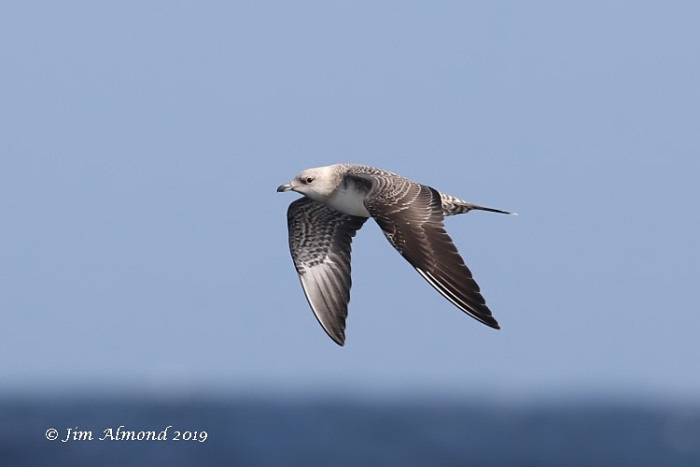
The wind had strengthened for my second weekend reaching gale force on Friday, then settling down to 20mph for Saturday and Sunday 17th / 18th August. It was business as usual so far as Wilson’s Petrel were concerned with 2 (Sat) and 3 (Sun) seen. The first interesting bird ‘shouted’ as we steamed east of St Mary’s was deemed by many ‘bird of the day’ and for me, ‘bird of the whole trip’! A juvenile Long-tailed Skua in an exceptionally attractive blonde plumage form. It didn’t hang around for long but we were treated to the spectacle of it unsuccessfully chasing some Storm Petrels and then in return being harried by the gulls! A small flock of Knot (8) were also seen near the islands, on checking back a Scilly ‘tick’ for me (these are infrequent Autumn visitors)!
Its impossible to predict the occurrence of mega rarities and the weather conditions are randomly variable when they do turn up. A Fea’s type Petrel on Monday 5th August followed by a probable Deserta’s on 23rd and yet another Fea’s type on the 27th proved that the birds are passing through. You just need to hit the ‘lucky’ day and be in the right place to connect with one. Sadly I missed them all but you can count on me being there in 2020 to try for a mega all over again!!

I had no reason to change my view that the 100-400mm Canon f/4 - 5.6L IS USM Mk II lens is my favoured option on a boat, other camera systems will have suitable equivalents. There will always be situations when a longer reach or prime lens will have the edge but the ability to zoom in/out, when birds are flying close to the boat makes it so much easier to keep them in the frame.
Huge thanks to Bob Flood, for the organisation / leading of the trips and skipper Joe Pender who steered us to some amazing seabird action. John Higginson, Scott Reid and Ash Fisher as spotters, plus Al Hannington for keeping count of it all.
Some tips for getting the best out of this type of trip.
- Book a place with Scilly Pelagics plus your travel / accommodation early! Places for the weekends in 2020 are already going fast! Note that the Scillonian III is usually full during August due to day trippers so book that early!
- Have waterproof clothing and protective covers / bags available for equipment. A thermal underlayer in windy conditions is a good idea. Sun cream / lip block in hot conditions is essential!
- If you suffer from sea-sickness, have medication or aids (eg wrist bands) available.
- Footwear should be non-slip, the deck is likely to get wet / slippery from fish oil.
- For photography, 400mm focal length is optimum but a zoom or fixed lens covering the 300 – 500mm range is ideal. A spare camera body will save you the hassle of changing lenses.
- A fast shutter speed is essential, aim for 1/2000sec or faster.
- Practice taking pictures of the gulls following the boat while sailing out, ensure your exposure is spot on and get into the rhythm of steadily tracking them in flight.
- Ensure you have enough large capacity memory cards with you, you may need them!
- Don’t put your equipment down on seats where it could slide off and get damaged.
- Enjoy the birds and be philosophical – it can be very difficult to get sharply focussed images with the inevitable motion.
- The unpredictable nature of the birds and conditions mean that every trip is different, always remember – nothing is ever guaranteed!
Be sure to check out the revamped Scilly Pelagics website www.scillypelagics.com for more information, fantastic images and check availability for 2020. The online ‘shop’ is now operational for purchasing tickets, multimedia ID guides and even a clothing range. Well done Scott Reid for the new look!
Jim Almond
24 September 2019
More images at shropshirebirder.blogspot.co.uk
Share this story