Red-shouldered Hawk parents invest more in daughters
A 13-year study in Ohio found that higher-quality nesting territories were more likely to produce female young, suggesting parent hawks may favour the larger, more demanding sex when resources allow.
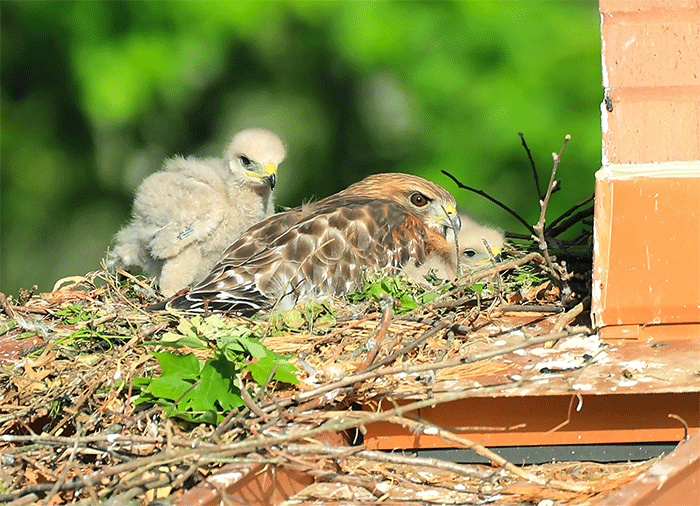
Red-shouldered Hawk parents appear to invest more heavily in female offspring when nesting conditions are good, according to a long-term study of suburban and rural birds in southern Ohio.
The research, published in the Journal of Raptor Research, examined nestling sex ratios in Red-shouldered Hawks Buteo lineatus between 2004 and 2016. The study used measurements of young hawks taken during ringing to determine whether nestlings were male or female, then tested whether sex ratio varied with territory quality, brood size, hatch date, study area or year.
Across the whole study, the overall sex ratio did not differ significantly from parity, meaning the population was not producing more males or more females overall. But a more detailed analysis revealed an important pattern: nests in higher-quality territories were more likely to contain female young.
That matters because female Red-shouldered Hawks are considerably larger than males, weighing around 23-34% more. In raptors with this kind of reversed size dimorphism, daughters are generally the more expensive sex to rear because they require more food during growth and development. Producing more female young may therefore be a strategy used by parents when they have access to better resources.
The researchers used average productivity at each nesting territory as an index of territory quality. In simple terms, territories that regularly produced more young were treated as better territories, likely reflecting better food availability, better nesting conditions, or higher-quality adult birds occupying them.
The results showed that as territory quality increased, the probability of producing female young also increased. At the same time, the proportion of male nestlings decreased as territory quality rose. The authors suggest this fits with earlier studies of raptors, where parents often produce more of the larger, more costly sex when conditions are favourable, and more of the smaller, cheaper sex when conditions are poorer.
Brood size and timing also played a role. Single nestlings were more likely to be female than male, with solitary young being female in 61.4% of cases. Meanwhile, the probability of producing male nestlings increased as the breeding season progressed, suggesting that female offspring were more strongly associated with earlier or better conditions.
The study does not prove exactly how parents influence the sex of their young. Birds may adjust the sex ratio of eggs before laying, or the sex ratio seen later in the nest may be shaped by differences in survival after hatching. In Red-shouldered Hawks, sibling competition can be intense, and smaller or weaker nestlings may be more vulnerable if food is limited.
The authors also caution that territory quality and parental quality are difficult to separate. Better territories may provide more food, but they may also be occupied by older or more experienced adults. Either way, the pattern points in the same direction: when circumstances are better, Red-shouldered Hawks are more likely to raise daughters.
For a common raptor, this kind of sex-ratio adjustment may seem like a subtle detail. But it helps show how birds can respond to local conditions in ways that affect the next generation. In smaller or more vulnerable populations, biased sex ratios could have important implications for future breeding numbers and population stability.
The study adds Red-shouldered Hawk to the growing list of raptors in which offspring sex appears to be linked to breeding conditions. Rather than producing sons and daughters at random in every nest, parents may be making - or at least revealing - fine-scale reproductive decisions shaped by food, territory quality and the costs of raising each sex.
June 2026
Get Breaking Birdnews First
Get all the latest breaking bird news as it happens, download BirdAlertPRO for a 30-day free trial. No payment details required and get exclusive first-time subscriber offers.
Share this story