Record numbers of Stone Curlew on RSPB reserves
Stone Curlew are making a triumphant comeback across southern England and East Anglia, with record numbers of the bird now found on RSPB nature reserves during spring and summer.
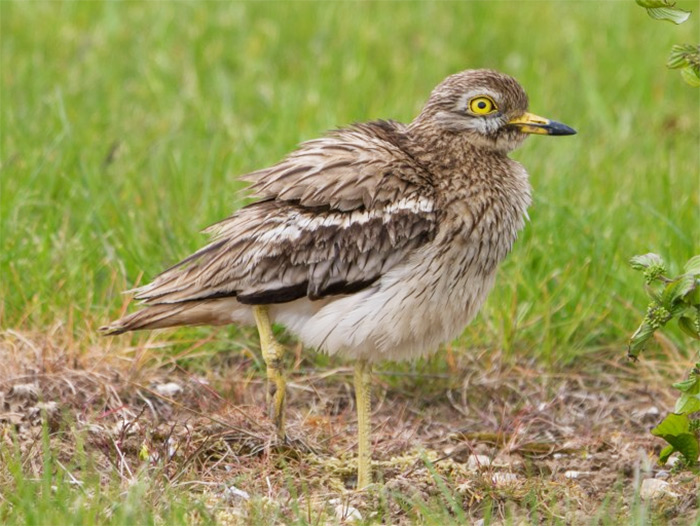
Migrating to our shores from southern Spain and northern Africa to raise their young, these peculiar looking birds are crow sized, have long yellow legs and - perhaps most distinctively – golden orb-like eyes which enable them to find food under the cover of darkness.
Once found across much of Eastern and Southern England, the species experienced substantial declines until the RSPB and partners started focused recovery work in the 1980s. Breeding on farmland, sandy heaths and downland, changes to agriculture previously caused a loss of suitable Stone Curlew nesting habitat.
Nesting on dry, stony, open ground and feeding on invertebrates in short grass habitats, the RSPB, together with farmers, have been restoring and protecting suitable nesting sites across Norfolk, Suffolk and Wessex. Alongside suitable farmland, nature reserves such as RSPB Minsmere and RSPB Winterbourne Downs are now providing a safe haven for the birds.
RSPB Winterbourne Downs, near Salisbury in Wiltshire, saw its highest ever number of Stone Curlew s, with 11 pairs fledging an incredible 19 young in 2022. And with a record 30 pairs of Stone Curlew counted across RSPB nature reserves in 2022, the conservation charity’s efforts are contributing towards a triumphant comeback for the rare, amber-listed species.
As RSPB England’s director, Nick Bruce-White, describes: “The success of Stone Curlew s across RSPB nature reserves and beyond shows just what can be achieved when conservation and nature friendly farming join forces to save our wild isles.
With these enchantingly wide-eyed birds migrating to our shores to raise the next generation, we must do all we can to ensure they have enough suitable habitat to nest on. With much of our wildlife-rich grasslands and 97% of our wildflower meadows lost since the 1930s, it is only through working in collaboration with likeminded farmers, landowners and partners that we can continue to see a rise in species like the Stone Curlew here in England.”
Working through a network of dedicated volunteers, the RSPB have worked alongside farmers and other land managers to protect nests and create safe nesting habitat on farmland, while restoring and creating suitable grassland habitats on their nature reserves.
As sensitive birds, countryside-goers can help this rare species by watching their step and being mindful of ground-nesting birds, as adult Stone Curlew s can be disturbed by human presence as much as a third of a mile (500m) away.
The celebration is tinged with worry for the future however, as Nick continues: “With current uncertainty over the nature of future support for Stone Curlew s, alongside other farmland wildlife, through agri-environment schemes, there is much to be done to secure a long-term future for this species in the wider countryside.
Now, more than ever, our farmers need the guarantee of support from the Governments of the UK through these schemes, empowering farmers to deliver for wildlife, climate and long-term food security”.
28 March 2023
Share this story