Rare moth returns to Cornwall after 10-year absence
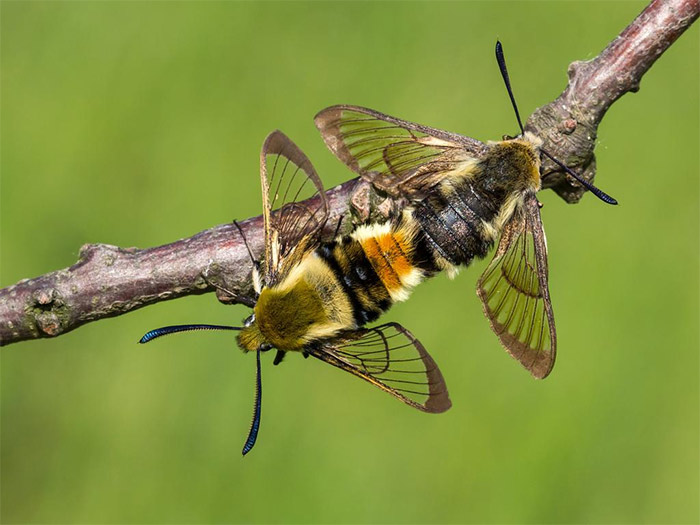
A rare moth has returned to Cornwall for the first time in more than ten years, wildlife charity Butterfly Conservation can reveal.
A caterpillar of the elusive Narrow-bordered Bee Hawk-moth was found on Goss Moor National Nature Reserve near Victoria in late June.
The discovery is confirmation the moth is breeding in the county again and is the first record of the species in Cornwall since 2008, when the moth was seen on Bodmin Moor.
Butterfly Conservation’s Jenny Plackett said:“This amazing find is all down to one of our young volunteers, Cerin Poland, who was trained as part of our All the Moor Butterflies project on how to identify the caterpillar.
“To have our volunteers discovering new sites for our rare butterflies and moths is really amazing and thanks to the dedication of people like Cerin, we are increasing our knowledge about the distribution of these species.”
24-year-old Cerin from Zelah in Cornwall said: “I was at Goss Moor helping to carry out a habitat survey for Natural England, who manage the National Nature Reserve. I was recording Devil’s-bit Scabious plants and saw the head of a caterpillar poking above one of the leaves looking up at me. I turned over the leaf and saw the distinctive pink horn on its tail and I knew straight away what it was!”
“Due to my training from Butterfly Conservation I was informed on the signs to look out for and how to identify the species, but I still can’t quite believe I found one. It is a great addition to the diversity at Goss Moor and I have high hopes we will discover the Narrow-bordered Bee Hawk-moth in other locations across Cornwall.”
The Narrow-bordered Bee Hawk-moth was once widely recorded in the UK and could be seen visiting flowers throughout May and June, but the species has undergone a substantial decline over recent decades.
The day-flying moth is also a distinctive bumblebee-mimic, with a yellow and black abdomen and transparent wings, which have well-defined black-coloured veins running through them.
Natural England’s Dave Hazelhurst said:“Working in partnership with wildlife charities like Butterfly Conservation means we can combine our efforts to maximise the benefits for these species and we’re thrilled that Goss Moor has provided a new home to the rare Narrow-bordered Bee Hawk-moth. It’s really heartening to see that everyone’s conservation efforts to help moths and butterflies at the reserve are paying off.”
15 October 2019
Share this story