Poorly-designed powerlines killing globally threatened birds of prey
Endangered birds of prey are being killed in Africa and the Middle East through poorly-designed powerlines, warn scientists.
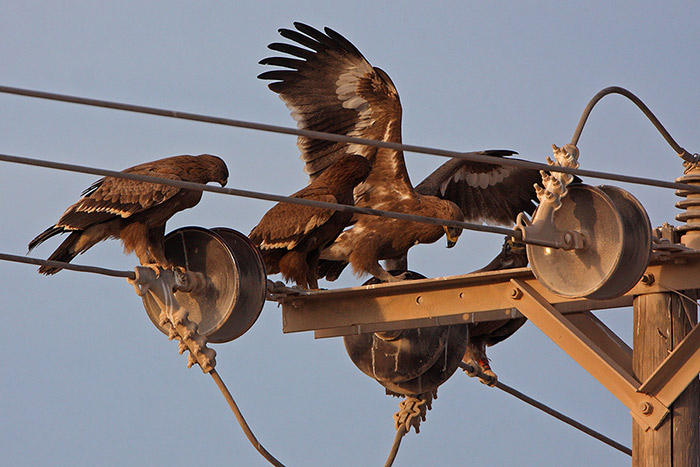
Two papers, published recently in the journal Bird Conservation International, have highlighted the threats posed to globally threatened birds of prey. Large wintering congregations of steppe eagles in the Saudi Arabian desert and Egyptian vultures in Ethiopia are exposed to electricity infrastructure that causes electrocution.
Most birds can safely sit on a powerline without being harmed. However, if a power pole is poorly designed, large birds that land on it come into contact with both the grounded support structure and the live wire – which leads to instant death of the bird by electrocution, as well as disruptions to the power supply. Although this problem has been known for decades, ongoing power development projects still use inadequate designs.
Large eagles and vultures soar over even the most remote places of Africa and southern Asia, and provide the vital service of removing rotting carcasses from the landscape. Whether dead cattle, elephants or antelopes – vultures ensure that these carcasses are cleaned up free of charge. The catastrophic decline of vultures in India led to an overabundance of feral dogs and increased rabies infections in people.
Steffen Oppel, Conservation Scientist at the RSPB’s Centre for Conservation Science and lead author of the vulture paper said: “Many countries in Africa and the Middle East aim to improve livelihoods of people living in rural areas by providing electricity – a convenience many people take for granted – but small powerlines are often the inadvertent cause of death for many large birds.”
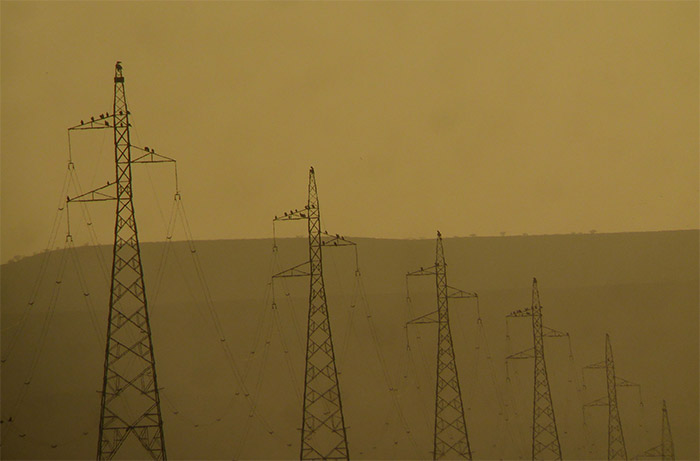
Many powerline designs are perfectly safe for birds of all sizes to roost on, but unfortunately these can be more expensive to construct and are therefore often not used in remote development projects. Better designed powerlines would immediately eliminate the electrocution risk to large birds, reduce maintenance costs, and increase the reliability of the power supply. While such improved designs should be used in all new infrastructure developments, existing infrastructure can be refurbished to reduce the already existing threats.
Stoyan Nikolov, manager of an EU-funded project to save Egyptian vultures in eastern Europe, said: “Conservation efforts to protect these birds in Europe or in western and central Asia are being undermined and it’s especially frustating as there are solutions. Funders and governments who aim to improve livelihoods of rural people should consider the critical services that many large birds provide – and invest in infrastructure that does not undermine the goal of providing healthy livelihoods to people.”
The threats are particularly worrying in Ethiopia as seven species of vulture regularly occur there. The country also hosts some of the largest congregations of wintering Egyptian vultures, a bird which has declined by >50% since the 1990s. Steppe eagles were listed as endangered in 2015, after their population underwent rapid declines due to habitat destruction, persecution, and power lines.
Another new study – published in the same issue of Bird Conservation International – shows that existing protected areas are insufficient to conserve these vulture populations as only about one fifth of vulture priority areas fall within protected areas. In addition, because vultures travel large distances in search of food, most individual vultures spend the majority of their time outside of protected areas, even if they regularly roost, breed or forage inside a protected area. Thus, it is essential that lethal threats to vultures are removed from the entire landscape so that vultures have a chance to survive outside of protected areas.
21 July 2021
Share this story