Mark Golley joins BOURC
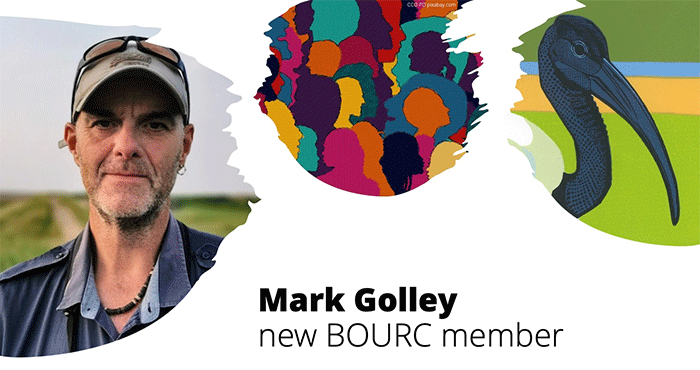
The BOU is pleased to announce the appointment of Mark Golley to its Records Committee (BOURC). Mark is an active birder and naturalist with a deep-rooted interest in rare birds, their identification and occurrence, and is no stranger to finding national rarities himself being based on the north Norfolk coast.
Writing on Twitter following the announcement Mark said: "I'm delighted to become the newest member of the BOURC & I'm really looking forward to working with my colleagues on a number of fascinating files ahead. Replacing @DEBALMER is quite the task! Grateful thanks to @IBIS_journal for the warm welcome."
Mark Golley – a profile
Mark has been watching birds for as long as he can remember, starting with Bullfinches and Buzzards at his childhood home in west Devon through to his present-day base, of over 30 years, on the north Norfolk coast.
After leaving school, where he would take several unscheduled days off travelling for rare birds, Mark began a career in conservation, working for a season at Gibraltar Point NNR, before heading to the famous Cley Marshes in 1990, where he spent four years as the reserve’s Assistant Warden.
A significant career change saw Mark eventually move into the media, where he remains to this day, as a freelance producer, working on many famous sports programmes and events, from Match of the Day to football World Cups and Euros to Super Bowls, Wimbledon, the Olympics and test match cricket. When not working on sport broadcasts, there’s plenty of in-field time in TG04, the Cley square.
A passion for rarities, their identification and vagrancy developed in his formative years and is still part and parcel of Mark’s birdwatching. He spent several years writing Rare Bird Alert’s weekly rarity roundup where factual analysis and personal anecdotes were melded together, every seven days, into multi-thousand word essays.
Currently in his second five-year term on the Norfolk Records Committee, Mark has written several “entry-level” books on birds, as well as numerous identification articles, (primarily for Birding World magazine), which culminated in a privately published labour of love detailing the field identification of Icelandic and ‘Continental’ Black-tailed Godwits. He has found several county firsts in his adopted home across the last three decades, including Desert Warbler to Red-necked Stint.
It isn’t all birds though. Mark has wide ranging interests within the natural world, focusing nowadays on moths, along with butterflies, dragonflies and plants (especially orchids).
And it’s not all Norfolk either. During the last decade Mark has returned, on numerous occasions, to Fair Isle, a place he first visited in the late 1980s then didn’t return to for over 25 years.
Diversity within the BOU Mark replaces Dawn Balmer who retires from the Committee this summer. Dawn has been a diligent and valued member during her time with us and became the first female member of BOURC.
For the last decade, the BOU has worked hard to improve diversity across all our activities. Central to this is the makeup of our Council and committees, where we have set the target of achieving a 50:50 male:female gender balance across these groups by 2022. For some individual groups, e.g. Council itself, we have attained this, and across all other groups, away from BOURC, the balance is 50:50. With BOURC included, it is skewed to 55% male across all our groups.
We always knew that BOURC was the outlier within our activities, with its membership being drawn from the birding community rather than the professional, and largely academic, ornithological community, as is the case for our Council and other committees and groups. Birding is a heavily male-dominated pastime and the interest in rare birds even more so. There are few female county bird recorders. The British Birds Rarities Committee has not yet appointed a woman to its ranks. And in recent rounds of recruitment for BOURC, although we have had women nominated for membership and have prioritised their selection, the invitations to join the Committee have been declined. However challenging, we remain committed to increasing the number of women appointed to BOURC in coming years, and are still actively striving to achieve this.
29 July 2021
Share this story