Major report documents widespread declines in Ireland’s wintering waterbirds
Long-term monitoring shows many duck and wader species have fallen sharply in recent decades
A comprehensive stocktake of Ireland’s wintering waterbirds
Ireland’s wetlands remain internationally important for wintering waterbirds, but a major new assessment paints a mixed - and increasingly worrying - picture of how many species are faring. Drawing on almost three decades of coordinated survey work, the report provides the most detailed overview yet of population size, trends and pressures affecting wintering waterbirds across the Republic of Ireland.
Covering the period from the mid-1990s to the early 2020s, the analysis combines data from hundreds of coastal and inland wetland sites, offering a rare long-term perspective on which species are holding on, which are increasing, and which are slipping into sustained decline.
Headline declines among ducks, geese and swans
Among wildfowl, the long-term picture is dominated by steep losses in several familiar winter visitors. Over the past quarter-century, multiple duck species have declined by more than half, with diving ducks particularly affected.
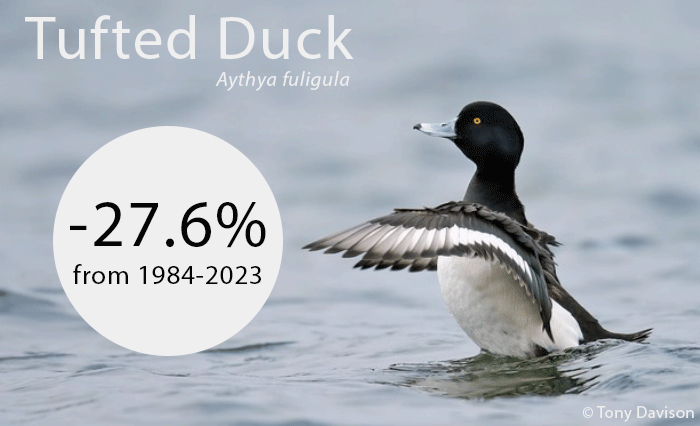
Bewick’s Swan stands out as one of the fastest-declining species, showing dramatic reductions in wintering numbers, while Pochard, Tufted Duck, Scaup and Goldeneye have all suffered severe long-term falls. Other once-abundant species, including Mallard, Shelduck and Wigeon, have also declined substantially, underlining that losses are not confined to specialists or scarce birds.
Waders show even broader long-term losses
The situation for waders is even more stark. Most regularly occurring species show declining trends over the long term, with some of the most iconic birds of Irish estuaries and shorelines now present in far smaller numbers than a generation ago.
Lapwing and Grey Plover have both declined by more than half, while Curlew, Dunlin, Turnstone and Purple Sandpiper have all suffered major reductions. These losses reflect changes not just at Irish wintering sites, but across entire flyways, linking pressures in Ireland with conditions on breeding grounds and along migration routes.
Not all species are declining
Set against these losses are a smaller number of clear winners. Several goose species, along with Whooper Swan, Little Egret and Eider, have increased markedly over the long term. In the wader group, Sanderling, Black-tailed Godwit and Greenshank stand out as notable success stories, each showing strong population growth.
However, the report makes clear that even some expanding species are now showing signs of recent levelling-off or short-term decline, suggesting that gains may not be secure.
Short-term trends offer little reassurance
Looking at the most recent five-year period, declines remain widespread. Many species that have been falling over decades continue to do so, while only a handful show consistent short-term improvement. This lack of recovery suggests that underlying pressures have not eased and, in some cases, may be intensifying.
Multiple pressures acting together
The report highlights a wide range of pressures affecting wintering waterbirds, rarely acting in isolation. Disturbance from recreation, coastal development and energy infrastructure continues to affect key sites, while changes in water quality, fisheries practices and land use place additional strain on wetland ecosystems.
Climate change is identified as an overarching influence, driving shifts in distribution and altering the suitability of traditional wintering areas. The growing impact of avian influenza has also emerged as a serious and immediate threat, capable of causing sudden population losses.
Ireland’s wetlands remain globally important - but increasingly fragile
Despite these challenges, Ireland remains a crucial winter refuge for millions of waterbirds moving along the East Atlantic Flyway. The report underlines that safeguarding wetlands here has implications far beyond national boundaries.
What emerges most clearly is that long-term monitoring is invaluable not just for documenting decline, but for identifying where conservation action is most urgently needed. Without sustained protection and management of wetlands, the downward trends highlighted in this report are likely to continue - and in some cases accelerate.
February 2026
Get Breaking Birdnews First
Get all the latest breaking bird news as it happens, download BirdAlertPRO for a 30-day free trial. No payment details required and get exclusive first-time subscriber offers.
Share this story