High-flying ducks cross Himalayas
Ruddy Shelducks can reach altitudes of up to 6,800 metres (22,000 feet) to cross the Himalayas, new research shows.
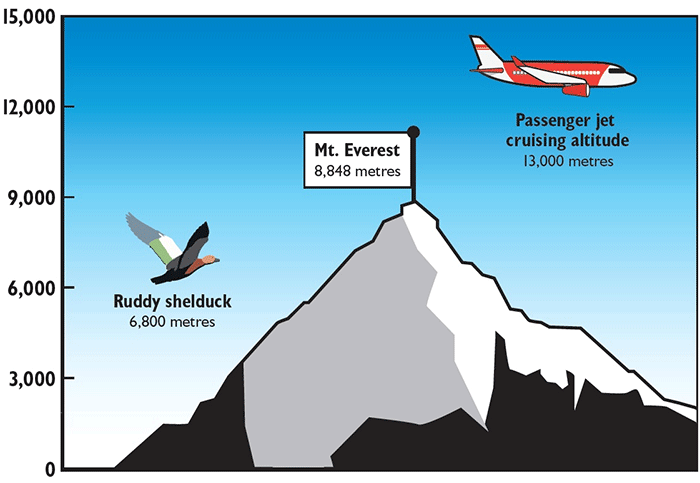
Ruddy Shelducks are known to breed north of the Himalayan mountain range, but spend their winters at sea level south of the Tibetan Plateau.
They need to fly over the Himalayas in the spring to get back to their breeding grounds, a huge challenge that sees them cross terrain higher than 4,000 metres, where oxygen levels are halved.
Scientists from the University of Exeter used satellite tracking to discover that they fly through valleys in the mountain range - avoiding massive peaks like Mount Everest.
"This is the first evidence of extreme high-altitude flight in a duck," said lead researcher Nicole Parr, of Centre for Ecology and Conservation on the University of Exeter's Penryn Campus in Cornwall.
"This species has probably evolved a range of adaptations to be able to cope with flying so high, where oxygen levels are half those at sea level. We don't yet know the nature of these adaptations.
"Our research also shows that the Ruddy Shelduck has a faster climb rate than the bar-headed goose - the only waterfowl known to fly even higher."

Dr Lucy Hawkes, the supervisor of the work at the University of Exeter, had previously tracked bar-headed geese to 7,290 metres altitude near Everest in 2014.
They were long thought to be the world's highest-flying bird based on flapping flight (some birds soar higher on thermals), but the new research suggests that the bar-headed geese may not be the only species flying at these high altitudes.
However, more research is needed to find out whether Ruddy Shelducks reach similar heights to bar-headed geese.
The scientists used satellite data collected from 15 Ruddy Shelducks from two populations spending their winter south of the Tibetan Plateau.
They found the birds, which take a "circuitous route" to avoid mountain peaks, regularly fly above 5,000 metres and sometimes go as high as 6,800 metres.
The researchers suggested that Ruddy Shelducks wintering further east in India may fly even higher, given the higher terrain that lies north of India.
11 September 2017
Journal reference: N. Parr et al, High altitude flights by ruddy shelduck Tadorna ferruginea during trans-Himalayan migrations, Journal of Avian Biology (2017). DOI: 10.1111/jav.01443
Share this story