Global animal tracking system Icarus is switched on
The German-Russian observation system for animal movements, Icarus, will go into operation on 10 July 2019. In the subsequent test phase, the Icarus engineers and scientists will check the system components on the ground, on board the International Space Station (ISS) and the transmitters that collect the animals' data. After completion of all tests, Icarus is expected to be available to the scientific community in autumn or winter 2019.
Icarus is a cooperative project between the Russian space agency Roskosmos, the German Aerospace Center (DLR), and the University of Konstanz under the leadership of Martin Wikelski from the Max Planck Institute of Animal Behavior in Constance. With the space-based observation system, scientists want to find out more about the life of animals on Earth: on which routes they migrate, under what conditions they live and, above all, how they can best be protected.
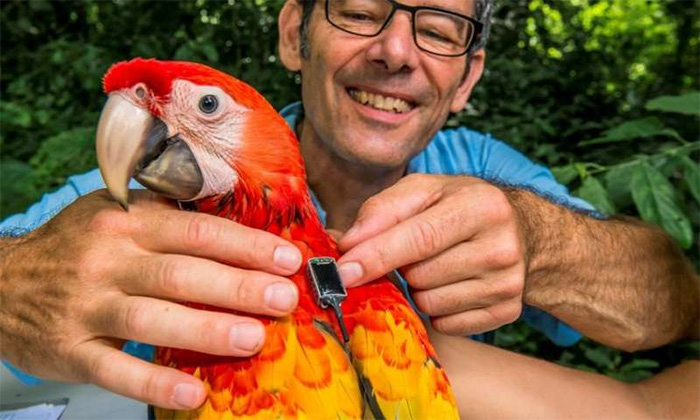
The researchers equip different animal species with miniature transmitters that send their measurement data to a receiving station in space. The data is transmitted to a ground station, from where it is sent to the respective research teams. The results are published in the Movebank database, which is freely accessible to everyone, and in a counterpart developed by RKK Energia and the Institute of Geography of the Russian Academy of Sciences (IG-RAS). The Icarus equipment supports the Russian space research project Uragan (hurricane), which was developed to adapt Earth observation hardware and methods and to observe potentially dangerous phenomena. Uragan instruments are used to simultaneously observe the Earth's surface to understand the migrations of animals and the reasons for their changes.
Activation of on-board computer
On 10 July 2019, the Russian ground control centre will activate the Icarus antenna and the on-board computer on the ISS. The on-board computer is already on the space station, the antenna was mounted by Russian cosmonauts on the outside of the "Zvezda" module. At the same time, a SpaceTech test ground station in Immenstaad will start operation.
Over a period of three to four months, the Icarus scientists will first test the data transmission from the transmitters via the ISS to the ground station. By measuring the background noise in the Icarus frequency range, the researchers want to find out where the transmission of other signals could be disturbed. The engineers will then switch on the Icarus transmitter on the ISS, which will later be used to program the animal transmitters. The test ground station will then record the transmission times and signal strength.
Next, SpaceTech's engineers and their Russian colleagues from RKK Energia will determine the regions of the Earth that will be covered by the ISS as the antenna passes over. The transmitters can only transmit their data into space if they are within the signal cone of the antenna.
Test for data transmission
For the worldwide observation of thousands of animals, large amounts of data must be sent smoothly and safely from the transmitters into space and back again. During the test phase, a simulator will generate artificial transmitter signals which will be transmitted to the Icarus module on board during the ISS flyby. With the simulator, researchers can test the transmission of data from individual to hundreds of transmitters. After all, real transmitters are to send their data from test areas in Germany and Russia into space. The security of data transmission will also be tested.
After completion of the tests and evaluation of the results, Icarus will be released for routine operation. By the end of 2019, scientists worldwide should be able to work with Icarus. The associated research projects on the Russian side will be managed by the Institute of Geography of the Russian Academy of Sciences (IG-RAS).
10 July 2019
Share this story