Finders in the Field: Two-barred Greenish Warbler, Suffolk, Sunday 13th October
I’d been pretty much laid up in bed the last two days with, well not just the ‘man’ version, but actual flu. On Sunday morning I felt a bit better and, not wanting another day of moping around in my pants, sweating and with achy limbs, was itching just to get outside for an hour or two. I decided to have a couple of hours birding without going too mad. Now I don’t stray far from the vicinity of the Alde estuary these days and going to see a bird at Minsmere constitutes a major twitch in my eyes. So, it was a toss of a coin on heads – check Orford or tails – check Aldeburgh. I’d put a fair bit of effort into Aldeburgh in recent years with some success having found: Pacific Golden Plover, Collared Practincole and Coues’s Arctic Redpoll there. It would be fair to say that Orford isn’t on the ‘birding map’ and was just my sort of place to give a go this autumn. I’d developed a little circuit over the last fortnight taking in some nice little areas of habitat and the previous weekend had: Yellow-browed Warbler, Firecrest and 3 Ring Ouzels (so as good as anywhere else on the Suffolk coast) – so heads you win – Orford it was.

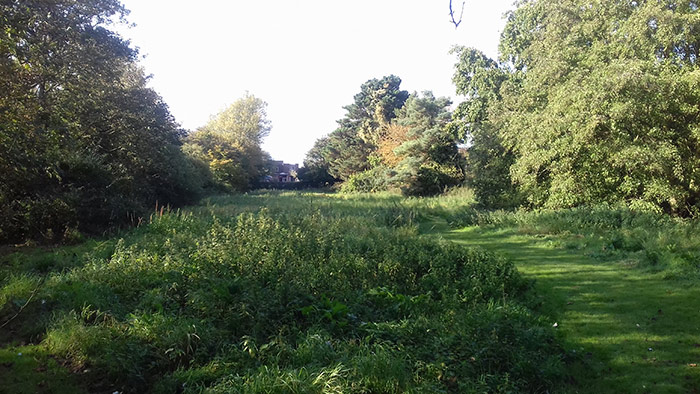
I arrived at Orford about quarter to nine, it was a grey and overcast morning with a moderate southerly breeze which was forecast to strengthen throughout the morning. My initial wander around the village revealed very little migrant activity and the ‘birding force’ didn’t feel strong. There was several Blackbirds kicking about, but no crests, Chiffs or any vis mig going on. Despite this it was just nice to actually be out and, well, you never know. I continued my normal route across the marsh to the river wall and then back to check the Quay area. The quay car park and adjacent meadow area is bordered with some taller trees along with lower shrubs and offers some decent passerine cover – indeed I’d seen Pallas’s & Yellow-browed Warblers in this area in years gone by, and Pied Fly this year. The ‘quay meadow’ area seemed to offer the best shelter from the wind and when I got there some 20 Blackbirds flew out, but otherwise it was pretty quiet. With little bird activity, my mind wandered to what time the nearby cafe opened and about getting a coffee. I thought it was at half nine – happy days – that was only in 5 minutes time – so decided to hang fire out of the wind in the meadow area until it opened.
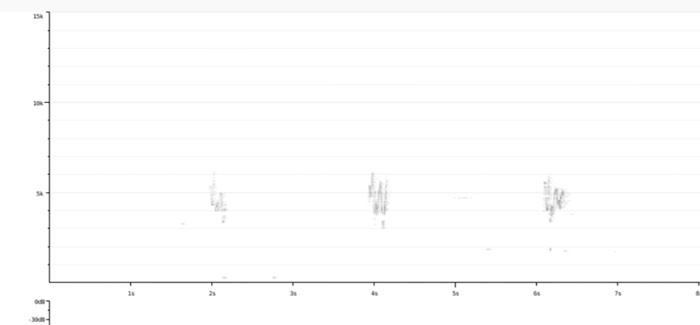
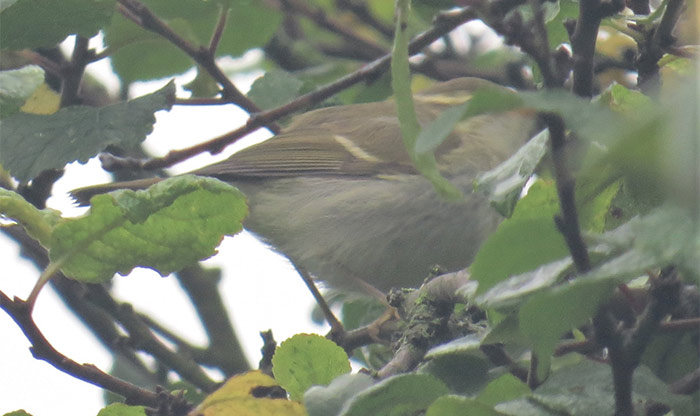
Never has the decision to wait and get an over-priced cup of coffee proved such a good one (perhaps the birding force was with me)! With very few birds calling I was drawn to a distinctive trisyllabic call coming from the cover next me. It was something like a cross between a Pied Wagtail and Sparrow and I just couldn’t place it in my head. To give it its due it kept calling but I just couldn’t see anything. A couple of minutes passed without hearing the call again when I noticed a small bird flick above my head. Before I raised my bins with my naked eye I could see a small green & white warbler, two obvious pale wing bars and a long broad supercillium and thought “nice a yellow-browed”, not putting it with the call I’d heard minutes earlier. As it was close, I choose to first get my camera out first and try and get a picture, as I unzipped the case I heard it give the trisyllabic call – now that’s no Yellow-browed I thought, aborted the camera and quickly binned the bird. At this point it was moving above me only some 12 feet away, but partially obscured by vegetation. It wasn’t amazingly active but was very vocal. I quickly noted that it had plain tertials, obvious double wing bars with the greater covert bar being long and evenly broad along the length. It was proportionally rather Yellow-browed like, if somewhat bigger billed in appearance. The upperparts were olive green, plain & uniform tertials with the fringes to the secondaries a brighter green. It had a long broad supercillium, white underparts with slight yellowy flush to the face. There was a fair bit racing through my mind at this point, but knew I had to get some (any) pictures of this bird. The lens to my bridge camera was misted up (!) I quickly wiped it and shot about 10 shots through vegetation and hoped for the best! There was no time to review them at this point just gather what features I could on the bird (later I realised 5 were in focus and they did document some of the features – four are below). The next thing was I pulled out my phone set the voice recorder going and holding it as high I could towards the bird took a short recording of the bird – unbelievably, although quiet, you could clearly hear the bird call three times on the recording without much background noise and no other birds calling.
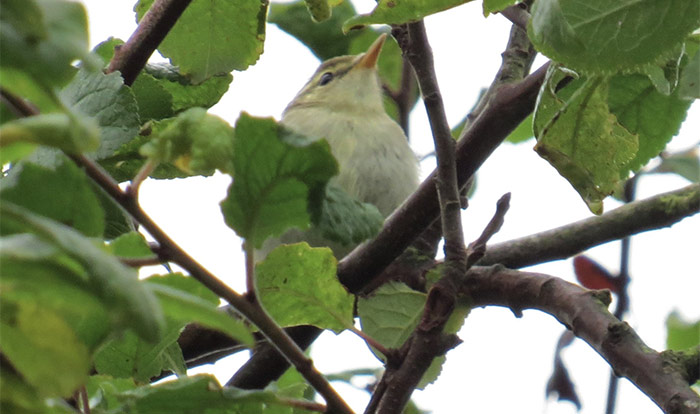
Now all this happened pretty quickly (over about 5 minutes) and I hadn’t had that much time to actually think “what is it?” I watched it disappear out of view, but fairly sure it hadn’t gone far, and went into a reflective period and very much a process of “what it wasn’t”, I’d sum up when filtered through my head in a very short period at the time:
• Yellow-browed had been ruled out straight away – plain tertials, call, etc
• It wasn’t Arctic – structurally all wrong, the call, the broad wingbar – so dropped that quickly.
• Greenish – call right, isn’t it a bit late (not sure?) and well that greater covert bar was a long, dirty great broad, parallel thing! Not the short, tapering wingbars I’ve seen on birds before.
• At this point the heart rate went up somewhat (not good for man who had a major heart attack in 2018) and well, I was all out for my field experience. I’d seen pictures, read the odd ID account but never actually seen Two-barred Greenish (I told you twitching’s not my thang, I mean I love 100’s of predominantly middle-aged men dressed in green crammed into a small area like the next person, but it’s just not for me).
• So there it was, a call of mahoosive proportions by someone who’s never even seen one “I think I might have a two-barred Greenish…..!?”

Now let’s just hold some horses and all calm down, I’ll phone a couple of people – well that idea went well – none of them answered! And only one phoned back – Richard Drew – he tells me my voice was a little shaky:
“Alright Richard, how busy are you?”
“Yeah pretty, I’ve got people over, why?”
“Well I've got this weird warbler, two wing bars like a Yellow-browed but plain tertials, strange wagtail/sparrow like call”
“That does sound interesting…”
“I know it sounds stupid – but I think it might be two-barred Greenish”
“Blimey, is it still there, I’ll phone Dave Fairhurst and see if he can get down as well and call you back”
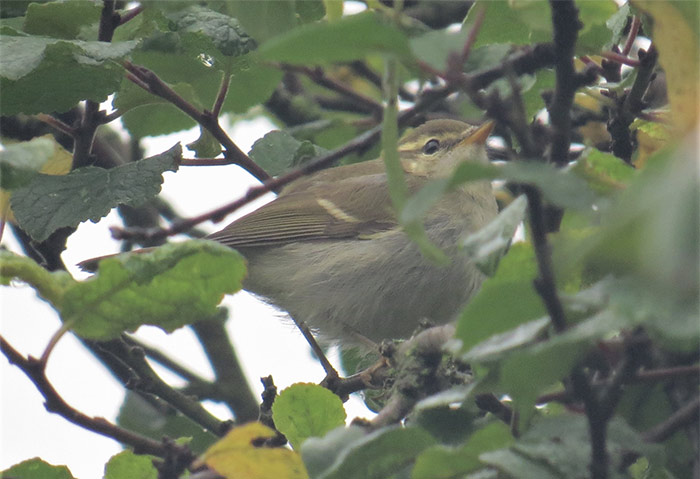
I also phoned my big brother briefly for a bit sanity and now it had just gone 09:50 and I’d heard it call a couple of times more but not seen it again. I quickly looked at a couple of photos online, checked some features, checked my photos and downloaded a call and felt that it probably was Suffolk’s first Two-barred Greenish Warbler. On the back of my camera my pictures seemed to show:
• A long, parallel, evenly broad greater covert wing bar extending to the scapulars formed by extensive pale tips to 7 greater coverts.
• A long, broad pale supercilium, being less distinct in front of the eye with dark loral stripe.
• Plain, uniform tertials with just very narrow slightly paler grey fringes.
• Brighter green fringes to the secondaries.
• A rather stout, broad-based bill with completely orange lower mandible.
• Legs greyish at the front and pale pink at the rear & sides.
I decided to release the news (I did wonder whether to sit on it, I’m not keen on big groups of people and like birding alone) and see what happened. So, with a set of kahunas I put out the following message on BINS (first for local news):
A bold call, but it seemed the right thing to do and we all know that everyone’s an expert sat at home on social media, but it’s a different ball game out in the field.
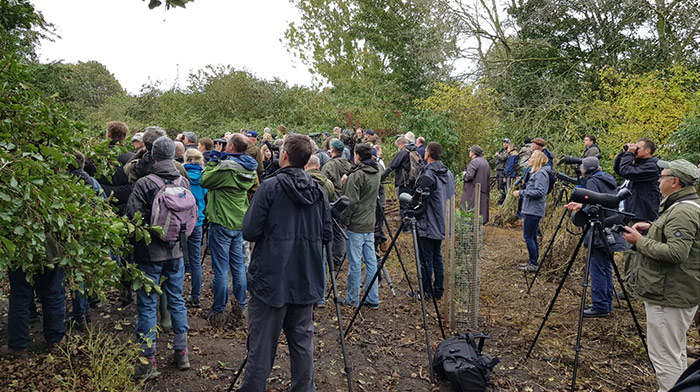
At just after 10am the bird reappeared, now much more active and manically feeding on the edge of a small Hazel. It was now affording excellent views and at this point D.Fairhurst arrived and jammed in with almost instant superb views. A few other birders arrived shortly after including Richard and the bird was still showing well. It became more mobile and started moving over a slightly wider area and feeding higher up. At about eleven it flew high up in a tall Scot’s Pine and well, didn’t come out, having shown on off for about an hour to just over 10 people. There was no doubt that it showed best earlier on and had become increasingly more active, quick and mobile as it fed with fly-catching sallies, hovers and rapid darting movements. Perhaps when I found it it had just arrived, appearing more lethargic in its movements and so vocal calling well over 20 times (it became pretty much silent after 10am).
I had left when the bird reappeared at the other side of the meadow at 12:25. It apparently showed well, albeit briefly, and was seen by about 20 people, when some excellent photos were also taken. And that was it with now further sign to dusk. The bird had been present for near on exactly 3 hours from when I first found it and went missing for half of that time. My decision to put the news out quickly allowed 30 or so lucky people to connect with what was a cracking little bird and first for Suffolk.
Over the last couple of days people have said it’s the best bird I’ve found and they’re probably right in rarity value although an adult male Red-flanked Bluetail on the Farne Islands in 1998 when they were mega rare will always take some beating. All proceeds from Rare Bird Alert for this article will go to Macmillan Cancer Support helping to support my dad and the many other thousands of families in similar situations.
Mark Cornish
22 October 2019
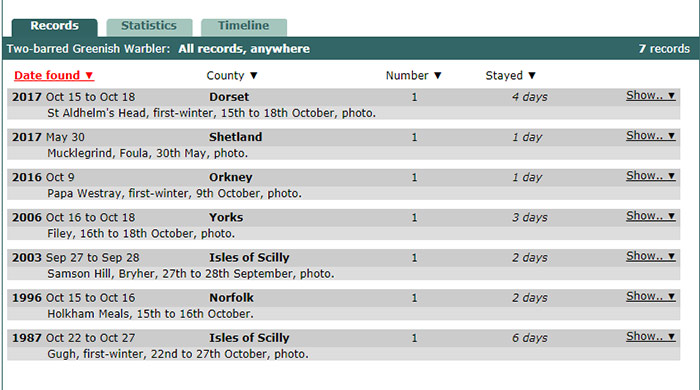
Previous Records

Share this story