Finders in the Field.. The one that got away
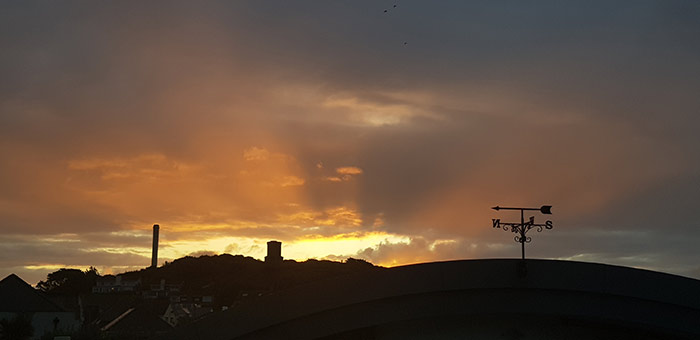
St.Mary's, Isles of Scilly, Sunday morning, 20 Oct. The wind on Scilly has finally gone to east overnight. As it gets light I leave Hugh Town and set off for Peninnis with Dick Filby, walking the coast path on the west side. Thrushes are on the move, streaming east over Porthcressa Bay, the calls of Redwing, Fieldfares, Song Thrushes and Blackbirds filling the air. DF has been here over two weeks and this is the first morning of such movement this autumn. Until now it had been incessant Westerlies, bringing a wet and windy conveyor belt of American passerines to Scilly, the best showing for years as well as some European goodies, most notably a Blue Rock Thrush.
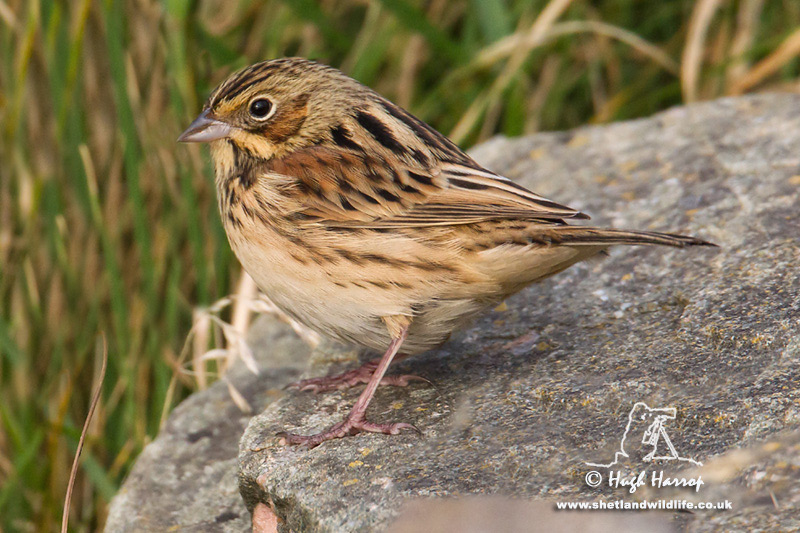
Approaching cattle fields midway along the western side of Penninis, a bunting with chestnut ear coverts and an obvious white eye ring was sat in trees above the stone wall not far from me. A few days’ previous I’d been watching a Little Bunting back at Spurn, but today’s bird seemed odd. The breast streaking limited, warm brown in the mantle and wing coverts, the supercilium paler buff and not chestnut and the bird didn’t seem as small and dainty as expected...I called to DF whom I was with, saying that I thought that I had a Little Bunting. The bird then disappeared and we didn’t see where to. A minute later, DF indicated that it was back in the tree, he said Little Bunting but then modified that with an understandable query. We looked at it perched. The same confusing mix of features, chestnut ear coverts, distinct white eye ring etc...Then it flew towards us at close range. It seemed larger than expected for Little Bunting in flight. What was more bewildering, were the calls heard...a harsh bunting tick but most calls were: a slurred ‘tzik-it’, ‘tssit’, ‘tzzitt’, and a sparrow-like ‘chip’.
This was confusing. A bird that was an odd Little Bunting, that we expected to give Little Bunt calls was definitely giving strange calls. And we were definitely listening to the right bird. It flew into more distant bushes giving brief scope views, only to be flushed soon after by cattle. It then flew again, towards us this time, circling over us, again close. By now another birder Gareth Richards, called over by DF, was present, seeing and hearing the flying bird. The bird called frequently, whilst low overhead as it circled us, perhaps calling 20 times in all as it flew around. It was so close, just a few feet over our heads, that we could hear it very clearly indeed. DF voiced our shared puzzlement, ‘What "on earth" is that?’ We both know Little Bunting very well.. Indeed, DF also saw one just a few days earlier, on St.Martins.. Then the penny dropped for me, memories of online research and wider reading... the calls we’d heard plus the plumage/size. I said that the bird was a Chestnut-eared Bunting. But, after circling us, the bird suddenly set off strongly and purposefully NE, to finally disappear out of view as a speck when several hundred yards distant, at maybe 50 metres altitude or so.
AAAAARGH!!! No photos, no sound recording, nor every feature noted. It was one to try and relocate... we put the news out and the area was soon being scoured by many scores of observers.
Birds continued to pour in.. and move through. Nearby, an hour or so later a Little Bunting arrived on rocks at the very tip of Peninnis, a few hundreds yards to the south, but that too was lost almost immediately as it headed north, Later that Little Bunting, or another, was seen briefly half a mile away at Low Moors, before it too headed off. Meanwhile, of our bird, still no sign...
Throughout the day we searched. Thrushes, finches, Skylark, were arriving on Peninnis but quickly moving off NE. Of our quarry, on Penninis and elsewhere, there was no sign.
We are very sure of the id, especially given the prolonged exposure we had of the flight calls. However, at the time of writing it has not been relocated and thus we don't have ALL the necessary evidence that a bird of this magnitude deserves. It is one thing to be sure of the id, but as we are unable to submit the record, so it is destined to be the "one that got away".
Elated, and gutted, simultaneously.
Tim Vaughan
24 October 2019
Previous Records
This would be only the third British record following singles on Fair Isle (Shetland) on 15th-20th October 2004 and at Virkie (also Shetland) on 23rd-25th October 2012 with the only other Western Palearctic record in Sweden in Uppland at Singö, Understen on 25th October 2011.
Share this story