Finders-in-the-Field: Swainson's Thrush and more, St.Mary's, Scilly
In early August every year my nervous system begins to reverberate with excitement for the impending Scilly season. In ‘just’ 2 months time I’ll be reunited with two of my favourite patches – Longstone and Bant’s Carn. As the fateful day in late September approached, all the moons and hands aligned to produce some seriously gripping weather. It seemed it was to be a westerly year with a relatively southerly Jetstream sweeping systems or fronts repeatedly across the islands. I was reaching fever pitch to get to Scilly, but I had an interview on the Wednesday afternoon so I booked myself on the Scillonian for the following morning along with a 04:00 train from Exeter. Not a moment was to be lost! The Yank year is here!
For me this is near perfect weather for Scilly; generally good visibility with bands of rain. An overhead jetstream whipping systems or fronts across the north Atlantic in survivable time for any on board passerines, followed by backing westerlies for those of longer-winged persuasion! Besides the Christmas light grip potential of a Nearctic warbler, some nice southerlies in front of these storms and fronts inevitably ‘sucked in’ some decent Palearctic birds including the ongoing superstar Blue Rock Thrush that was in its fifth day of residence as I disembarked the Scillonian on the morning of Thursday 27th September.
After some obligatory twitching I quickly acclimatised to my patches, trying to suss out where looked good for what and when. For me, the overwhelming ‘mainland’ levels of cover and connectivity on St. Marys demand a targeted patchwork approach where I intensively bird a few sites. My hope is that regular coverage will unearth birds as they arrive or move around due to changing weather or resources. To this end I’m pretty lucky that my patches have been particularly productive this autumn!
Bant’s Carn is canny in any wind with south in it, especially late afternoon when it’s bathed in the warmth of the setting sun. In light of the strong sou’west winds I headed up for my first visit and immediately saw a Short-toed Lark parading around a hidden sheltered field. A super blond individual, it was almost ridiculous watching it feed on the contrasting black soil field. For once the pale blob in the middle of that field wasn’t a stone! Ironically I checked that field a couple of weeks later and only had a pale stone…!
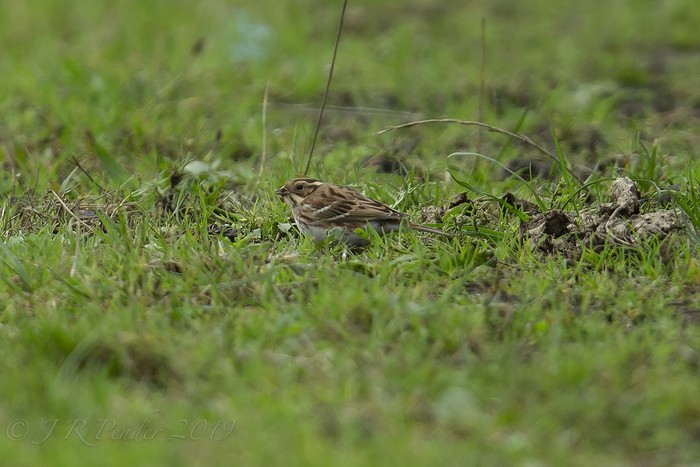
The following morning dawned becalmed and extremely mild. You could almost feel the birds descending from every compass point towards this deceivingly warm slab of air over the islands. As I birded Longstone at first light I was on high alert…feeling the day could be as much about east as west. Classically the rare moment came when I least expected it, during a phone call. Turns out I had done alright at that interview just before Scilly and was being offered the job. A great moment! I stood absentmindedly scanning some linnets relishing the feeling. Insanely at this very moment a Rustic Bunting stuck its head up! I’ve been lucky to find two previously including a mind-blowing spring male on the Farnes; but still, this was a massive moment and demanded concentration. My new boss was asking me some questions, however I could feel myself descending into the ‘rare tunnel’ when I zone fully in to the bird. This isn’t good, it was important to me that I made a good first impression, so I prized my eyes off the bunting which was showing in full view at about 15 feet range and turned away. Luckily upon hanging up and turning back around it was still there!

The proceeding days saw unrealised potential beat the islands in the form of relentless gales and rain. Yank rares were occurring, if not sticking, and the general vibe was one of high hope and razor sharp focus. Whilst watching a Red-eyed Vireo at 5ft range a birding friend told me some beginner birders at their B&B had seen a ‘funny’ Blackbird sized bird with white cheeks in Carreg Dhu gardens, a site in the core of my intensive Longstone patching. They had been shown yank thrush and cuckoo pics but none matched. Either way, to be safe I had an extra real thorough eyeball around with no sign other than the usual menagerie of scruffy Songies and Blackbirds.
Fast forward three days. The 10th of the 10th dawned sunny and relatively calm after the previous 24 hours of torrid squalls and galeforce westerlies direct from the other side. With bright sunshine and westerly breeze I walked an established route that grilled Longstone, Tremelethen Farm and trail before ending in Carreg Dhu gardens just as the sun lit the sycamores up. The route was cracking in terms of birding ‘feel’ but relatively quiet. I was almost daydreaming as I walked in the sun, managing to drag myself out of this catatonic meditative state as I walked up through the pines from Parting Carn to the top of Carreg Dhu; telling myself that I needed to be alert in case of a catharus!
Upon entering Carreg Dhu I continued along my prescribed route that allowed me to subtly check all its nooks and crannies without disturbing them, and with the sun behind me. To this end I walked through the bamboo and up to the sheds to scan the central grass area – a favourite spot for thrushes. Then the sublime moment happened. There was a small group of six or seven blackbirds beneath the palm about 30ft away. Automatically I lifted my bins on to the smaller, browner bird in the middle of the melee. To my utter shock I exclaimed out loud ‘Well that’s a Swainson’s Thrush then’ to myself as my bins rested on the bird. Pleasantries out the way I proceeded to start swearing at myself and the bird but it’s a ‘you had to be there’ kind of thing so won’t divulge too much of what was said.
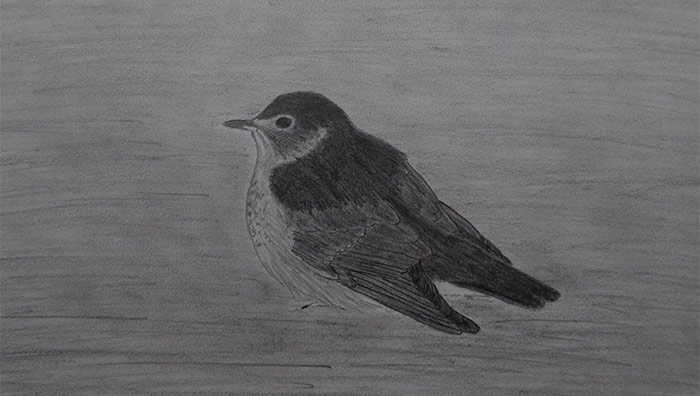
At this point I should say, I whipped out my camera and secured a valuable record shot. Nope. I had truly rinsed my body the previous week and wasn’t fully recovered from a summer surveying in the Dales. Needless to say my back was knackered so I had taken to walking my Longstone patch camera-less to try and heal but still get out birding. Ironically as I left the house camera-less the previous day I said to my mum “I’ve not got my camera so I’ll probably see something haha”. It was a blessing in disguise as I was able to watch and enjoy the moment to its fullest…and it turned out to be all too brief!
The Swainson’s Thrush was sitting in full view on the short grass. Its body was facing left but slightly away while its head was looking back over its left shoulder at the persuing Blackbirds, giving me a perfect side-on view of all diagnostic bits. It was always going to be a young bird but the pale covert tips confirmed that, but anyway stop looking at its wings Will! The face was a thing to behold. Almost Blue-headed Vireo levels of bespectacled buffness destroyed my brain. That, along with similar coloured buff variegation on the cheeks and the lovely concolorous grey/brown uppers ruled out the other species instantly. I had a brief worry about the grey wash on the flanks which was soon allayed upon checking the literature. It was like seeing a new bird really, with my distant memories of spring birds in the states just that.
A few seconds had passed, I think, adrenaline is a funny thing. I continued to absorb the views and began to plan how to get the news out. The bird looked a bit knackered, its eye was pinching in the middle and there was a very slight wobble to it. It looked nailed on! I called my dad, Mick Scott, hoping he could get down for this supreme Longstone tick and perhaps form a line that the arriving birders could observe from. After two failed phone calls I was back to watching the bird as things were looking frisky. The attending Blackbirds were not having it. One adult male faux-mobbed the Swainson’s, nearly hitting it from behind. The air blast from the blackbird’s fanned tail trigged the Swainson’s into life. It suddenly woke up, flew low left and then immediately right out of sight up the main path. I moved to gain a visual on the area but no Swainson’s or blackbirds remained. Eh?! Where had they gone?! At this point I made the dream shout of ‘calling all birders, calling all birders’ on the radio; cue scrambled airwaves and rapidly approaching footsteps.
Frustratingly the bird did not show. I spent two days intensively searching all the accessible and observable sheltered fields, lawns and pinebelts within a decent radius of Carreg Dhu without success.
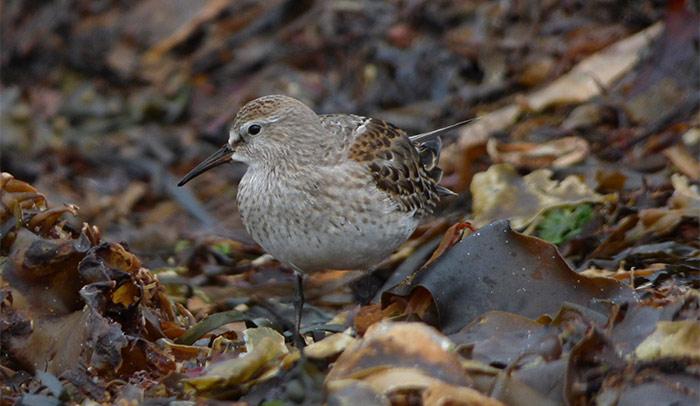
After going round in circles for two days I needed to get away from Longstone. The wind had calmed once again so I was keen to get to Bant’s Carn as the blasting westerlies had stopped any coverage of the site since the Short-toed Lark on September 29th! Like at Carreg Dhu I walked a pre-determined route that covered all the habitats as efficiently and thoroughly as possible. I always end Bant’s Carn on the lower beaches. They’re usually sheltered, covered in seaweed and lit up by any afternoon sun. For me this makes them an irresistible spot to sit and watch. Above the beach is a small pittisporum thicket and I have always fantasised about yank thrushes making landfall there and dropping on the tidal rack to feed. Nevertheless this dream has never come to fruition, but there’s usually some waders and gulls to grill. Today however, as I reached the beaches a drenching shower began, and with nothing obvious in the poor visibility bar some crows, I quickly made my way towards the pittisporum clump. As I did so I flushed a small wader from within the boulders. It zipped away and wheeled up and round, almost like a seabird, with its obvious white rump giving it a storm petrel feel. I had bins on it the whole time, the ID was straight forward, even in flight the structure and facial markings were shamelessy White-rumped Sand. Please land I begged it out loud. Luckily it heard me and pitched down on the beach a few feet from me and ran on to the tidal rack of seaweed. Phew!

Within the next hour and good number of happy but breathless birders enjoyed the ginger belter on this far flung St Marys spot with me. For me sharing a bird is as good as finding it, so it was rewarding to see all the smiling faces, with it being a Scilly tick for many and the first since 2011 for those that it wasn’t. Being such a fresh ginger juvenile meant that it was a plumage tick for many including me – what a beauty!
There’s one final twist in this story. The other day I heard from birder who was staying at Longstone Lodge. They had a very brief glimpse of a thrush that looked to have a catharus underwing near Longstone farm on Sunday 13th. It was exceptionally brief and his subsequent searches proved fruitless. Although I didn’t know about this sighting at the time, my regular searches of that area were also unsuccessful. However it sounds like the bird flew into the only part of Longstone that I can’t get my eyes on – the bottom of some fields that run down from the pine belt that borders Carreg Dhu gardens, about 200yds from where I had the Swainson’s, and a great place for feeding thrushes. If it was in there, it would have never been seen. Even intensive patching has limitations I suppose! Wherever that bird is now, I wish it well!
Will Scott
25 October 2019
Share this story