Finders in the Field: Song Sparrow, Bardsey, Gwynedd, May 2023
Ed Betteridge
I woke just before 0700 and started by opening the nets around the Observatory Garden as I do most days. I knew there was a chance of rain so only opened a few nets and by 0730 I was running around closing them as the rain started. The rain continued in short heavy bursts over the next 45 minutes before finally clearing at 0830 and I reopened the nets. Ringing had slowed down since early May but two Sedge Warblers and a Willow Warbler before 0730 suggested a small arrival. A few net rounds went by, and I had caught a few Blackcaps.
I had just finished a net round when I walked across the back garden and saw what looked like a sparrow or bunting sat on the roof of what is the Observatory Shop. The initial size, shape and colour made me think Reed Bunting, this would have been my first on the Island this year and only the second of the Spring. I lifted my bins and immediately realised this was no Reed Bunting! The bird was well marked and clearly had a ‘sparrow’ like bill. Most of my attention went towards the head and the large amount of grey especially in the strip above the eye. I started to panic, and time seemed to slow; though I felt like I had seen a bird like this in a book before I just couldn’t think what it was.
My first thought was I need a photo of this but with my camera inside I fortunately stopped myself from running for it and grabbed my radio. I knew Steve Stansfield, the Observatory Warden, was in his house which was and the other end of the building the bird was sat on! I radioed Steve simply saying, ‘Steve Obs come into the back garden now!’ Steve quickly emerged but as I saw him out of the corner of my eye the bird flew along the roof and dropped down somewhere behind. I quickly explained to Steve I had seen a bunting which I can’t seem to name but seemed to have grey in the head. Steve said ‘Ortolan?’ which I replied ‘no, I don’t know what it was, but it is f*ckin rare’.
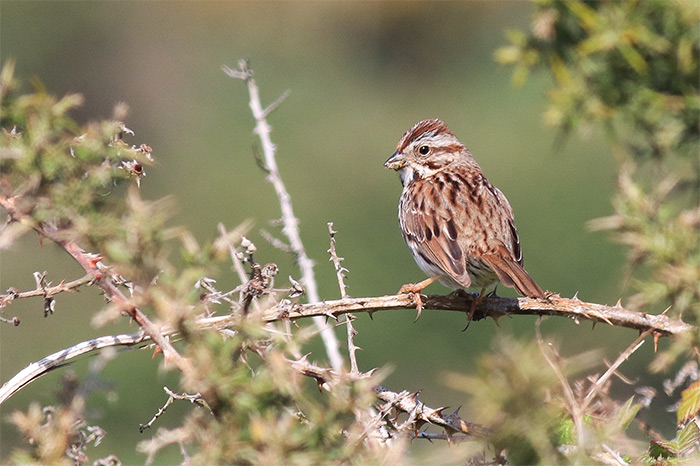
Steve decided to go look for it, as I loaded Merlin Bird ID on my phone and started flicking through Buntings whilst it was still fresh in my mind in case it wasn’t seen again. I quickly excluded most ‘common’ migrant Buntings and was running out of possible options as my brain started to think of Nearctic vagrants. I had just found a Colins guide as Steve radioed ‘Ed come to the School House now’. By now I had also located my camera a ran down to find him. The bird was feeding on the track about 50 metres away and Steve explained how he thought it looked good for Song Sparrow but needed to check it wasn’t a Fox Sparrow. The bird was happily feeding on the track and was slowly making its way away from us. The bird now looked much redder and the grey in the head that I first noticed was a lot less obvious. The bird clearly had a dark malar patch, brown lateral crown-stripes and paler median stripe, broad brown lateral throat stripes and grey supercilium. In flight the bird was dumpy and had a noticeably long, all brown, rounded tail. It was 100% a Song Sparrow!
By now the guests that were staying at the Observatory had also, made it and were watching it. The bird was seen feeding on the track only flying a few metres at a time. After watching the bird for around 15 minutes, it flew up the mountain and landed in a gorse bush out of view.
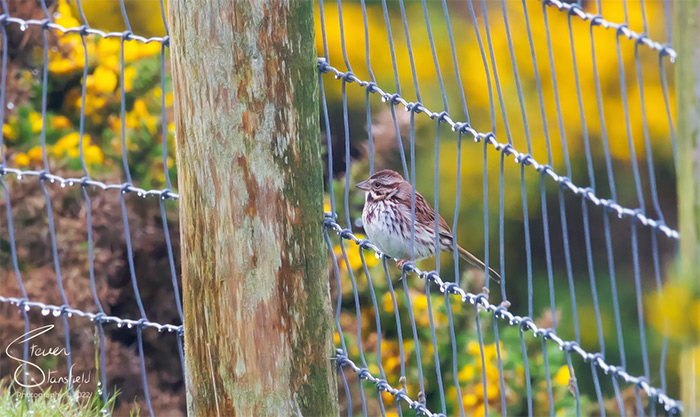
It was now time to get the news out. Being on an Island any twitch comes with some logistic difficulties. Firstly, we needed to tell the boatman Colin and see if a twitch was doable. After finally getting hold of him he agreed to run extra boats that afternoon. The news was released via RBA and almost immediately the phone started to ring, and ring, none stop for the next few hours! It was now 1000 and being a workday not many could get here that day, but many were booking for the next calm day or for the weekend. The next job was to get hold of my fellow assistant Ollie King who had woken up to undertake a Breeding Bird Survey at 0500 and had gone back to sleep due to the rain, only for his phone to die! We finally got hold of him, and by now the bird had been missing for over an hour. We searched with no avail until I decided to expand the search and walk down to the Farm. The track was getting busy with many overnight guests now awake and walking up and down, so I quickly made my way to the quieter areas around the farm. On arrival I saw a bird hoping around on the picnic benches of what is the Café. To my surprise, there it was feeding around under the tables. The bird hoped to a nearby bush before dropping onto a rocky sheep track on the mountain behind. Ollie and Steve’s wife Emma quickly arrived and saw the bird for around 5 minutes; phew, all the birders on the island had seen it! The bird then flew down into a garden where it dropped out of sight and went missing again.
Again, there was no sign of the sparrow for a couple of hours before it was relocated this time to the north of the Observatory where it was happily feeding on rocky ground around another of the houses. Here it seemed more settled, happily feeding on daisy and dandelion heads and at times acting rather Dunnock like as it ran around on the floor and walls. The bird showed well for over an hour in and around the buildings apart from a brief fly around the Wetlands. The bird again went missing for a few hours before finally showing well in another garden at the very Northern end of the Island and eventually everyone who had travelled to the island got good views; phew!
The weather the following day was strong westerlies which cancelled any boats however, there was no sign of the bird and presumably left due to calm clear skies during the night. In total, 23 people manged to get to the Island in time to see it! This was this second record for Bardsey and Wales. The first being from 5th-9th May 1970.
Ed Betteridge
6 Jun 2023
Share this story