Finders in the Field: Siberian Rubythroat, Quendale, Shetland, Oct 2022
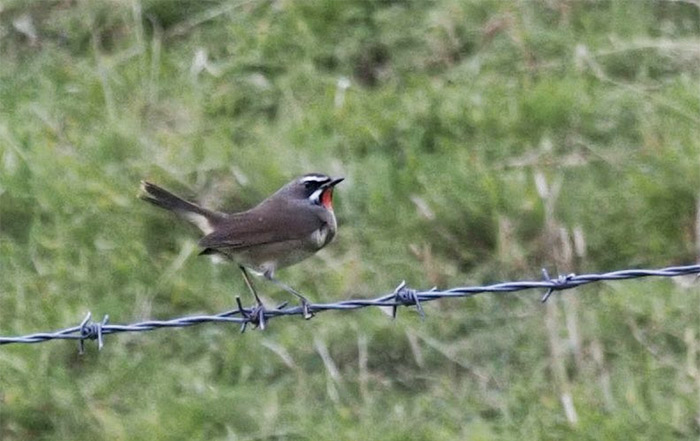
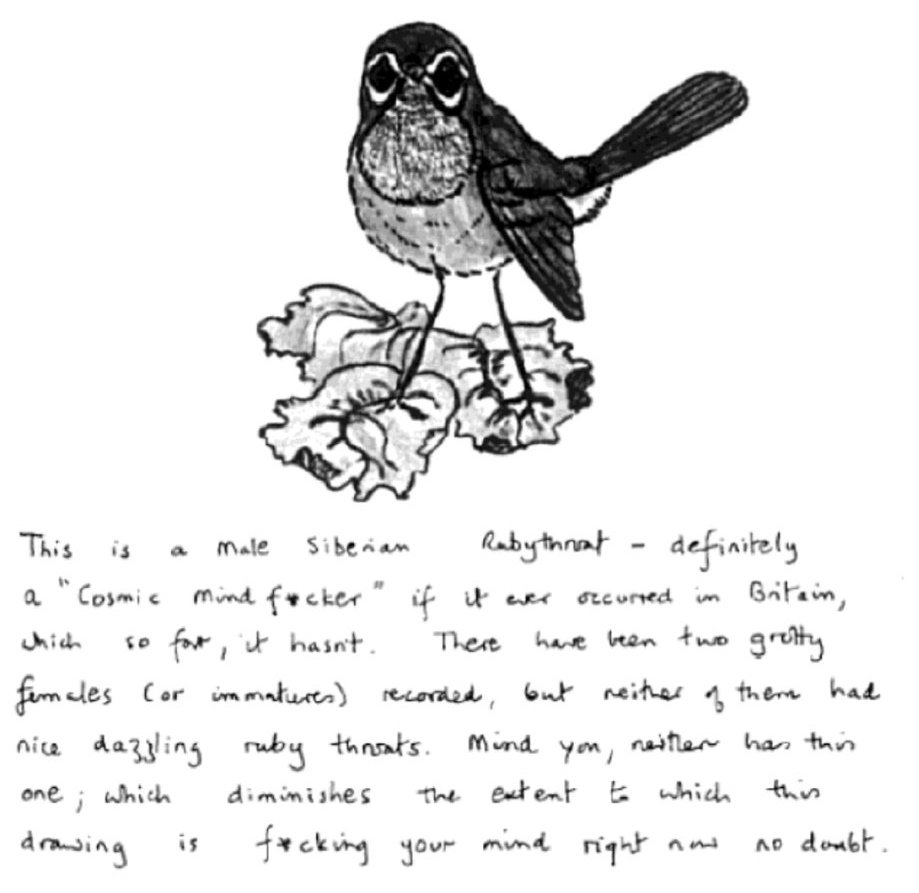
I’ll never forget the first time I heard about the mystical and exotic sounding Siberian Rubythroat. It was the late 1980s, I was about eleven years old, and avidly devouring the contents of Bill Oddie’s Little Black Bird Book, on loan from the local library. This irreverent little book really brought birding to life for me. Using Bill’s ‘self-identification’ key, I decided I was either a ‘Twitcher’ or a ‘Birder’, although emphatically not a ‘Dude’! I daydreamed of exciting weekend-long car chases to twitch ‘megaticks’ the length and breadth of Britain. These were innocent times when there was very little – if any – awareness of our carbon footprint and its impact. Given their stunning appearance and (then) extreme rarity, the book used some very rude words to describe a male Rubythroat, although in those days it seemed that the chances of a stunning male ever turning up in Britain were slim: Bill informed us that at that point only two “grotty females (or immatures)” (!) had only been recorded in the UK. The prospect of clapping eyes on a Rubythroat – in any plumage – in Britain seemed a complete flight of fancy, the ultimate tick/find, a ‘cosmic mind fryer’…or words to that effect!
Fast-forward to 2022 and the middle-aged me had somehow managed to persuade my long-suffering boss that it made perfect sense for me to take four weeks of annual leave and spend them on Shetland in October. Much of my spring had been spent working with another member of the chat family as I’d somehow stumbled across the year’s top UK location for breeding Black Redstarts at a site in East Anglia. Little did I know that during my time on Shetland a vagrant chat species would make the year even more memorable!
Although I first visited Shetland as a teenager to see a Pine Grosbeak at Lerwick in the early 1990s, I, like many others, now visit Shetland regularly with the aim of trying to find rare birds. For me, attempting to uncover vagrant birds on our most northerly archipelago – where anything can turn up – is an adrenalin-filled challenge. Most years I’ve somehow been lucky and managed to bump into something, although usually it comprises just one or two scarce migrants. Rufous-tailed robin (2019) and grey-cheeked thrush (2013) have been my most exciting finds to date. But it is undeniably hard work (‘guerrilla birding’ as Gavin Maclean describes it) and pushing yourself in the field from dawn to dusk (often in crap weather) can be exhausting and frustrating in equal measure. Each year, the ubiquitous barbed wire fences get just a little harder to climb and, given the terrain and distances walked, no day is complete without me falling on my backside at some point.
I’m forever grateful to John Sweeney who organises our Shetland ‘campaigns’, and this year we’d arranged to spend time on Fetlar, Unst and mainland Shetland. I’d got lucky on Fetlar with an American Golden Plover and a Buff-breasted Sandpiper as the westerlies that dominated early October brought in several Nearctic birds. But as these winds continued, it seemed that slim pickings were on offer, and I distracted myself with the finds of others, twitching White’s Thrush, Pechora Pipit, Lanceolated Warbler and the moribund Least Bittern that was taken into care before several of us could get ‘down south’.
I’d managed to lose my keys during my stay and this necessitated remaining on Shetland a little while longer to sort out new keys – a mishap that turned out to be pretty fortuitous…
By week commencing 17th October, John and the rest of our crew had headed home, and I was now by myself in Lerwick, although in regular contact with Ray O’Reilly and Lyn Griffiths. Easterly winds were forecast once more, and things were looking exciting. Migrants were in again in evidence, especially thrushes, finches, Blackcaps and Goldcrests. On 20th October I arrived at Quendale just before 9am and the easterlies were working their magic: there was a Siberian Chiffchaff and a group of Tree Sparrows at the car park. I worked my way slowly up the valley, covering every iris bed (and any other bit of decent-looking vegetation) methodically. Birds were in evidence, with a couple of Garden Warblers, a Reed Bunting, a Water Rail and a Great-spotted Woodpecker all more than enough to keep me going. The quarry on the northern flank of the valley contained another Siberian Chiffchaff and two Goldcrests and I continued, reaching the extensive iris bed above a concrete structure that I now know is called the Rifle Range.
It was just after midday when a plain-looking brown bird flushed briefly about 40 feet ahead of me and given its relatively short tail and fluttering flight my first thought was that it was a Dunnock, a bird I’ve not seen much of on Shetland. I continued towards where it had dived, and a second even briefer view revealed a prominent supercilium, but no more than that. By now it obviously wasn’t a Dunnock, but I couldn’t place it and I started thinking about things with supercilia, Sedge Warbler, even daring to consider Pallas’s Grasshopper Warbler. It flew a third time, now back in the direction of the Rifle Range and I could see that it clearly wasn’t a warbler, but I still hadn’t made much progress with its identification. I managed to get close to where the bird had gone into the irises and staked it out for what felt like a long time but was probably only a matter of seconds before – BANG! A vividly patterned black, red and white head popped up to look at me. We looked at each other. I started shaking. Then I muttered several equally vivid expletives! Here was that mythical Siberian Rubythroat, all those years later and I was in a state of absolute shock!!!
Panic set in and what had been a reasonable morning’s birding descended into jangling nerves as I wanted to avoid a repeat of my Rufous-tailed Robin find in 2019 when I was the sole observer of a fourth record for Britain. The last thing I wanted was to acquire a dubious reputation for finding rare chats that no-one else saw! But getting the news out was going to be less than straightforward as Shetland was suffering a communications blackout – no mobile phone or internet signal had been available all day. I put out a couple of messages on a local WhatsApp group in the hope that communications would soon be restored. The next obvious thing to do was to get a photo. I carry a camera for episodes like this, but I’ve not had a camera very long and unlike those such as the legendary Mush Ahmad, I don’t have that muscle-memory to capture shots when birds briefly appear. The bird had gone to ground again. I walked forward, hoping it would sit up, hoping I’d get a shot of it and then I’d be able to relax. But that wasn’t to be. This time the bird really seemed to have vanished. At that point I made the decision to hotfoot it down the valley into the car and try to get the news out with a phone call – provided I could use someone’s landline. The ladies in the shop next to the Quendale road turning very kindly let me call RBA’s Chris Batty and the news was out – although with no internet on Shetland I had no idea how anyone was going to get the news!
I knew that Roger Riddington lived nearby and after leaving the shop I drove in the direction of Virkie trying to find his house. This turned out to be a complete waste of time as I had absolutely no idea where Roger’s house was and so headed back to Quendale. At the car park I decided to walk back up the valley and see if I could re-find the bird and get that all-important picture. Crazily, as I reached the Rifle Range, the Rubythroat flew up in a split second and jauntily landed on the roof of the concrete ‘hut’ before dashing back behind it, pretty obviously annoyed that I was back to bother it. For the second time that day I was face-to-face with a Rubythroat – another heart-stopping moment. But again, the bird was just too fast for me to get a picture. The bird appeared to dive into the small patch of nettles behind the Rifle Range, and I hid myself in the irises not far away, camera poised. Once more, however, the bird had no intention of being photographed. At that moment, looking down the valley I saw Roger’s car arriving in the distance. I then abandoned all thoughts of stalking the bird and stood up, waving frantically in the hope that I might be seen – mobile and internet was still down. It seemed at that point that several people all appeared at once and it wasn’t long before there were about a dozen of us walking the iris bed.
We scoured the valley for what felt like hours with no luck, and it looked as if this was going to be another single observer episode with me likely to be saddled with that “you should have been here five minutes ago” reputation. We’d covered pretty much all of the iris beds and the general atmosphere was one of disappointment and aching limbs. By now the communications blackout across Shetland had lifted and others, including Dan Brown and Dan Pointon, had arrived. We covered the main iris bed again, but several people had lost faith at that stage, and it seemed that the bird really had vanished. When a smaller group of folk decided to walk further on up the valley away from the main iris beds, I wished them luck but I was just too tired (and deflated) to go any further. By now, I was just moping around, asking myself why this rare bird finding lark was so fraught with stress and frustration. More people were arriving, but my glum expression gave them all they needed to know. A while later my phone pinged in my pocket, and the message I read sent me almost delirious with relief - I just couldn’t believe what I was reading – Matt Bruce had re-found the Rubythroat at the top of the valley and a stunning picture from Dan Brown came through!!! I can’t describe that relief (in fact, a kind of dizziness) I felt at that stage. When you’re lucky enough to stumble across something rare you really want others to see it and to share that excitement, otherwise the whole occasion is slightly tainted. Ray and Lyn (who both saw the bird) joined me for a celebratory meal in Lerwick that evening, and I went back to my digs completely unable to sleep!
Despite the copious amounts of beer and lack of sleep that night I was somehow back out again the following morning for another full day’s birding. Now for Siberian Blue Robin!!!
Andrew Tongue
15 Nov 2022
Share this story