Finders in the Field: Brünnich’s Guillemot, Holkham & Wells, Norfolk
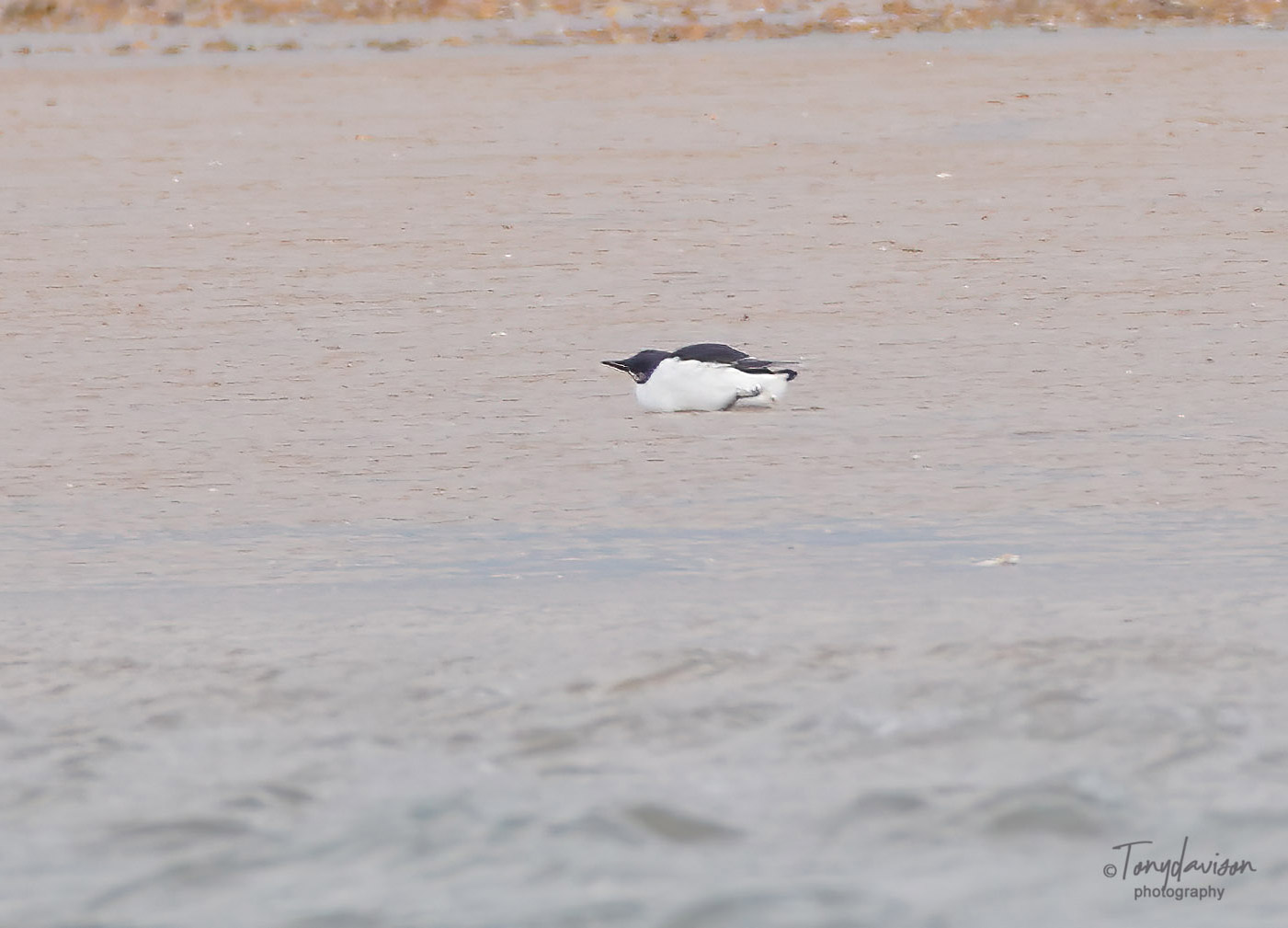
The weather forecast was not looking too good for the group I was due to lead on one of my regular three-day North Norfolk birding tours on 26th-28th November, with Storm Arwen due to hit us particularly on the Saturday and Sunday. I thought Friday 26th offered the best chance of us getting out and about, and I was hoping to head for Holkham to try to show them the Shorelarks. But when I picked the group up first thing on Friday morning, it was already drizzling heavily with a very blustery SW wind gusting over 35mph and it felt like we would have to head for some hides somewhere else, just to get out of the weather.
There had been a Black-throated Diver reported late the previous day off the quay in Wells, so I thought we could go and have a look for that before committing to a change of itinerary. After driving up and down past the quay, I spotted a diver in the channel but could immediately see it was actually a Red-throated Diver. Still, we found somewhere to stop and braved the rain for a closer look. The drizzle seemed to be easing a little so I decided we would have a go for the Shorelarks next, as it seemed like our best opportunity. It was very lucky I did!
It had stopped raining by the time we got to Holkham. We made our way slowly out to the saltmarsh, with several stops on the way, and it was quite sheltered in the lee of the pines as we stopped to watch the Shorelarks. It was around high tide now, and I could see through the gap in the dunes beyond that the sea was not too rough, though there was a good swell running. I wasn’t sure what we would be able to see in the swell, but I figured we could get into the shelter of the dunes and at least have a look.
It was hard to get onto anything which was any distance out, but we quickly added a selection of sea duck to the trip list, as well as more Red-throated Divers and Great Crested Grebes. I was scanning with the scope, hoping for one of the rarer divers or grebes which have been here recently, when I had a glimpse of a dark-headed guillemot just behind the breakers way off to the west. I had been seawatching at Sheringham for 4 hours on Thursday morning and had seen a couple of dark-headed auks flying past there, but despite looking more closely just in case they might be Brünnich’s Guillemots, they had unsurprisingly both turned out to be Common Guillemots. I figured this was just another of those and resumed scanning.
A little later, I was just trying to get the group onto a Black-throated Diver which was diving constantly just offshore in front of us, trying to find it again through the scope, when the dark-headed guillemot appeared in the foreground as it rode over the crest of a wave. It was only in view for a second, but my heart skipped a beat – it looked just like a Brünnich’s Guillemot!
I tried to follow it and watched it ride over another wave and my first impression was reinforced. It was jet black above, with a largely black head with white speckling limited to the throat. The shape was wrong for Common Guillemot, rather hump-backed, with a more angular head which was pulled in making it look neckless. The bill was very short and I thought I could just see a hint of a pale tomium stripe, though couldn’t entirely rule out that being the effect of the light on such brief views.
Well, that wasn’t in the script! Guiding today - see the Shorelarks at Holkham, then out for a quick look at the sea. Just trying to get the group on a BT Diver when an auk pops up in the foreground - BRUNNICH’S GUILLEMOT!!! pic.twitter.com/yXi5WkFanW
— Marcus Nash (@norfolkbirdtour) November 26, 2021
I was aware of BRRC’s historic scepticism regarding reports of Brünnich’s Guillemot in Norfolk and I knew immediately I had to get a photo or I would not be believed, but it would be impossible in these conditions. I thought my best bet would be to try to get some video through my scope so after one more brief view, I took my phone out and tried digiscoping. Thankfully I managed to keep on the bird as I put the phone on and managed to get about 8 seconds of video before I lost it in the scope view.
At the same time, I tried to get the group onto it – explaining where it was, what to look for and attempting to convey the significance. All the time the bird was being carried very quickly east on the running tide, but several members of the group had scopes and between them all, everyone got a look at it before we lost sight of it.
I finally had a chance to stop and think, and I realised I had actually only seen the bird through the scope for a few seconds, as it rode up out of the troughs. Now I started to doubt myself – had I really seen what I thought or had I imagined it? A Brünnich’s Guillemot in Norfolk – it didn’t seem possible. I checked my phone and I had at least managed to capture some video of the bird while it was in view, so somehow, with shaking hands, still out on the windswept beach, I went through the video and took a screengrab. Not great, but it looked reassuring, so realising the enormity of the call I thought I would send it to a few people with the question ‘Am I going mad?’. It didn’t help that, having upgraded my iOS and WhatsApp the day before, I somehow managed to send the message set to delete straight after viewing! The upgrade also appeared to be the last straw for my phone’s battery, which had gone straight down to 1%. While I wrestled with it, trying to work out how to send another, non-deleting message, expecting my phone to die at any second, I started to get some positive feedback. At the same time, Ash Saunders appeared with his group – I walked over and showed him the videograb, and he reassured me that I wasn’t going mad too.
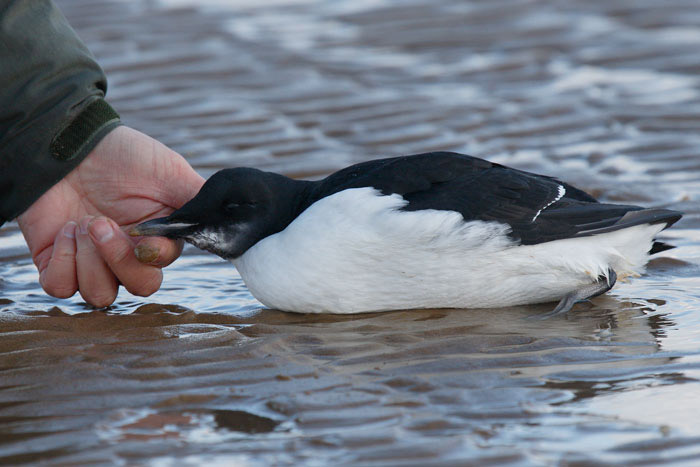
The last time we saw it, the Brünnich’s Guillemot was being carried straight towards the channel into Wells Harbour. From where it was, it would take quite a bit of effort for it to get further out and round the sandbar beyond and it had not done anything as it was carried past us on the tide – it looked pretty exhausted. I figured it would probably be in the harbour, so I put the news out straightaway in the hope that it would get refound. Then still in a state of disbelief, we walked back to Lady Anne’s Drive.
As I had suspected, it didn’t take too long for Mike Buckland to refind the bird in the harbour, so we drove round there for another look. It didn’t look well now and was fairly quickly beached on the sand by the receding tide. Mike managed to arrange a boat to head over to investigate, and I decided to take my group over too. Unfortunately given the tide, the boatman couldn’t get us close enough to the sandbar, so while we were dropped back by the outer harbour Mike and Steve Gantlett were taken over to the other side further back up the channel and walked out beyond East Hills.
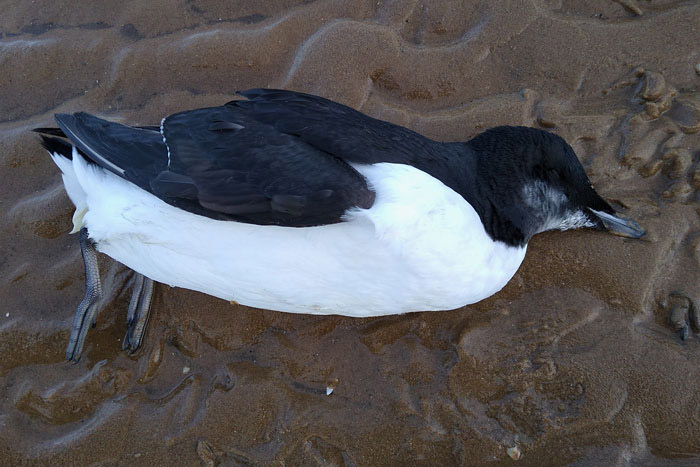
My group and I stopped for lunch and a coffee break at the Beach Café, and fairly quickly we started to get updates from Mike and Steve. The bird was moribund and soon after the news came through that it had passed away, only about 3½ hours after we first saw it. A very sad ending for an amazing bird.
This is the first confirmed record of Brünnich’s Guillemot in Norfolk, and only the fifth for England (one of which was already dead when found). There have been two previous claims in Norfolk, both birds seen flying past Cley, which were submitted to BBRC but were deemed ‘Not Proven’. At least in part this was apparently because there was no evidence that Brünnich’s Guillemot occurs in the southern North Sea, and this stance has undoubtedly discouraged other reports. Clearly Brünnich’s Guillemot can occur here! Interestingly the Norfolk bird appeared before Storm Arwen struck, bringing with it an unprecedented series of reports of Brünnich’s Guillemot over subsequent days.
Marcus Nash
2 Dec 2021
www.birdtour.co.uk
Share this story