Finders-in-the-field: Baillon's Crake, Seahouses, Northumberland

My wife (Ann) and I had just spent two weeks on the west coast of Scotland and stopped off in Northumberland for a couple of days on our way back to Sussex. The first day was mainly spent on Holy Island, which was pleasant but not very successful bird wise. The next day, we decided to go on a boat trip to Coquet Island and check a few others areas nearby.
The day started well with us seeing the drake Baikal Teal at Druridge Pools and an Otter at Cresswell Pond. I had seen one Baikal Teal before, a 1st Winter male at Minsmere in 2001, but this was a far more handsome individual. The Coquet Island boat trip was also excellent, with good views of Puffins, Arctic and Roseate Terns.
Having heard about a male Garganey at Monks House Pool, near Bamburgh, we decided to finish the day off with a quick look for this. When we arrived at the pool, an initial look failed to find the Garganey. I guessed that it may well be hiding in the vegetation, as they can be quite skulking. Twenty minutes later, having spent most of that time looking for and failing to see the duck, I thought one last scan with binoculars around the edges of the pool and then we would leave. I spotted, what I assumed, was a Water Rail, preening at the edge of the pool. I put my telescope on it and immediately thought, ‘this seems small’. When it’s head became visible and it did not have a long red bill, panic set in – it was either a Baillon’s Crake or a male Little Crake! I have seen a few Little and Baillon’s Crakes over the years, mainly on trips to the Middle East, but none for over twenty years. The last Baillon’s I had seen, was at Grove Ferry in 1999. I tried to remember the key differences and recalled that Baillon’s did not have a red base to the lower mandible and it’s wings were shorter. On this bird, there was no red base to the pale greenish bill and the primary extension did seem quite short.
BAILLON'S CRAKE at Monks House Pool, Northumberland. After a bit of a wait it showed for a few minutes@BirdGuides @RareBirdAlertUK pic.twitter.com/n4eNbqZXQu
— Owen Beaumont (@OwenBeaumont1) June 5, 2019
I thought that Ann should try and get an image of the bird, with her camera, and quickly pointed out where it was. Unfortunately, when I looked through the telescope again, it was gone. I wasn’t sure how long I had watched it. It may have been a minute, or it could have only been a few seconds – time had stood still. I checked the Collin’s Bird Guide App on my phone to see what else was diagnostic. I had noticed that the upperparts were quite well spotted, with white, but I had not really noticed the leg colour, or how well barred the lower flanks were. I telephoned Rare Bird Alert and left a long rambling, probably quite incoherent, message, basically saying there is a probable Baillon’s Crake at Monk’ House Pool, but, I had not completely eliminated Little Crake.
I stayed for about two hours after my original sighting but, did not see it again. I did eventually see the Garganey, but, if it had been easy to see, I would not have found the Crake. I will be forever grateful to that skulking little duck.
Richard Kelly
10 June 2019
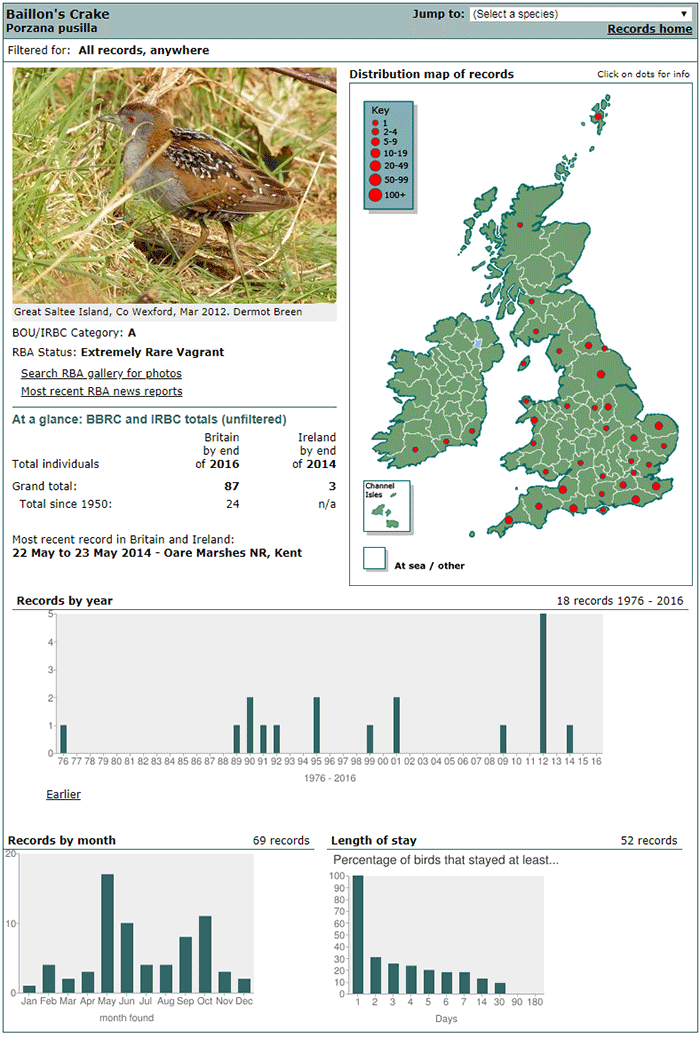
Baillon's Crake in Britain and Ireland
Accepted Baillon's Crake records in Britain and Ireland. Taken from our Previous Records Database. Please note: subscriber only features and links have been disabled in this graphic.
Share this story