Finders-in-the-field: Western Orphean Warbler, Bardsey
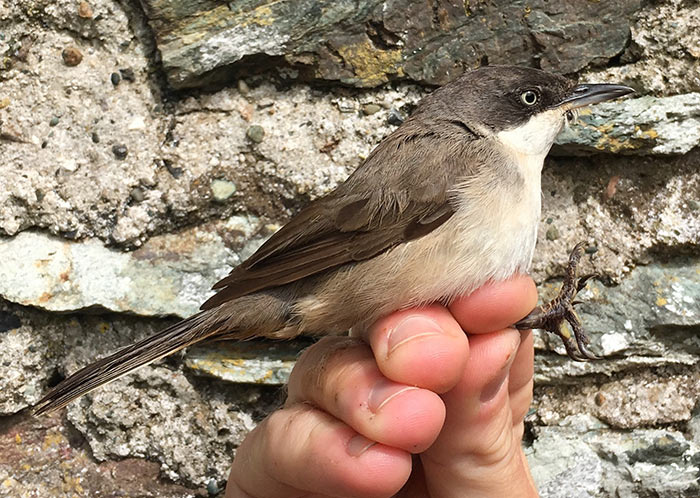
Sunday is usually a half day for staff at Bardsey Bird and Field Observatory (BBFO), and I had been up later than usual the night before, as I planned to lie in until 8am or 8:30 before doing some bits and pieces birding wise. The weather hadn’t looked promising, just gentle northerlies for the last couple of days, and clear skies with no strong winds for over a week, so I wasn’t too fussed about going all out birding round the island. However, my plan to wake up at 08:00 was thwarted when Lewis Hooper, my colleague and contemporary Assistant Warden knocked on my door at 07:20 and said, “you ought to get the nets open, there’s a few birds around”. I (somewhat reluctantly) got up and had the nets open by 07:35 and waited for the birds.
Caught at 10:40, 19/05/19, Cristin Garden
Weight-19.4g
Wing length-73mm
Wing point-P3/4
P2=6/7
Fat/pectoral muscle: 2/2
I was quite happy with the few birds that were caught, of them was a very red Lesser Redpoll, and the odd Sedge Warbler, Whitethroat etc… At around 10:30, Lewis had returned from his morning bird census and asked if he could join me with ringing, of course I said “yes, mate!”, and that I was doing a net-round in about ten minutes. I find it funny now, how I had no idea that this would be a net-round that would probably stick in my memory for years to come, and the story of it will be boring my friends for possibly even longer, when a lot of the details have faded away.
Lewis got on with the net round ten minutes later, and I went to catch up with him (I needed the loo beforehand). At BBFO the nets are set up in numbered order, 1-4 being to the north of the garden, 5 in the middle, and 6-9 at the south end of the garden. I hadn’t opened 1 and 3 so I walked straight to net 5 to find Lewis, who was not there yet. I walked to the top of the steps and saw from a distance a Dunnock, and what I assumed was a Lesser Whitethroat, I took a few steps and picked up the pace as some confusion set in. As I got a bit closer, it was the size of the warbler in the net that struck me most, it looked massive, what is that?! I got to the bird and I imagine I went a bit pale, staring at me was a characteristic eye. I got the bird out the net and said to myself, “what is going on? Have I gone mad, or is this an Orphean Warbler?!” sheer disbelief was the leading emotion. I quietly but urgently called Lewis “Lewis… Lewis!”, I heard him say “uh oh” before appearing around the corner. Then I said to him “what’s this?”, and credit to him, without hesitation he shouted, “mate, that’s a f**in’ Orphean Warbler! Check under the tail!” after a brief look we decided we better move on. We got the bird in a bag and just laughed at what was happening! Absolute madness! I have never felt quite like that before! We hurried round the rest of the nets...
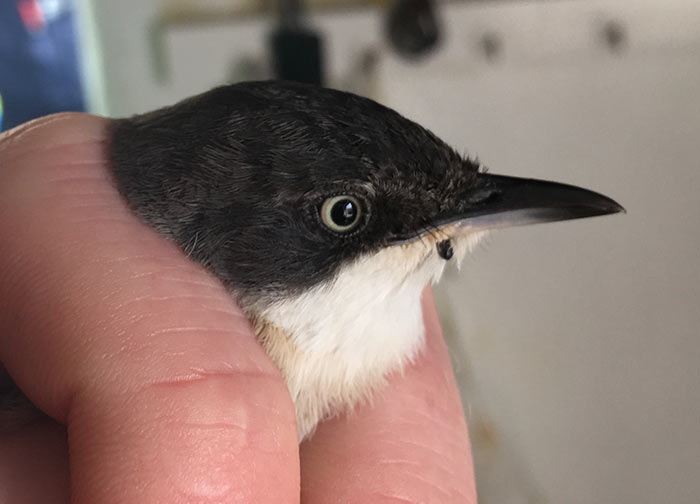
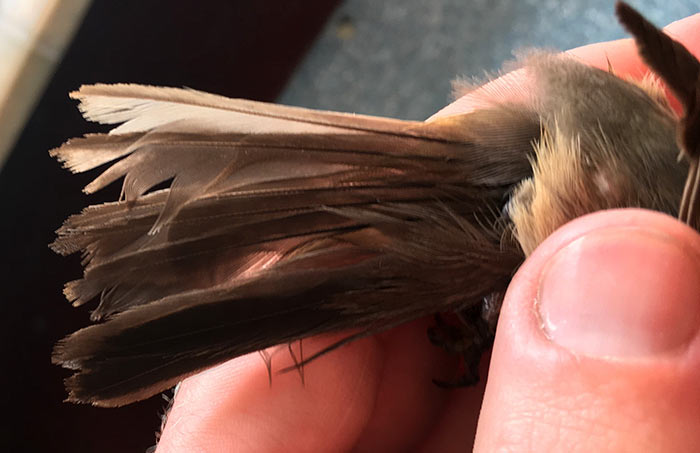
Some visitors had come to the Observatory to have a look through the moth trap, we told them we were going to ring some birds first and then we’d be right out! We also added that they may want to watch, for general interest and also because they may well never see one these birds in Britain again! We got through the Chiffchaffs, re-trap Dunnock etc, and moved onto ‘the beasty’. Out of the bag, the black head, contrasting with the white throat made up a quite a distinctive male bird, and that eye! The pale iris and the black pupil… Brilliant! The undertail coverts (UTCs) were wet, but even back at the nets, the general impression was of a Western Orphean Warbler, generally buff coloured underparts and no visible chevron markings to the UTCs. Indeed, after a closer look back at the ringing hut, by all accounts this appeared to be the case, plus it was the more likely of the two Orphean Warblers after all. After identifying it, I fitted a B ring (as it happens, that is the first B ring that I have used at the Observatory since arriving!). Then we had a closer look and took some photos, my limited experience with the species meant that I definitely required some literature, so I consulted the Demongin guide. The bird looked to be in its second calendar year (age code 5), based on the tail and greater coverts. One mistake we initially made that I want to address; the tail being an indicator to distinguish between ‘Eastern’ and ‘Western’, ‘Eastern’ having a notch in the white marking on T6 is generally only accurate on adult tail feathers, not on ‘our’ bird’s seemingly first-generation feathers, so we retrospectively took that factor out of the identification process, especially as a diagnostic feature.
This was a learning curve, and with the warden, Steve Stansfield, a very experienced A ringer, being away, Lewis and I had to muddle together our knowledge and do what we could in a very exciting situation! In all honesty, I was happy I remembered to ring it, and that I didn’t have a butter fingers moment, as my hands were genuinely shaking!
After we had taken plenty of photos and let it go, we went inside to message Steve a photo. He had joked a couple of weeks ago about how something like this could happen with him leaving the island in May, but what are the chances that something like this would happen! He put the news out on the Twitter page and started to get enquiries almost instantly!
After the bird was released it was unfortunately never again located, a couple of birders came over to the island to have a go at seeing it, but to no avail. This species breeds around the Western Mediterranean, latitudinally as far north as Southern France, and about as far east as Italy. It then winters south of the Sahara, so not a hugely long-distance migrant compared to some other warbler species. This was the 6th record for Britain, 2nd for Wales and 1st for Bardsey and the ringing highlight of a lifetime.
Sam Prettyman
May 2019
Share this story