Finders-in-the-field: Marmora’s Warbler, Baliasta, Unst, Shetland

After three days of what had felt promising south-easterly winds, whilst our garden had played host to a singing male Bluethroat, it’s fair to say that the numbers and variety of grounded migrants had proved more than a little underwhelming. Overnight to the 14th there had been a splash of rain, and perhaps just as importantly, a classic reversal in the wind direction to a north-westerly that sometimes seems to stop northbound Spring migrants in their tracks.
An early morning visit to Skaw produced a Lesser Whitethroat and a Willow Warbler, so although there were still far more perches than birds, by this Spring’s standards, it almost amounted to a fall! A walk along Lamba Ness added a female Pied Flycatcher sat along a fence-line that added to my suspicion that there was a thin scatter of migrants grounded across the island. In fact, there then seemed something for every birder active on the island, with a succession of messages received relaying news of another Pied Flycatcher, a Spotted Flycatcher, a male Red-backed Shrike, a male Bluethroat, a Sedge Warbler and a Marsh Warbler.
As the migrants included some clearly bound for Scandinavia, I’d mentioned to Brenda the possibility that we might find a Rustic Bunting having found two Spring birds on Unst in the last three years. Unbeknown to me, whilst leaving me to check a garden or two, Brenda had refreshed her memory of what to look for by taking a quick look in the Collins Guide that was in our car.
We’d taken a long walk around Haroldswick and then visited Burrafirth but had seen very little. It was already mid-afternoon by the time that we headed for Baltasound. Birders were present at all three of our first intended stops so we deviated from our planned route but again saw very little at the sites that we checked. By late afternoon we decided to make the gardens along the road to Baliasta our last port of call for the day. We’d checked the gardens from the Manse to the Cemetery that will be familiar to many birders being the area which the Cape May Warbler frequented in the Autumn of 2013. We were back in the car heading for Houlland when Brenda suggested that we take a look at a small sunken garden enroute that looked something of a suntrap in the late afternoon sunshine. Having been out in the field for nearly 12 hours by then, I was flagging, and I almost didn’t bother to stop …
… I parked the car, and walked across the road to the dry stone wall opposite with the sun behind me. From immediately the other side of the wall, a tiny long-tailed Sylvia took flight, and with a typically weak and jerky flight it set off low across the rough grass towards the wall the other side of the c.30m wide field. Its jizz was that of a Dartford Warbler but its plumage appeared a uniform paler grey - even in that short flight - the possibility of it being a Marmora’s Warbler flashed through my mind. It landed on the wall, perfectly lit by the sun, and basically appeared all slate-grey save for its darker lores, red eyes, pinkish base to its bill and orange legs… and then it all too promptly hopped over the top of the wall and out of sight down the other side. Of all the miles of dry stone wall to walk up to, I’d literally had the good fortune to choose the correct square meter of wall to do so!! Despite the whole encounter lasting just a few seconds, I shouted to Brenda that it was a Marmora’s Warbler, and for her to grab her camera. She rather calmly but reassuringly replied ‘oh, the all grey one with a red eye and orange bill & legs’ that rather took me by surprise, as she seemed to know as much about the species that there is to know – it transpired that whilst looking for Buntings in the Collins Guide, the Sylvias had caught her eye, especially Marmora’s Warbler, as it had an unfamiliar name that she’d never heard me mention until now!

I still don’t recall how I sprang over the fence/wall combination and crossed half the field in pursuit, but as I cautiously crept the last few meters with camera poised, unbelievably there was no sign of it. I’d seen exactly where it had disappeared, and had remained transfixed, hopefully ensuring that I didn’t miss it fly again. I rechecked along the wall but there was still no sign of it. As I looked up I could see walls stretching away into the distance in just about every direction. Surely we weren’t to be left without any further views or images of it. Initially I was almost at a loss as to know where to look. The sunken garden itself has a few rosa rugosa bushes so I considered that the best place to start. I’d made my way halfway across the field towards them, when much to my relief it flew right past me heading in the same direction! It landed on some bare earth and hopped, tail-cocked, into the depths below one of the bushes. Still no images, but it soon worked its way up through the bush and perched briefly on the adjacent wall allowing for more views and we both quickly rattled off some images. It disappeared over the wall and out of sight again. I checked my images, and whilst confirmatory, the camera settings weren’t great being on a very high ISO.
We walked the wall, but again, it had vanished in front of our eyes. We again checked the sunken garden and the immediate surrounding walls but there was no sign of it. Effectively we’d had two very brief encounters, but then completely lost it.
I explained to Brenda that Marmora’s Warbler had recently been split into two species, and that we needed to eliminate the, albeit unlikely, possibility of it being a Balearic Warbler. Our first edition Collins Guide pre-dated the split and I was struggling to recall the features of Balearic Warbler. My own recollections of them from Mallorca was that they were paler, more silvery-grey in appearance compared to the only Marmora’s Warbler that I’d seen being the first-summer male at St. Abbs in 1993 that I’d considered was darker, more sooty grey in appearance. I’d already noted that ours was also showing some brownish hues to its upperparts, and particularly its wings, which I was fairly sure I could recall helped aged the St Abbs bird as a first-summer.
With no mobile phone signal we drove to Houlland where we knew we would obtain a partial signal. Already approaching 6pm I didn’t think anyone would thank me for not putting the news out whilst we further considered the unlikely possibility of it being a Balearic Warbler so Brenda used her smartphone to transfer a couple of ‘back of the camera’ shots along with an appropriate caveat that we didn’t have any literature with us re Balearic Warbler onto the Shetland Whatsapp system. With the lack of bandwith available it took nearly 10 minutes for each shot to upload to Whatsapp despite Brenda’s arm being stuck-up in the air out of the car window!
In the meantime I spoke to my father, John Cooper, and he very quickly checked the Sylvias Helm Guide. The combination of its small white malar and dark throat swung it firmly in favour of Marmora’s although I could tell that he was slightly perplexed by me describing its underparts as showing some buff. I then phoned Brydon Thomason and pretty much just said ‘Marmora’s Warbler, Baliasta, get here!!’ After a few expletives he said that he was about to take his son, Casey, to a youth club commitment but they’d now make their way via Baliasta… JFC then called me back to read me the text in the Helm Guide relating to a first-summer Marmora’s Warblers that stated ‘underparts more solidly coloured but, compared to adults, slightly duller and buffier overall’. Hence, nothing at all seemed amiss for it being a Marmora’s. I then called Roger Riddington whose initial reply was a simple ‘bloody hell…’ I ran through the identification features that we were using and his words were something along the lines of ‘it sounds like the job is done, I’d love to see it, please stick with it until 9pm as I should be there about then…!’ Whilst speaking to Roger the first Whatsapp message complete with photo pinged through. Paul Harvey soon phoned and ran through the features of Balearic & Marmora’s Warbler. Someone also took the trouble to send to Brenda’s phone the complete Surfbirds article dealing with the identification of the two species written by Brian Small.
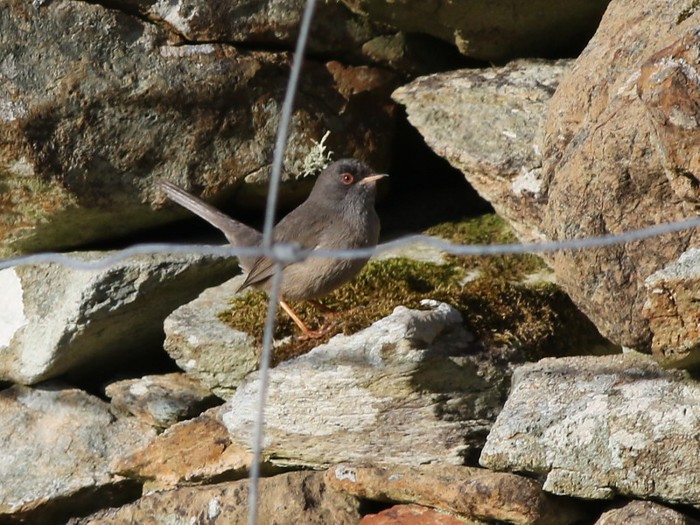
Of course, by now, we wanted to return to the site to try and relocate and watch the Warbler and we simply didn’t have time to reply to all of the incoming congratulatory messages. We returned and Brydon, Casey and Robbie Brookes were already there. Thankfully Brydon and Casey had obtained views of the Warbler but it had done its, by now, usual vanishing act over the top of a wall. However, it didn’t take long for it to reappear just prior to Al Conlin arriving. Brydon had helpfully brought his copy of Sylvias that on seeing the plates only reinforced our view that it was a Marmora’s. Whilst elusive, it seemed to have a discrete circuit feeding in and out of nooks in the dry stone walls. It helped that it was a lovely sunny, warm and calm evening. Brydon & Casey left for the youth club beach clean-up, Brenda headed home and Al did likewise to tend to a chicken that he’d left cooking in his oven!
Robbie and I both decided that we would remain on site until 9pm but then we received the news that Mark Warren had found a Black-faced Bunting at Norwick! Dilemma, we decided that we just had enough time to take a look for, and hopefully see it, but still return to Baliasta before the birders arrived from the mainland. We failed to find the Bunting but did arrive back at Baliasta, along with Brydon, just before Pete Ellis, Paul Harvey, Dougie Preston, Roger Riddington & Paul Sclater arrived off the ferry. A tense wait ensued, but just after the sun dropped below the hillside, the Warbler obliged. It then gave its most prolonged and close views to the assembled small group of observers who in turn where giving a few ‘oohs and aahs’ in appreciation. It gave a few quiet calls comprised of short, hard, slightly slurred and scolding ‘chak’ notes strung together - very different to the long drawn-out churring call of a Dartford Warbler. It also gave what two former members of BBRC considered was ‘a clear response’ to a short playback of the song of Marmora’s Warbler – Brian Small’s article suggested that neither species reacts to the playback of the other’s song. It then flicked into a garden that offered plenty of suitable cover for it to roost and all the observers left the site.
The birders from the mainland were effectively stranded on Unst so a couple of them stayed at ours and the malt whiskey flowed in celebration. I was so wired that I was still awake at 1am and it was proving a calm, clear and very bright night - unfortunately there was no sign of either the Marmora’s Warbler or the Black-faced Bunting the next day.
Very many thanks to JFC, PVH, RR & BHT for openly sharing their expert opinions with us, and indeed to everyone for making it all the more memorable an occasion.
David Cooper
21 May 2018
Share this story