Finders-in-the-field: Dusky Thrush, Whalsay, Shetland
Shetland winters are not for the faint hearted! Named - and un-named - storms rip through the islands with monotonous regularity and even when they blow themselves out there is often rain and poor light to contend with. But occasionally, just occasionally, we get a day of "proper" winter weather; calm, clear, frosty conditions. Such a day was 5th December and as I had Archie, an elderly but still energetic Jack Russell, to walk, I decided that a yomp round Skaw Taing, the most northerly and easterly part of our island of Whalsay, would make the most of the day, with exercise for man and beast and a little gentle birdwatching and Birdtracking thrown in. It's probably my favourite walk on the island, despite the fact that since 1976 it has also been the site of "Britain's most northerly golf course". The sea is on three sides, and although treeless, the generally short turf is great to walk on. Over the years it's produced a few interesting birds such as Buff-breasted and Pectoral Sandpipers, Dotterel, and Sabine's Gull whilst earlier this year an adult White-tailed Eagle briefly toyed with the idea of getting Archie on the menu!
The walk got off to a good start with Whooper Swans and 4 species of duck on the North Loch. A few Fulmars were back on their breeding ledges whilst offshore were into the teens of Black Guillemots and 19 Great Northern Divers, some of which were giving their haunting calls. Passerines were few; small flocks of foraging Starlings, the odd Shetland Wren and some Rock Pipits on the wrack heaped up on the beaches with the only migrants singles of Fieldfare, Blackbird and Redwing.
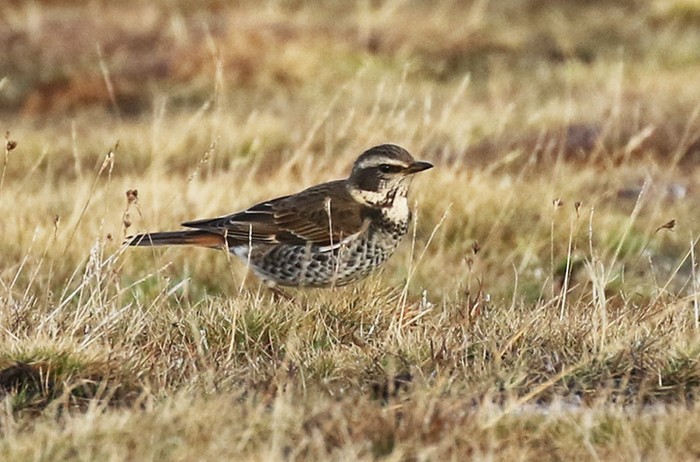
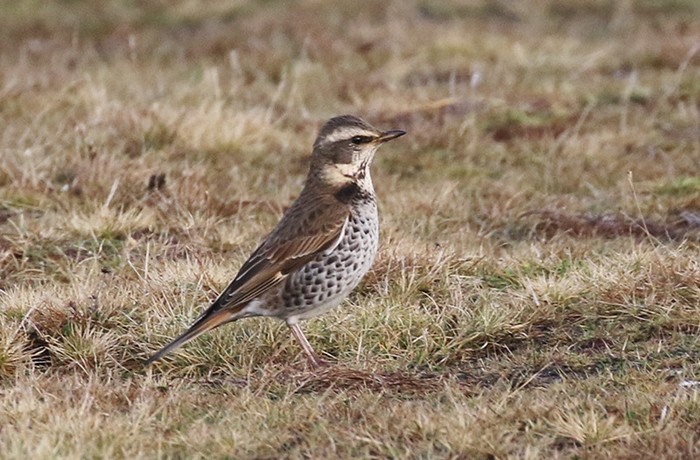
At 11.45 I had just about finished my circuit when, as I approached the first tee, a thrush flew from the edge of the track and landed about 50 metres away. I raised my binoculars expecting another Redwing but was amazed to see that it was in fact a Dusky Thrush. It was perhaps a little larger than a Redwing, somewhat darker on the back due to some dark centres to mantle feathers but most strikingly it had creamy yellow supercilia, chin, throat, upper breast and sides of neck whilst there were black chevrons along its flanks and forming a band across its lower breast.
I phoned John Lowrie Irvine (JLI) a really keen Whalsay birder and also put the news on the Shetland birding app.
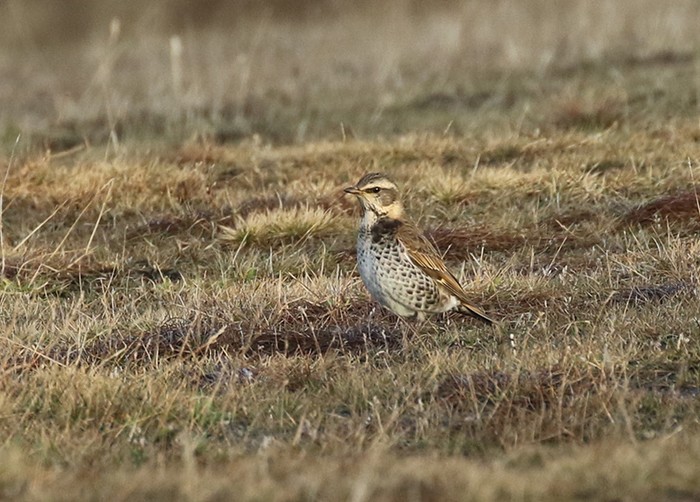
JLI was scanning Eider flocks at the other end of Whalsay where they congregate around the salmon cages. To paraphrase, I suggested that he should get himself to Skaw pretty smartish but as he was some distance from his car I had an anxious wait for him to arrive and get his eye on the bird. Happily it gave good views and JLI got excellent photos before the bird suddenly flew off and disappeared. It took us a while to relocate it further out on the Taing, and it continued to be flighty. We last saw it at about 13.30, just as the only 2 Shetland Mainland birders who had been able to make it came into view. Unhappily for them, they missed it by seconds as, possibly spooked by a low-flying Starling, it lifted and flew off South East, disappearing behind a knoll.
We didn't see it again.
The photos show a contrast between the moulted, inner greater coverts with rufous edges and unmoulted outer feathers suggesting it was a first winter bird.
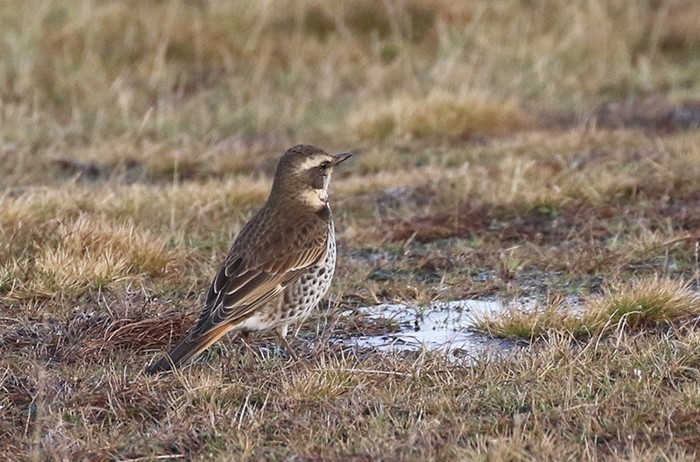
This was the fourth record of Dusky Thrush in Shetland and my second, as I was lucky enough to see the 1975 Firth bird. Interestingly one on Whalsay in September 1968 was found by the late Johnnie Simpson, JLI's grandfather.
Brian Marshall
20 Dec 2018
Share this story