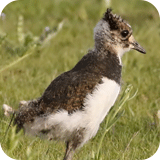
Farm-calendar rules leave nesting waders exposed across Britain
Fifty years of nesting records show that fixed farm-management dates fail to match regional and species-level differences in the breeding seasons of Lapwing and Eurasian Oystercatcher.

Fixed national dates used to protect nesting waders on farmland are often out of step with the birds' actual breeding seasons, according to new UK research.
The study brought together 50 years of nesting records spanning approximately 1,200 km of latitude. Its final analysis included 6,277 Lapwing nests and 2,387 Eurasian Oystercatcher nests, drawing on information from the BTO Nest Record Scheme and research projects run by the RSPB and Game & Wildlife Conservation Trust.
The start of nesting differed by as much as six weeks between the two species. Latitude mattered too, but not in a uniform way: Lapwings tended to nest later farther north, while Eurasian Oystercatchers started earlier, with dates shifting by as much as three days for every 100 km.
That variation creates a problem for agri-environment schemes which pay farmers to delay grazing or mowing during the breeding season. The restrictions are generally set using fixed dates across an entire country, despite substantial differences between species and regions.
Using Scotland's Agri-Environment Climate Scheme as a case study, the researchers calculated that as many as 80% of Lapwing pairs and 84% of Eurasian Oystercatcher pairs could still be nesting when livestock are permitted to return. In silage fields, up to 35% of Lapwing chicks and 72% of Eurasian Oystercatcher chicks could be less than 20 days old when mowing is allowed.
Both nests and mobile chicks are vulnerable. Cattle and sheep may trample nests, while mowing machinery can kill young birds which have left the nest but cannot yet fly. The pressures add to habitat degradation, predation and reduced food availability.
Scotland's breeding populations of Lapwing, Eurasian Oystercatcher and Eurasian Curlew declined by 63%, 41% and 62% respectively between 1995 and 2024. Low breeding success, rather than poor adult survival alone, is considered a principal cause of the continuing declines.
The researchers propose setting exclusion periods according to three factors: the target species, latitude and the agricultural activity involved. Extending or adjusting current dates by approximately two weeks was predicted to reduce exposure to livestock to 50% of Lapwing nests and 27% of Eurasian Oystercatcher nests. The model indicated that exposure of chicks younger than 20 days to mowing could be eliminated for both species.
The encouraging finding is that relatively small changes to existing schemes could make a substantial difference.
Leah Gray, University of Aberdeen
The analysis used existing nesting datasets rather than an experimental change to farm management. Search effort varied between regions and years, and late nests or replacement attempts may have been under-recorded. The authors therefore suggest that their estimates of exposure to resumed grazing and mowing may be conservative.
The work was designed to inform NatureScot's advice on Scotland's agri-environment scheme. Any changes would still need to be developed with farmers and ecologists so that later or more locally tailored dates remain practical to deliver.
16 Sep 2026
Get Breaking Birdnews First
Get all the latest breaking bird news as it happens, download BirdAlertPRO for a 30-day free trial. No payment details required and get exclusive first-time subscriber offers.