Could AI replace some bird ringing for individual identification?
Researchers working with Cerulean Warblers are developing a tool that could allow scientists to recognise returning birds by voice, reducing the need to recapture and re-identify them.
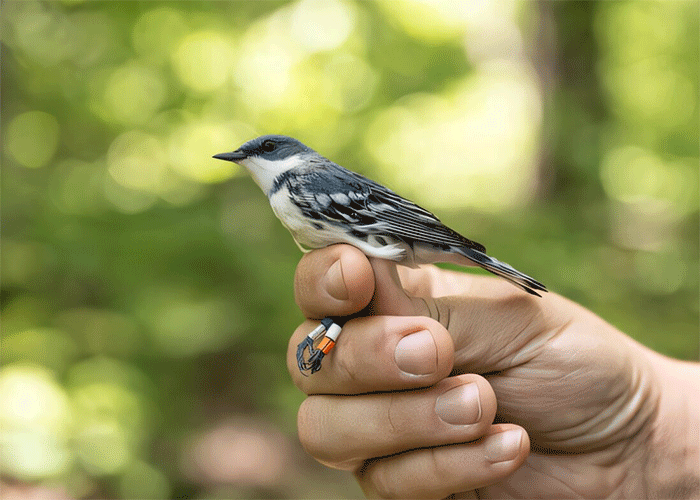
Artificial intelligence could give conservation researchers a new way to follow individual birds through the landscape - not by identifying the species they belong to, but by recognising which individual is singing.
The project, reported by Phys.org from the University of Kentucky, is focused on the Cerulean Warbler, a declining North American songbird that breeds in mature deciduous forest and can be difficult to monitor because it often sings from high in the canopy.
Bird identification apps and automated sound recorders are already able to recognise many species from their calls and songs. The new work aims to go a step further. Rather than asking whether a recording contains a Cerulean Warbler, researchers want to know which Cerulean Warbler is present.
That distinction could be important for conservation. Traditionally, researchers tracking individual birds have relied on catching them, fitting them with rings or colour bands, and then trying to relocate and identify them in later surveys. For small canopy birds, this can be slow, difficult and sometimes intrusive. It also depends on birds being seen well enough to read or interpret the marks.
The new approach could allow some birds to be recognised from recordings alone. If AI can learn the fine details of an individual’s song - subtle differences in pitch, timing, rhythm and structure - it may be able to identify a bird in much the same way that people recognise familiar human voices.
For field researchers, that could mean a major change in how long-term monitoring is carried out. Instead of repeatedly capturing or closely observing birds to confirm their identity, scientists may be able to place recording equipment in the field and use the songs birds are already producing to track whether the same individuals return to the same territories.
Such information is central to understanding population decline. If researchers can identify individual singers from year to year, they can begin to measure survival, site fidelity and movement more efficiently. They may be able to tell which birds return, which disappear, and whether individuals shift territory between seasons.
The project is being led by PhD student Lauren Chronister at the University of Pittsburgh, with Darin McNeil of the University of Kentucky among those involved. The work is still at an early proof-of-concept stage and currently relies on specialist recording equipment, including parabolic microphones, rather than mobile phones.
For now, the system is being developed as a tool for scientists rather than as a birding app. But if the method proves reliable, it could have wider uses for species that are hard to catch, hard to see or difficult to monitor visually.
The Cerulean Warbler is the starting point, but the broader idea is that individual birds may carry a recognisable acoustic signature in their songs. If AI can detect those signatures consistently, conservationists could gain a less invasive way to follow birds across seasons without depending so heavily on retrapping, resighting or physical marks.
June 2026
Get Breaking Birdnews First
Get all the latest breaking bird news as it happens, download BirdAlertPRO for a 30-day free trial. No payment details required and get exclusive first-time subscriber offers.
Share this story