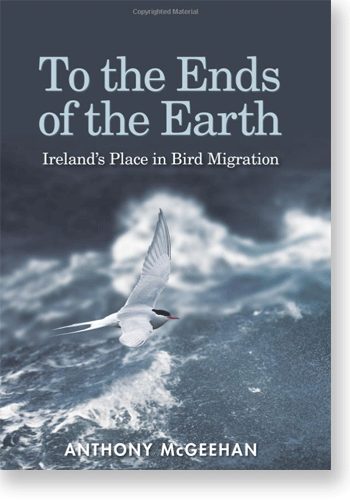
To the Ends of the Earth - Ireland’s Place in Bird Migration
Author: Anthony Mcgeehan
After memorably dipping a brief Long-toed Stint at Ballycotton in 1996 I’ve not done much Irish birding. That stint was costly in so many ways – it was an expensive twitch from Kent, it was almost certainly instrumental in my getting a lower degree classification, and it put me right off the idea of travelling to Ireland for just one bird.
Which isn’t to say I’ve not spent plenty of time in Ireland in the years that followed, nor that I don’t enjoy enormously the vicarious pleasures of reporting upon the rarities that turn up there. Better yet, when Anthony McGeehan was writing his regular Birding from the Hip monthly column in Birdwatch, I could read about what was making Irish birders tick.
And to this day, while those vintage magazines have long since been consigned to the recycling bins, McGeehan’s articles reside in a homemade anthology, pasted into a scrapbook, source of much enjoyable winter reading when, outside, the weather is too bleak to countenance picking up my binoculars. McGeehan is a natural storyteller, spinning delicious yarns with twists in the tale, painting evocative pictures with words of his beloved birds, his homeland, and the birders there who watch them.
All of which should tell you that it was with a mixture of high anticipation and a certain amount of trepidation that I picked up my copy of To the Ends of the Earth – Ireland’s Place in Bird Migration. Trepidation? Well, when you’ve raised a birder writer onto a pedestal, you don’t want to find they’ve lost their touch…
I’m delighted to say McGeehan’s touch remains deft and assured. Broken into thirds – entitled “Time to Fly”; “Mechanisms of Navigation”; and “Days of Wonder” – each third of the book comprises a series of essays in which Ireland provides context and illustration of everything that makes bird migration so compelling and confounding, and can inspire such euphoria in those who bear witness to it.
McGeehan has a rich vein of material to mine in this regard. So many bird species migrate, for starters, and to such very different places; he’s got ample avian source material to work from, birds humble and rare alike with stories to tell. The mechanisms of migration, the factors that affect it, the wild card that weather can play – all of this is grist to his mill.
In the wrong hands though, this could still be dry, turgid, factual stuff. Happily, this is not that book. Each essay sparkles with anecdote, either personal or third party. It’s an absolute treasure trove – in his essay examining the fate of migrants at sea, “A hurricane called Daisy”, McGeehan takes us back to October 1962, examining the anatomy and effects of a tropical storm born in the West Indies that grew into a hurricane off Bermuda, tracked up the eastern seaboard of the USA to Newfoundland and then headed east across the Atlantic.
Interspersed with vivid first-hand reports from Alan Durand, an observer on board the RMS Mauretania at the time, McGeehan’s writing has the mounting tension of a whodunit and the pace of a thriller – accompanied well out to sea by Monarch and Pipevine Swallowtail butterflies, the Mauretania is soon festooned with migrant birds – hordes of warblers and sparrows and, amongst them, stranger fare still – woodpeckers, a Blue Jay, a flock of Cedar Waxwings. After a five day crossing, most are gone – either under their own steam or hosed from the decks by the crew at night. Most, but not all - Durand recounts a Yellow-shafted Flicker flying strongly inland at Cobh.
Great names of twentieth century ornithology recount memorable experiences on land too. J.T.R. Sharrock’s account of a fall on Cape Clear in 1959 is a window into a golden period of Irish and British birding, when such bird populations were not the shadow they have now become, and such falls were, if never commonplace, then certainly less unusual than they are today.
Yet this is a book rooted firmly in the present too, and is no mere nostalgic trip down memory lane, undeniably pleasant though such excursions are. McGeehan’s first-hand accounts of contemporary Irish birding are beautifully immediate and gripping. Approaching rafts of shearwaters off Co.Galway in 2016, McGeehan observes, “Manx Shearwaters are Trappists. The smooth sea seemed to chime with their silence.”
Nature writing can fall into the trap of being overly elegiac, archly celebrating the author’s chosen subject. Like reminiscence, there’s a time and a place for that – but it’s refreshing to see McGeehan leavening his writing with an example of the scale of loss possible at the hands of man when we stop being laudatory and appreciative, and allow instead politics and profit to take the upper hand. His account of the loss of Capercaillies, Goshawks, Wolves and Wildcats from Ireland is chastening and unflinching. He describes a brainwashed nation that believes “’tourist-board green’… is a natural appearance”, where emerald green fields have replaced the woodlands that once covered much of Ireland.
(The Tudors had much to answer for: “As colonisation sewed conflict with Irish society, woodland was exploited or razed. Land was cleared to make way for human plantations and farming…. Wolves were hunted to extinction. In the eyes of Lord Blennerhassett, that meant two-legged as well as four-legged varieties. In 1610 he recommended ‘periodic manhunts to track down the human wolves to their lairs’.”)
McGeehan concludes To the Ends of the Earth on a wistful note. He laments the loss of Capercaillies, and as they are not migratory knows they will never return to their former home. “I wanted to collapse time and visit the past – and feel that I was in Ireland’s lost world of magnificent birds and beasts.”
I know how he feels. Reading his book feels like removing the boundaries of space and time – we are transported across the sea to an Ireland past and present, in the company of a guide who is both a cracking birder and a writer.
It’s like the best night out, ever – great company, great birding tales, and great times. And with no morning after. I loved it.
Jon Dunn
16 January 2019
Share this review

Commission for Conservation
Rare Bird Alert does not profit from the sale of books through Wildsounds. Instead we are part of their Commission for Conservation programme where a percentage of every sale made through RBA helps supports BirdLife's Spoon-billed Sandpiper Fund.