Review: Birds of Chew Valley Lake
- Birds of Chew Valley Lake by Keith Vinicombe (John Rossetti - editor)
- ISBN: 9781527263680, Hardback, Nov 2020
- Buy from WildSounds & Books for £24.95 +£6 p&p
PLUS 10% of each sale (£2.50) will be donated to the World Land Trust but only when you quote code: RBABOTW
Chew Valley Lake, CVL to its friends, has been an important part of my life – for a period of just about five years it was where I wanted to be, with my binoculars, in any spare moment. That was nearly 50 years ago and the journey to CVL was then a 40-minute cycle ride from home. Within minutes of arriving at the dam I had clues as to whether it was going to be a profitable visit – what was the water level, were there any waders on the dam itself or the nearby margins, were there any distant terns or small gulls out in the middle of lake? I learned a lot about birds and birdwatching in the surrounds of that sheet of water.
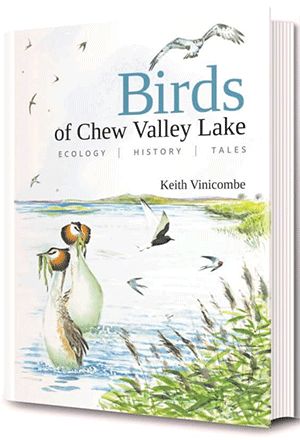
This is a big book by Keith Vinicombe, whose initials KEV, were even then attached to records of species that I had seen, or much more often, missed. At nearly 500 pages one might wonder what could possibly fill the pages – after all, it’s just a reservoir. And even less charitably, one might wonder whether such a book might be the product of an obsession not shared by anyone else. But no, this monumental book is well-judged, well-illustrated, well-designed and well worth having on your bookshelf. Yes, especially if you know the site or you are one of the hundreds of birders who live in or like me, grew up in, the catchment area of this sheet of water.
There are introductory chapters about the history of the site, its non-avian wildlife, its non-birding visitors (mostly anglers and people buying ice-creams and looking at the view) and some personal, and very good, reflections on the site by KEV and a few others.
But most of the book is given over to a taxonomic list of bird occurrences. I have now ‘missed’ even more species at CVL than I had in the 1970s. It has continued a remarkable record of rarities and is still a top birding spot for Bristolians, the residents of Somerset and those passing through. Over 300 species of bird have been recorded at this artificial site since it was opened by the Queen in the mid-1950s and the birds run from Alpine Swift to Yellow-legged Gull or Red-legged Partridge to Reed Bunting depending how you order them. This includes a list of waders numbering in the high 40s and 20+ gull species. But for me the graphs of numbers of birds seen, or indeed ringed, over the decades were of most interest. Most reflected national trends and so you can see the increase in Little Egrets (and some other white egret species) as a birding phenomenon as well as the decline in a range of nationally declining species such as Spotted Flycatcher and Meadow Pipit (and, of course, Ruddy Duck). For many species their occurences through the calendar are shown by month.
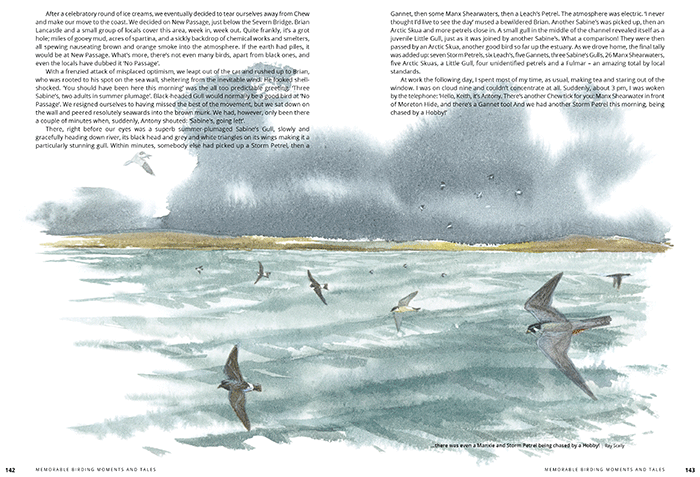
This is quite a book. Packed with information and beautifully illustrated with fine photographs, well-presented tables and graphs and with Laurel Tucker’s artwork. There are stories and opinions as well as facts and figures.
No birder ‘owns’ such a public site as this but KEV perhaps comes as close as any, having been birding regularly at this site for all these years and being a major contributor to the information on both rarities and the everyday species. There are probably other birding sites that deserve such a book but few will get them and those that try will have to use this book as a benchmark for their efforts which will be somewhat daunting as this book sets a very high standard. That is largely down to its author but he insists that much of the credit goes to his (and my) friend John Rossetti and there are a wide range of other acknowledgements of course.
I discover that the two Hawfinches I saw with school friends in April 1974 were the first of 12 records for CVL – I’d forgotten that, and I would have struggled to remember which of my school friends made up that group but I could take you now to the spot where we saw them and point to the tree, if it is still there, in which they perched. Such is the grip of birding on the memory.
But if you will indulge me, my most memorable Chew moment was not any of the American waders or the White-winged Blacks, or even the surprise at finding a group of Common Scoter or of an Avocet flying past, it was, I think, on a misty April morning when a Great Northern Diver called several times bringing the sound of the Arctic to north Somerset (or perhaps the fake county of Avon) for a few minutes.
My Chew years number only those when I had a bicycle in my teens before heading off to university, never to live in the Bristol area since. KEV has been birding this site before I started and all the years since. Wow! And his love for this place and its birds shines through these pages
Mark Avery - markavery.info
1 February 2021
Share this review

Commission for Conservation
Rare Bird Alert does not profit from the sale of books through Wildsounds. Instead we are part of their Commission for Conservation programme where a percentage of every sale made through RBA helps supports BirdLife's Spoon-billed Sandpiper Fund.