Birds of Prey of the West: A Field Guide
Birds of Prey of the East: A Field Guide
Brian K. Wheeler
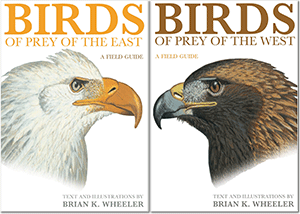
When travelling abroad, birds of prey present some of the most challenging identifications. Their multiplicity of plumages and often distant or brief appearances can cause real problems whilst, counter-intuitively, close views of perched birds can be even more testing. For an observer unfamiliar with the species involved, the identification error rate can be quite high.
The author of these two new guides fully understands these problems and has devoted much of his career to documenting the field appearance of North America’s birds of prey. He noticed long ago that conventional field guides did not give sufficient text space to the issues whilst larger handbooks failed to provide sufficiently useful illustrations. The result, thirteen years in the making, is the publication of these twin guides, one to the birds of prey of the West, the other to those of the East.
The format is that of a conventional field guide, with the familar structure of plates and facing text but with a limited number of species to consider there is much more space to devote to each. Each species therefore comes with multiple plates covering all ages, sexes, subspecies and plumage morphs, both perched and in flight in a variety of standard poses. These are supplemented by close-ups of tails and head patterns where appropriate. For Red-tailed Hawk, the most variable raptor in the region, there are no fewer than fourteen full plates in the Western guide.
The plates are all by the author and add up to a hugely impressive body of work. They lack a certain artistic finesse and are a little ‘wooden’ but as diagramatic representations suitable for a field guide they are exactly what is required. Considerable thought has gone into their design - the standardised portrayals facilitate easy comparisons whilst the use of neutral coloured backgrounds enables plumage contrasts to be portrayed exactly as seen under field conditions.
Published: May 2018 - Princeton University Press 2018
360 pages (West) 296 (East)
Birds of Prey of the West: A Field Guide
Hardback. Price: £41.95

Softback. Price: £22.95
Birds of Prey of the East: A Field Guide
Hardback. Price: £41.95
Softback. Price: £22.95
The plates are accompanied by a detailed text which is about as comprehensive as you can get although it is extremely dense and the use of a small font size doesn’t add to its accessibility. This is therefore far from a bedtime read but as a reference source based on vast amounts of knowledge and research it is unsurpassed. In addition to the plate-facing text, there are additional sections describing habitat, status, nesting, movements and comparisons with similar species. Also included are introductory sections on anatomy and plumage terminology, age classification and moult stages and, in both books, a separate chapter on plumage variation in ‘Eastern’ Red-tailed Hawk.
Adding greatly to the content are the distribution maps which, unusually for a field guide, are reproduced at full page size and are therefore genuinely useful. A particularly welcome feature is that each subspecies is given its own map. These maps have been painstakingly produced and represent the most up to date picture available of North American raptor distributions, including outlier vagrant records. A final welcome touch is the inclusion of a number of photographs of the exciting habitats in which these birds can be found.
Having spent time with these guides it is obvious that my own approach to identifying birds of prey in North America has been far too superficial. With this new information now available, it will be possible to take a far more disciplined approach in future. For birdwatchers in Britain these guides will also be an invaluable resource in attempting to identify a vagrant ‘Taiga Merlin’, tundrius Peregrine, Rough-legged Hawk or Northern Harrier.
Andy Stoddart
26 June 2018
Share this Review

Commission for Conservation
Rare Bird Alert does not profit from the sale of books through Wildsounds. Instead we are part of their Commission for Conservation programme where a percentage of every sale made through RBA helps supports BirdLife's Spoon-billed Sandpiper Fund.