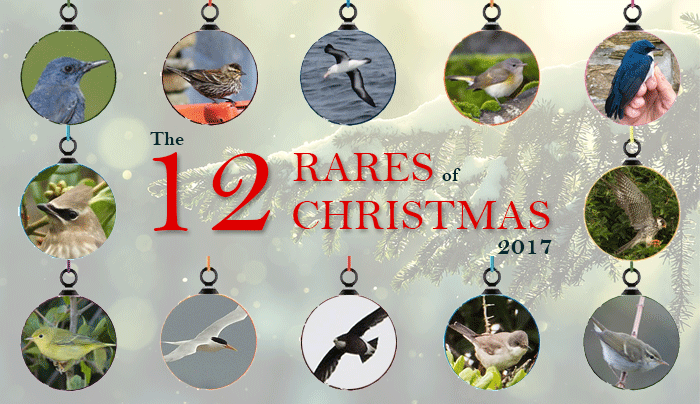
12 Rares of Christmas 2017: Day 12
How’s the head?
Whether you’ve been out on a madcap all-or-nothing attempt to crack the 100 species mark for the first day of the New Year or prostrate upon the sofa with the Alka-Seltzer, Ibuprofen, cold flannel and a bucket all close to hand after one too many Babychams last night, here’s the last of the RBA’s “12 Rares of Christmas” to a ease you in to 2018.
It was a close run thing between the two individuals that follow and the Fair Isle Green Warbler as being the bird/s afforded the honour of seeing us in to 2018 but the significance of Two-barred Greenish Warbler cannot be underestimated.
Not only did we have, for the first time ever, two records of the species within the same calendar year, one of which was the first spring occurrence here in to the bargain, but most importantly of all, for those of us who’ve enjoyed this delightful Phylloscopus on these shores we can now, officially, put a great big tick by its name as we enter the heady world of an I.O.C. British List…

The ins and outs, the whys and wherefores, the net gains, the net loses and why the I.O.C. run the show are questions that have been floating around for almost a year following the B.O.U. announcement of the decision to follow a new systematic list (bringing with it a different taxomomic outlook at times) at the end of January 2017.
Amongst the birds elevated to specific status on the British List a few hours ago was Two-barred Greenish Warbler and it seems entirely fitting to mark a new era of British birdwatching with a “new” species here ~ a species that, as mentioned above, surfaced twice through the course of the past 12 months.
Part one of the rise of the Two-barred Greenish Warbler story began, not as you’d expect, in the depths of autumn but towards the last knockings of springtime ~ not, at first glance, a time for the rarer overshooting Phylloscs. warblers to make landfall here but, as the most of us are getting used to nowadays, the rulebook often means little and surprises lie in wait at any time.
The last week in May can be festooned with some of the rarest birds to make it to Britain and Ireland across the whole of a year, a crescendo of vagrants clamouring for attention. Truth be told, there was little noise to be heard from the last few days of May 2017. There were reports of both Crag Martin and Black-browed Albatross and a Great Snipe too. Spurn excelled with a masterclass in VizMig birding (scoring four different Red-footed Falcons, an Alpine Swift and a Red-rumped Swallow within five hours) but the frisson of excitement so often associated with the time of year was definitely missing.

Fortunately all that changed during the afternoon of May 30th when news emerged from Shetland’s most westerly outpost, Foula, of the discovery of Britain’s first-ever spring Two-barred Greenish Warbler.
The same week had already laid claim to three Greenish Warblers elsewhere around the country so there was a certain amount of interest in any images that emerged from Foula. When they did, wow ~ it looked like the real deal, looking just as you’d want it to.
Birders who have travelled to the Far East know just how distinctive this species can be as May concedes to June, but they can also be pretty subtle affairs too, so it was exciting to see Donna Atherton’s striking image of the Foula bird; the look of that Shetland individual stood up well to the rigours of online analysis, you could quickly do any number of “compare and contrasts” with late May Greenish and Two-barred Greenish Warbler and tick off not only the differences between the two species but also see just how good the Foula bird was in terms of being plumbeitarsus. It looked the business.
Shetland had its first Two-barred Greenish Warbler and, typically for this remarkable set of islands, it broke the mould by producing not only a first record for the archipelago but also a first British spring record (assuming it sails through the records committee ~ which having seen a photo, seems a shoe-in doesn’t it?).
Rather more typical was the year’s second example of this newly elevated species but given the paucity of favourable weather for long-haul overshoots from the east, it still came as something of a surprise.

Part 2 of the Two-barred Greenish Warbler story for 2017 began in exceptionally quiet circumstances ~ the pager reporting news of a possible Arctic Warbler in the quarry at St. Aldhem’s Head on the Dorset coast after dark on October 15th. The bird had only been seen briefly at dusk and that was all that was known.

Outside Dorset, this news was of little significance; the county had had just two accepted records of Arctic Warbler, in 1984 and 2005 and, Greenish Warbler aside (particularly that fascinating early summer double-barred Portland individual), the most interesting wing-barred wanderer in the county of late was the astounding Sakahlin or Pale-legged Leaf Warbler of October 22nd 2012.
So, news of a brief, dusk sighting of a possible borealis on a Sunday night wasn’t going to see too many folk losing sleep. Two days later, that would change.

Around lunchtime of October 17th, things began to stir; the St. Aldhem’s Head warbler was still around and it was morphing into a Two-barred Greenish Warbler. The confirmed identity firmed up soon enough and it was well watched throughout the rest of the afternoon. Happily for those who hadn’t caught up with the species prior to this, the sometimes obliging visitor performed throughout the following day, showing to everyone who journeyed to the south coast. More elusive by all accounts on 19th the sightings were more sporadic through the day and by Friday morning, the event was over.
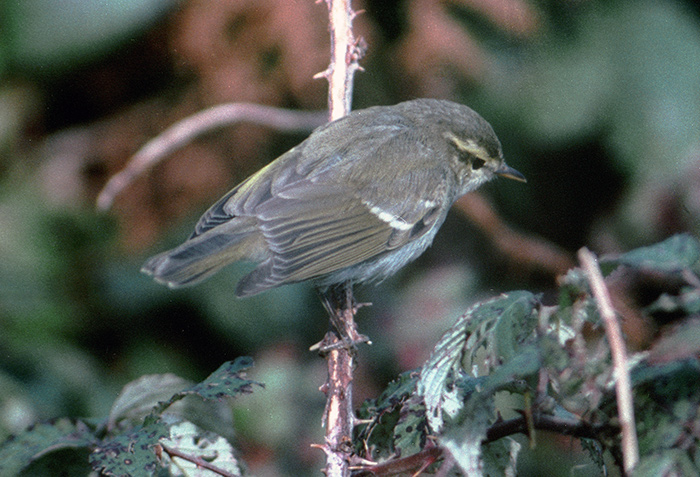
This year’s duo represent the sixth and seventh British records for Two-barred Greenish Warbler ~ Britain’s first was the famous much-debated at the time bird that spent October 22nd-27th 1987 on Gugh. Opinion lurched from Yellow-browed Warbler through to Two-barred Greenish Warbler and it was some while in to the proceedings before a consensus was reached. We had to wait until 1996 for the next one, found in mid-October by the legendary John Kemp in north Norfolk’s Wells Wood. That two day bird didn’t generate anywhere near the fuss it should have ~ folk drawn north for a Great Knot and south for a Northern Waterthrush ~ while Scilly’s second, another two-dayer, around Samson Hill, Bryher followed at the end of September 2003.

North Yorkshire got in on the act in mid-October 2006, when a much appreciated bird spent three days at Filey and then a whole decade elapsed until Britain’s fifth surfaced, a photographed cracker found on Papa Westray on October 9th 2016.

In these modern times of exceptional extreme eastern Phylloscopus vagrancy, since 2009 there have been four Eastern Crowned Warblers and two Pale-legged Leaf Warbler-types, there’s something almost old skool (and, again) eminently satisfying about the double appearance of Two-barred Greenish Warbler in 2017.

It doesn’t feel as though the day everyone drops everything for a Kamchatka Leaf Warbler is very far away either (some may argue that it’s a species that has already slipped through the net already) but until then, we’ll make do with the species that started the ball rolling back in 1987. And now, over 30 years on, it officially makes the grade with full species status and a siny new spot on the British List.
There we are then, done and dusted on our Yuletide tramp through the rarity undergrowth of 2017. Normally I’d wrap things up with a look ahead to next year and the eternal wishlist birds for many (nothing’s changed, it’s still Hawk Owl and Wallcreeper for the majority) but instead of that, there’s a little bonus to plug ~ coming tomorrow is sweep up of some of the remaining big rarities from the year that fell just short of the Committee of One’s decisions as to which birds made the “12 Rares…” grade.
One more time for the boy’s in the band…
Mark Golley
1 January 2018
More from 12 Rares of Christmas 2017 series
Day 1 - Blue Rock Thrush
Day 2 - Red-winged Blackbird
Day 3 - Black-browed Albatross
Day 4 - American Redstart
Day 5 - Siberian Blue Robin
Day 6 - Scilly megas
Day 7 - Amur Falcon
Day 8 - Yellow Warblers
Day 9 - Elegant Tern
Day 10 - White-throated Needletail
Day 11 - Eastern Orphean Warbler
Day 12 - Two-barred Greenish Warbler
Share this story