10 Million Aliens
Simon Barnes
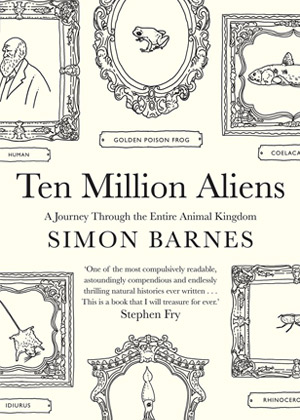
This latest book by the well-known writer and columnist Simon Barnes is a rip-roaring trip through the wonders of the natural world. Instead of obsessing about whether we are alone in the universe we should, argues Barnes, give a whole lot more consideration to the astonishing array of fellow beings with which we already share our tiny, fragile planet.
This book is an introduction to only part of this great diversity - the Animal Kingdom, that part of nature’s great array to which we ourselves belong. It is, in some ways, an encyclopedia of the unknown millions (Barnes say ten millions) of animals which inhabit this branch of the natural world, a compendium of all its creatures, from its highest profile top predators - its sharks, bears and tigers - to its smallest and most obscure representatives - its worms, snails and centipedes. Rest assured, however, that this is far from being a dry and repetitious undertaking. Even the book’s core structure helps to avoid the dangers of a linear, systematic approach. Split into two entwined threads, ‘vertebrates’ and ‘invertebrates’, the chapters alternate between these two strands. We therefore lurch, often abruptly and unpredictably, between lions and leeches, mites and monitor lizards, birds of prey and bacteria.
It is, however, the quality of the writing which prevents this from becoming a dusty list of animals. Barnes is a consummate raconteur and in his hands we are treated to a veritable roller-coaster ride, taking us to moments and encounters in far-flung corners of the world (though most often to Africa). The opening of the chapter on aardvarks is but one example: “You only see aardvarks when you’re drunk. You may be told this when travelling in Africa, and certainly I can provide experimental verification.” Barnes’s journey is literary too, invoking sources as diverse as Charles Darwin, James Joyce and Ian Fleming. Engaging, irreverent and humorous throughout, this is a book which beguiles with its wit and easy style.
Published: Oct 2014
Pages: 480
ISBN: 9781780721422
Hardcover RRP: £19.99
SPECIAL OFFER: Pay just £14.99 when you quote discount code RBA64
Please read before ordering: When ordering via WildSounds, the value of the voucher will be deducted from your order when the order is processed. The total displayed on your shopping basket excludes the value of the promo but this will be applied before final payment is taken.

It also has few qualms about digging about in the more ‘earthy’ aspects of the natural world. Look away now if you are shy about reproduction or defacation for both are constant themes, explored in detail and with relish. These are, after all, the very things with which all animals, human or otherwise, have a reliable preoccupation. “Entoproct”, writes Barnes, “means ‘anus inside’. And that is perhaps the most fascinating thing about this phylum: they are creatures with hidden bottoms.”
Despite the relentlessly picaresque nature of his exploration, there is an ever-present subtext about our relationship with the natural world. This is a book which makes us smile but which also pulls no punches. Carefully woven throughout is the simple message that we are ultimately a lot more closely related to the rest of nature than we might think (or perhaps like to think) and that our position as an intelligent ape gives us a unique responsibility not just for our fellow creatures but for the planet itself. Barnes concludes: “we are part of a continuum. We are linked to our fellow animals, linked by our past and our present, linked by evolution and by ecology. We are linked, above all, by the planet that has supported us all for so many years. So far, anyway. And this sense of continuity is what matters; the continuity of our wild places, the continuity of the species with whom we share our planet, the continuity of the life-support system that is planet earth. We’re all in the same boat: we all come from the same stock, we’re all part of the same continuing cycle of life on earth.”
Andrew Stoddart
www.northnorfolkbirds.co.uk
12 November 2014

Commission for Conservation
Rare Bird Alert does not profit from the sale of books through Wildsounds. Instead we are part of their Commission for Conservation programme where a percentage of every sale made through RBA helps supports BirdLife's Spoon-billed Sandpiper Fund.