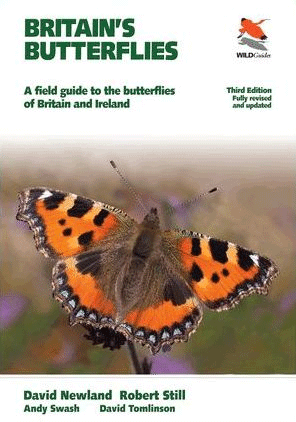
Britain's Butterflies (3rd edition)
David Newland, Robert Still, Andy Swash and David Tomlinson
Spoon-billed Sandpiper campaign
This is a new third edition of a field guide which first appeared in 2002 and it remains an excellent introduction to Britain’s fabulous butterflies.
Useful introductory sections cover the differences between butterflies and moths, the butterfly life cycle, habitats and where to look for butterflies and how to identify them. Then come the main species accounts followed by brief sections on species of doubtful provenance, food plants, images of eggs, caterpillars and chrysalises, a complete list of British butterflies and introductions to butterfly photography, recording and monitoring, conservation and legislation and further reading.
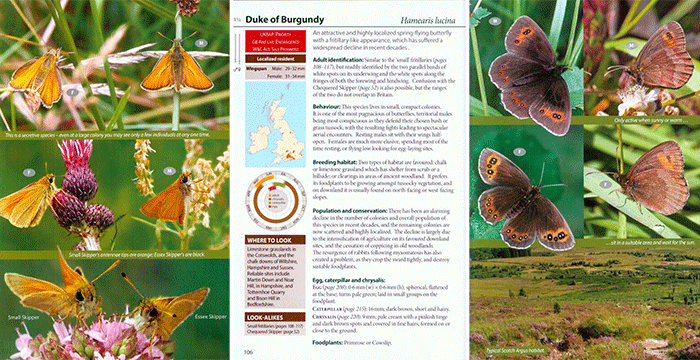
The species accounts are of course the main component of the book and each butterfly receives the traditional field guide treatment of a double-page spread. The text page on the left crams a lot of information into a small space and covers the identification of adult butterflies, behaviour, breeding habitat, population and conservation, egg, caterpillar and chrysalis and foodplants. Also included in the left margin are the relevant conservation designations, biometrics, a range map, a calendar showing each stage of the life cycle, a ‘where to look’ paragraph and a cross-reference to ‘look –alike’ species.
The texts are of course up to date with the latest discoveries about Ireland’s Wood Whites, now recorded as Cryptic Wood Whites, and also the constant ebb and flow of butterfly numbers and ranges. The northward spread of the Marbled White and the Silver-washed Fritillary are both noted, for example.
There is also a commendably full treatment of former breeding species and occasional migrants. Though often clouded by questions of provenance, these species are also important to document as some, such as Map, may represent future colonists. As with the texts on the regular species, those on the rarities are up to date too, incorporating the remarkable scatter of Scarce Tortoisehell sightings in south-east England in summer 2014.
Published: Mar 2015 - Princeton University Press/WILDguides 2015
Pages: 240
ISBN: 9780691166438
Softback RRP: £19.75
SPECIAL OFFER: Pay just £13.25 when you quote discount code RBA71. Valid till 31 Mar 2015
Please read before ordering: When ordering via WildSounds, the value of the voucher will be deducted from your order when the order is processed. The total displayed on your shopping basket excludes the value of the promo but this will be applied before final payment is taken.

The right-hand page contains montages of photographs of each species together with images of typical habitat. Although generally a fan of artwork-based rather than photographic field guides, I was actually very impressed with the images. All are of exceptional quality, utterly sharp and avoid the problems of poor lighting or untypical poses which so often spoil photo-based guides. The images cover the necessary range of male and female appearances and upperwings and underwings too. It is also good to see coverage of Britain’s butterfly subspecies, with some superb images of, for example, oblita Speckled Wood and thyone Grayling.
With a bright, attractive design and a practical clear plastic dust-wrapper to protect the book in the field, there is everything to like about this field guide. For butterfly beginners and for collectors of fine butterfly portraits, it’s an ideal purchase.
Andrew Stoddart
www.northnorfolkbirds.co.uk
18 March 2015

Commission for Conservation
Rare Bird Alert does not profit from the sale of books through Wildsounds. Instead we are part of their Commission for Conservation programme where a percentage of every sale made through RBA helps supports BirdLife's Spoon-billed Sandpiper Fund.