


Intertidal shellfish farming sustaining migratory shorebirds in China
Large-scale research shows that intertidal mariculture along China’s coast has become an essential food source for migratory shorebirds – and that poorly planned bans could accelerate their decline.
A flyway under extreme pressure
The East Asian–Australasian Flyway is widely recognised as the most threatened migratory shorebird flyway on Earth. Over recent decades, vast areas of intertidal mudflat along China’s coast – the flyway’s most important refuelling zone – have been lost to land claim, development and coastal infrastructure.
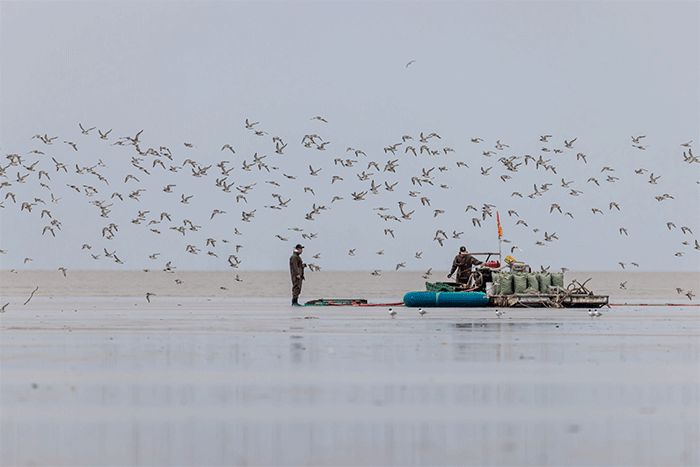
Against this backdrop, new continent-scale research reveals an unexpected lifeline for migratory shorebirds: China’s extensive intertidal shellfish farming. Rather than simply degrading habitat, managed mollusc mariculture has become a critical food source sustaining millions of birds during their northward spring migration.
Tracking birds and shellfish along 18,000 kilometres of coast
The study draws on a decade of coordinated surveys across 43 coastal sites spanning the entire Chinese mainland coastline, from the Bohai Sea to the South China Sea. Researchers combined long-term counts of migratory shorebirds with detailed sampling of intertidal molluscs to examine how food availability shapes bird distribution and abundance.
In total, 49 shorebird species were recorded during spring migration. Of the species whose diets are known, over half are mollusc specialists, and these species make up around three-quarters of all individual shorebirds counted along the coast.
Commercial molluscs dominate shorebird food supply
The results show that farmed shellfish – clams, mussels and other commercially grown molluscs – now dominate the benthic food base of China’s intertidal flats. Although fewer in species number than wild molluscs, commercial species account for more than 80% of total mollusc density at many sites.
Where commercial mollusc densities were highest, shorebird numbers were consistently greatest. This relationship was especially strong for mollusc-eating species such as Great Knot and Red Knot, whose densities closely tracked shellfish abundance across space and time.
When food declines, birds disappear
The study also documents what happens when this food source is abruptly removed. At a key staging site in southern China, a conservation-motivated ban on intertidal mariculture led to a rapid collapse in commercial mollusc populations, driven by unregulated public harvesting.
Within two years, overall mollusc density fell by more than half, and densities of commercial shellfish declined by over 70%. Shorebirds responded immediately. Numbers of the endangered Great Knot dropped sharply, and individual feeding rates fell by more than 50%, leaving birds unable to refuel effectively during migration.
An unintended ‘tragedy of the commons’
Rather than restoring natural conditions, the mariculture ban transformed managed mudflats into open-access areas with no controls on exploitation. The result was a classic ‘tragedy of the commons’, where food resources were depleted more rapidly than under regulated farming.
The findings challenge assumptions that removing human activity automatically benefits wildlife. In this system, carefully managed shellfish farming provided predictable, high-energy prey that many shorebird populations have come to rely on after decades of habitat loss.
Rethinking conservation along crowded coasts
The authors argue that blanket bans on intertidal mariculture risk doing more harm than good unless alternative food resources are first restored. With China planning widespread restrictions on shellfish farming over the coming decade, the study warns that poorly implemented policies could destabilise the entire flyway.
Instead, the research points to a more pragmatic path: integrating biodiversity conservation with sustainable food production. Managed shellfish farming, if carefully regulated, may help offset the loss of natural mudflats and buy time for shorebird populations already pushed to the brink.
A fragile balance worth protecting
In one of the most human-dominated coastal systems on the planet, this study highlights a rare example of coexistence between food production and wildlife conservation. For migratory shorebirds of the East Asian–Australasian Flyway, the future may depend not on removing people from the coast, but on managing their activities wisely.
December 2025
Get Breaking Birdnews First
Get all the latest breaking bird news as it happens, download BirdAlertPRO for a 30-day free trial. No payment details required and get exclusive first-time subscriber offers.
Share this story





