Inland Sooty Falcon population confirmed in Saudi Arabia
New fieldwork in the AlUla region has revealed at least 38 breeding pairs of Sooty Falcon, confirming successful inland nesting for the species in north-west Saudi Arabia.

A newly published study has confirmed successful inland breeding by Sooty Falcon Falco concolor in the AlUla region of north-west Saudi Arabia, revealing a previously unrecognised breeding population in one of the most arid parts of the Arabian Peninsula.
The work, published in Ornis Hungarica, documents at least 38 breeding pairs across the AlUla conservation area network, with the core population concentrated in Sharaan National Park. Additional probable breeding pairs were found in Gharameel Nature Reserve and Wadi Nakhlah Nature Reserve.
The finding is significant because Saudi Arabia’s Sooty Falcons have been best known from Red Sea islands and coastal cliffs, while inland breeding has remained poorly understood. Earlier inland records suggested the possibility of breeding, but this study provides the first confirmed evidence of successful reproduction in the AlUla region, including juveniles fledging in Sharaan National Park.
Researchers surveyed the AlUla conservation area network between 2023 and 2024, covering a National Park, Nature Reserves, a Biosphere Reserve, a White Volcano Geopark and areas rich in biodiversity. Sooty Falcons were recorded between April and October in three areas - Sharaan National Park, Gharameel Nature Reserve and Wadi Nakhlah Nature Reserve - with breeding activity concentrated in the sandy flatland and sandstone landscapes of the north-east.
Evidence of breeding included courtship, copulation, territorial defence, nest attendance, hunting behaviour and the presence of juveniles. In October 2024, young birds were seen near nest entrances in Sharaan National Park, with some making their first flights under the supervision of adults.
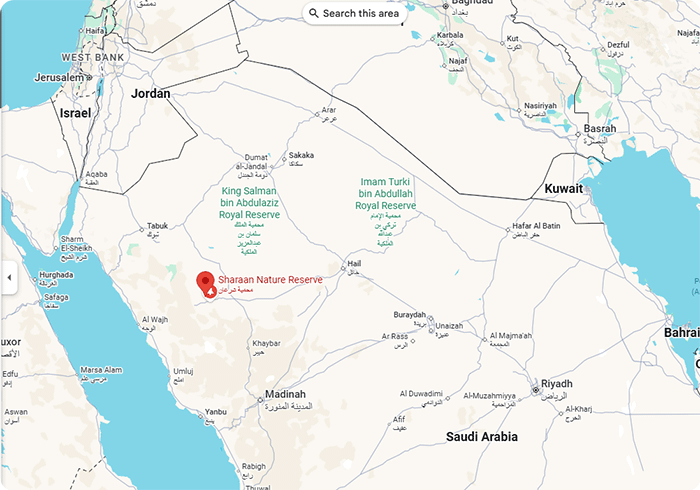
The population estimate is conservative. Of the minimum 38 breeding pairs recorded across AlUla, 35 were estimated in Sharaan National Park, two in Gharameel Nature Reserve and one in Wadi Nakhlah Nature Reserve. Ten pairs were confirmed through direct evidence such as copulation, nest attendance or juveniles, while the remaining pairs were inferred from adults in suitable habitat showing behaviour consistent with breeding.
The nesting sites were found on small inselbergs, steep sandstone cliffs and rocky escarpments, usually between 40 and 90 metres high. Some pairs nesting on isolated inselbergs were relatively close together, with distances between pairs of around 300-1,000 metres, while pairs on larger cliff systems were more widely spaced.
The authors suggest that these inland landscapes may function in a similar way to more familiar coastal and island nesting sites, offering elevated rock faces, cavities and reduced predator pressure. The discovery also shows that Sooty Falcon may be more adaptable to arid inland environments than previously documented.
Sooty Falcon is globally listed as Vulnerable, with an estimated world population of 2,800-4,000 mature individuals. The newly identified AlUla population represents nearly 2% of the estimated global breeding population, giving the discovery clear conservation importance.
The paper concludes that further survey work and long-term monitoring will be needed to refine the population estimate, assess habitat quality and understand whether other inland populations remain undetected elsewhere in the Arabian Peninsula.
June 2026
Get Breaking Birdnews First
Get all the latest breaking bird news as it happens, download BirdAlertPRO for a 30-day free trial. No payment details required and get exclusive first-time subscriber offers.
Share this story