


Finders in the Field: Turkestan Shrike, West Rise Marsh, East Sussex
David Thorns
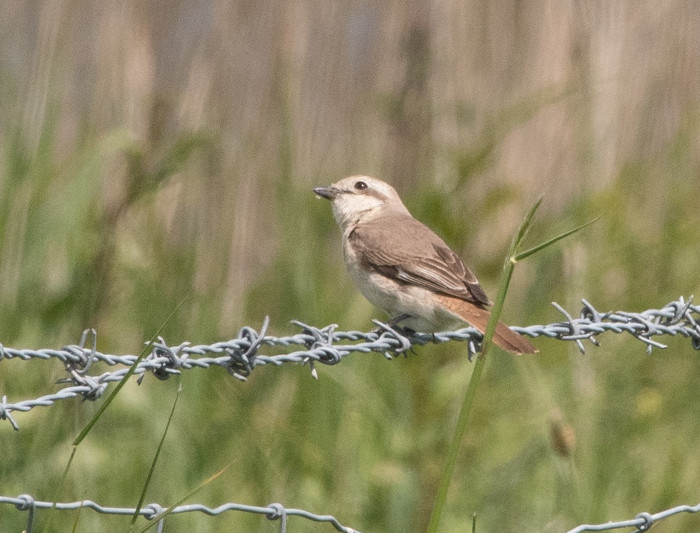
There didn’t seem to be anything special about Tuesday 30th May; it was once again bright and sunny outside with blue skies and scattered cloud, and the trees were still rocking in what seemed like a never-ending strong northeasterly. Nevertheless I decided to go to West Rise Marsh where at least there would be a smattering of gulls on the choppy lake which would keep me amused for a while if nothing else. (I should add that being an oldie now in semi-retirement allows me to do this sort of thing).
At midday I started walking my usual anti-clockwise loop around the edge of the marsh (which should really be a Local Nature Reserve at the very least…scandalous!). It was quiet, as I had imagined it would be, with very little singing, sparrows chirping from the reeds and just a few Swifts careering overhead in the strong sun. And there was indeed a group of gulls out there on the water - I’d look at those later.
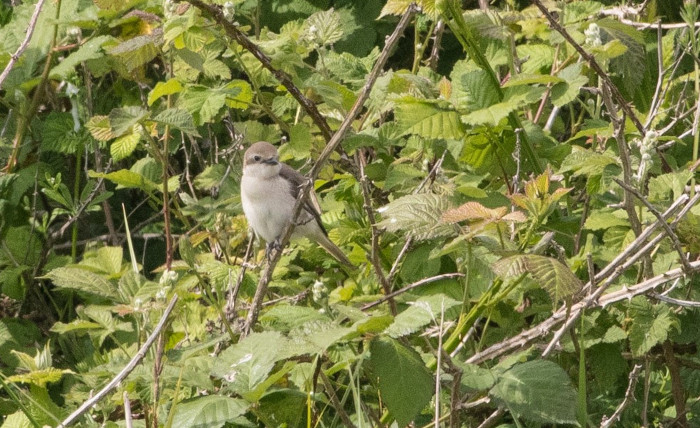
After a while I began wondering what the hell I was doing out here, traipsing slowly through long grass, seeing nothing in this blasted incessant wind. Miraculously it was at this point that a pale brown, chunky-looking large passerine flashed across my field of view and swooped onto a nearby bush. I quickly raised my binoculars and, wow, there it was…unmistakably and unbelievably an Isabelline Shrike! (Well, I did say I was old). I heaved up my heavy camera which was wobbling and trembling in the wind as I took a few quick record shots. I looked down to check one or two of them: OK…not too bad. However when I glanced up again the bird, naturally, had completely vanished and was nowhere to be seen!
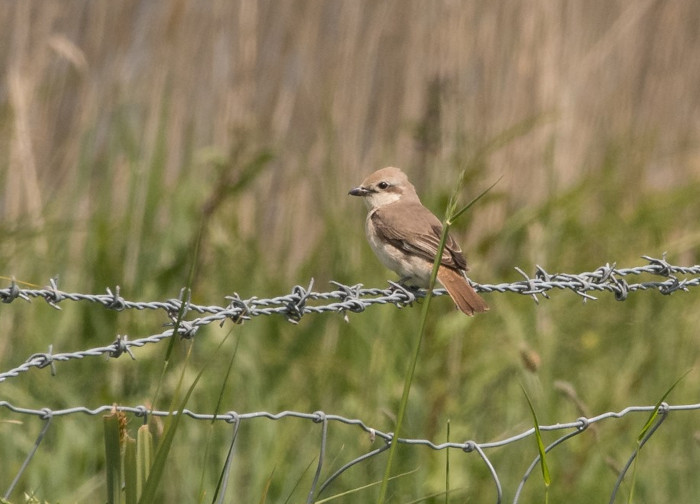
I immediately took a picture of my camera-screen and sent out a couple of Whatsapps about the find. Soon after, a friend called me to say that Chris Batty had already identified the bird from my photograph as what is classified as Turkestan Shrike: "a female due to the dull eye-stripe behind the eye, the lores being pale, and the presence of crescent marks on the flanks, and a Turkestan as opposed to Daurian Shrike based on the white not buff underparts and supercilium". This was also the feeling of Laurence Pitcher who, living just a few kilometres away on the other side of Eastbourne, was the first respondent to arrive on the scene. He and I, along with other local birders James and Stuart, split up in an effort to find it again and it didn’t take long before Laurence phoned to say that he’d located it in its original spot. As I hurried towards him, I could just make out Allsworth Redman in the distance walking quickly across a field, fresh off the 99 bus…he’d made good time.
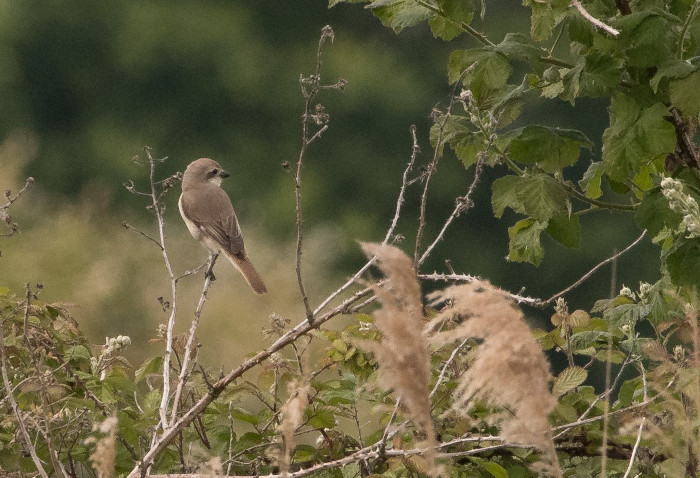
Fortunately, from that moment on it was all plain sailing: the bird was faithful to a small area and would spend several minutes at a time in one place, surveying the grasses and occasionally swooping down to catch prey. It was an attractive and captivating bird to look at with a subtle, cold-looking brown-and-white appearance and a rather cute facial expression. Several birders were on the scene when I eventually left in the late afternoon and it was still being seen as late as 8pm. Unfortunately for some, however, the bird did not reappear the following morning. I was thrilled to find out later that Turkestan Shrike, should it be accepted, would be only the ninth recorded in Britain and a first for Sussex!
David Thorns
2 June 2023
Share this story








