Finders-in-the-field: Pied-billed Grebe, Loch of Spiggie - A Shetland First
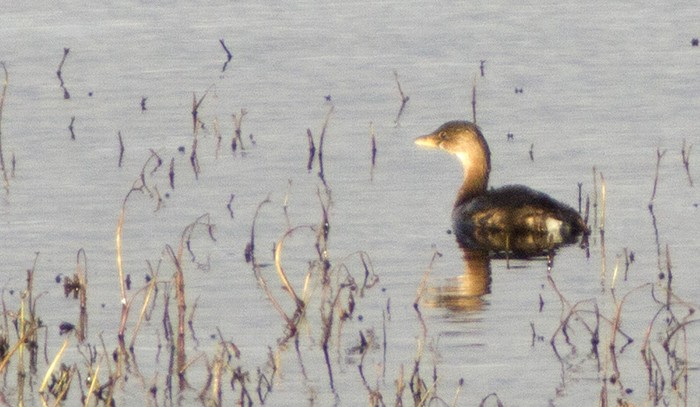
By the time the clocks went back, the 2017 Shetland autumn appeared to be meandering quietly and aimlessly towards winter. The wind swung into the southwest on 24th October and (at the time of writing) it’s been westerly ever since. Mind you, resident birders could hardly complain, given that the headline acts of the previous six weeks had all been from the west – Shetland’s second Black-billed Cuckoo and White-crowned Sparrow, and its first White-winged Scoter.
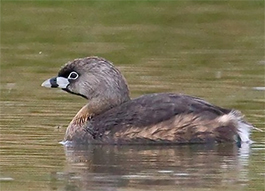
BOU/IRBC Status: A
RBA status: Rare Vagrant
Accepted British records: 44
Accepted Irish records: 12
Most recent accepted record: 2015 25 Apr to 4 May - Leighton Moss RSPB, Lancs
Prime month(s) to occur: April and November
Saturday 4th November dawned bright, with moderate SW winds and occasional heavy showers. Given the lack of spark in the preceding days, I didn’t anticipate full day in the field and left the house around 10.00 with little intention of leaving the driving seat. I figured that a lap of the local watery places would probably take me nicely up to lunchtime.
And in the first hour there was little to get too excited about. A family group of three Barnacle Geese at Fleck (two adults and a juv, one of the adults being colour-ringed) seemed a good candidate for the birding highlight of the day, although they would surely prove to be from the Svalbard population, where virtually all of Shetland’s passage Barnacle Geese originate from.
I pulled up at the south end of the Loch of Spiggie, the largest freshwater loch in the south mainland, around 11.45. Scanning over the loch revealed several groups of Mallards, a winter-plumaged Slavonian Grebe and very few Aythyas, which was disappointing. I took the scope from the passenger seat and scanned over the Setter Marsh area. Everything seemed entirely peaceful, and then a Little Grebe swimming past a drake Mallard sent a kick of adrenaline through me, like a shock from an electric fence: ‘why isn’t that a Pied-billed Grebe?! Surely that bird is really big…’ Suddenly, I was properly awake. I cranked up the zoom on the scope, and concentrated. Fifteen minutes of ‘is it? isn’t it?’ ensued, dithering which later seemed inexplicable, yet the bird wasn’t that close, and at some angles it looked just like a Little Grebe. And it was diving constantly, which didn’t help. Eventually, I’d been through the key criteria multiple times, and it surely ticked all the boxes – it wasn’t the most obvious of Pied-billed Grebes, but it was one!

... it was a hugely enjoyable Saturday afternoon, all the more so for being wholly unexpected. The bird was my 400th for Shetland, 25 years and a few months after stepping off the north boat in April 1992.
I spoke to Rory, my stepson, on the phone, since I knew he wasn’t far away and might appreciate coming to see a first for Shetland with the kids before the news went out. He decided he would do just that, so I had a bit longer to enjoy the bird, as well as the opportunity for a second opinion before the news went out to the world. The bird seemed wholly settled and worked its way across to the near edge of the loch so that in good light and at a range of 150 m I had some nice views. Rory and the girls duly arrived. One-year-old Malin was predictably unimpressed; three-year-old Thea was disappointed at how far away it looked through her prized, all-plastic FisherPrice bins; but daddy said he was OK with it as a Pied-billed Grebe.
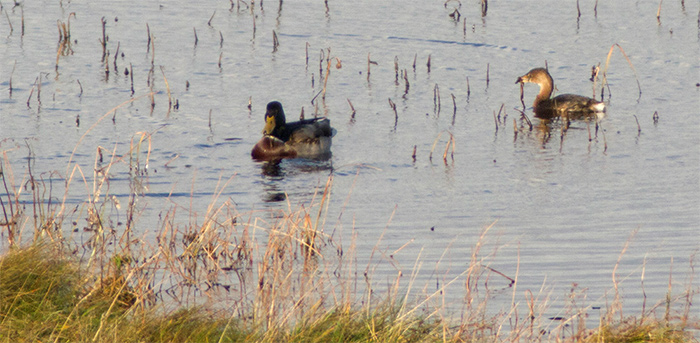
Even though the light was good, it was just too far away for even for the biggest lenses in Shetland so there are no gripping photos to accompany this write-up. I alternated between disgiscoping, my canon 400 with a converter, and a notebook & pencil – none of which worked particularly well. The bird’s size – the first thing I’d noticed – and shape were distinctive, but so was its behaviour. It was surprisingly aggressive, bossing the Slavonian Grebe and pretty much all the ducks it encountered, including Mallards. When alarmed, it did the classic Pied-billed Grebe ‘submarine’ routine, sinking its body beneath the water, leaving just the head and tail (or just the head) visible – and then either disappearing from view completely or resurfacing.
All in all, it was a hugely enjoyable Saturday afternoon, all the more so for being wholly unexpected. The bird was my 400th for Shetland, 25 years and a few months after stepping off the north boat in April 1992. Two postscripts to report. Perhaps unsurprisingly, given how at home the bird seemed, it later emerged that it was not newly arrived – it had been photographed, as a presumed Little Grebe, two days previously. And, to add a gloss to the day’s notebook, a subsequent e-mail from Steve Percival revealed that the Barnacle Goose family was not from Svalbard but was the first confirmed record of Greenland barnies in Shetland for maybe 30 years. The same group had been photographed a few days before, in Foula, by Geoff & Donna Atherton, who we’d enjoyed the Foula White-crowned Sparrow with four weekends earlier…
Roger Riddington
13 November 2017
Share this story