Finders-in-the-Field: Western Sandpiper, Tacumshin Lake, Wexford, April 2020
By Killian Mullarney
While the principle objective of my visit to Tacumshin early on 7th April was to take a fresh look at early spring plumages of Dunlin, it is impossible not to be excited by the prospect of encountering rare or unusual birds at this wonderful birding spot. A quick scan of the large flock of Black-tailed Godwits from the east end revealed the presence of the long-staying Long-billed Dowitcher, now in full breeding plumage, but largely obscured by one of the more colourful godwits.
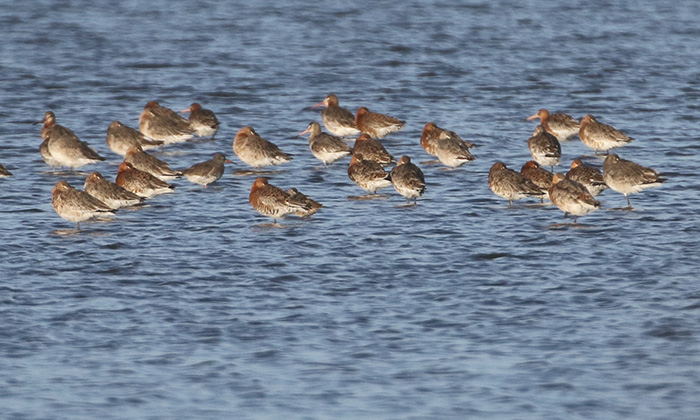
In early April the Dunlin numbers are still quite small, but I was excited to see that a few of the race schinzii were already in full breeding plumage, while the majority were still essentially in winter plumage. As I scanned through the flock comprising c40 Dunlin, c80 Sanderling and about 50 Ringed Plovers (almost all of which were recent arrivals referable to the darker psammodromus race) I noticed a stint in their midst, which at long range appeared to be in full winter plumage. Little Stint would be the most likely species here, especially at this time of year, but I needed to get a closer look to confirm the identification.
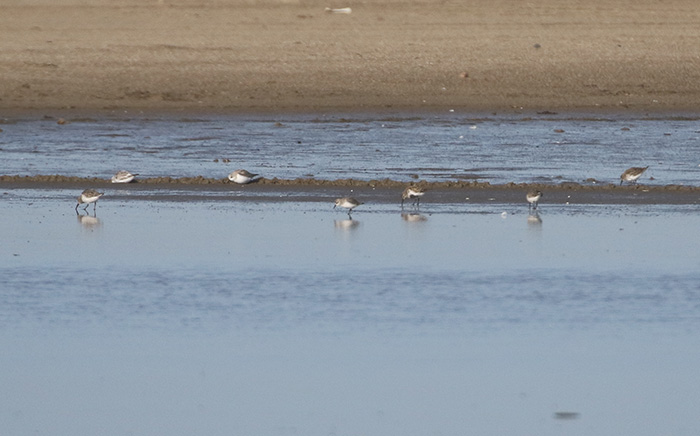
On this occasion, the flock was not particularly settled or approachable, so it took a little time to get closer, but with the bright sun and rising heat-haze, even then it wasn’t easy to determine details reliably. My impression was that it was not a Little Stint, a species I am used to seeing around this time of year on annual visits to the Greek island of Lesvos, when even the less advanced birds usually show some hint of rufous fringes to recently moulted tertials and inner greater coverts. This bird completely lacked rufous, and on the left side especially the tertials were prominently edged with white. Furthermore, the shape and structure of this bird led me to suspect it was a Semipalmated Sandpiper, but with the few previous spring records of Semipalmated Sandpiper in Ireland all having involved breeding plumaged adults in May or June, identifying a winter plumaged bird in April presented a little more of a challenge.
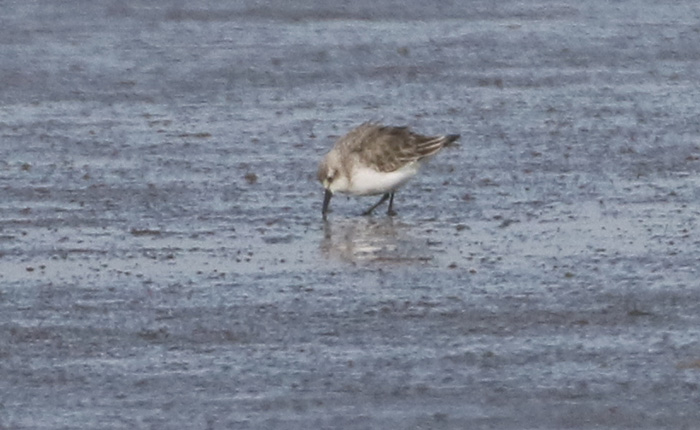
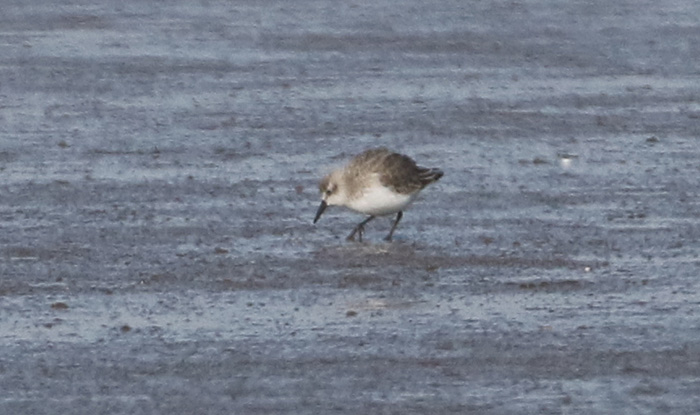
As the bird was mostly wading in very shallow water or wet mud it wasn’t possible to confirm the presence or absence of palmations, but I repeatedly got an impression of a prominent hind-toe, a feature that I discovered could be useful in the elimination of Little Stint when, a few years ago, I was asked to assess a record of what proved to be Estonia’s first record of Semipalmated Sandpiper, a winter adult photographed at Rahuste in December 2011. Eventually, the flock of birds moved to an area of dry sand, and here I was able to confirm that the bird definitely did have palmations. In view of its seemingly rather stocky build, short and apparently quite stout bill and a well-marked darkish ‘mask’ I was pretty confident that I was looking at a Semipalmated Sandpiper, but unfortunately the bird vanished before I had an opportunity to examine it in more detail. I was unable to relocate it for over an hour, at which point I decided to call it a day.
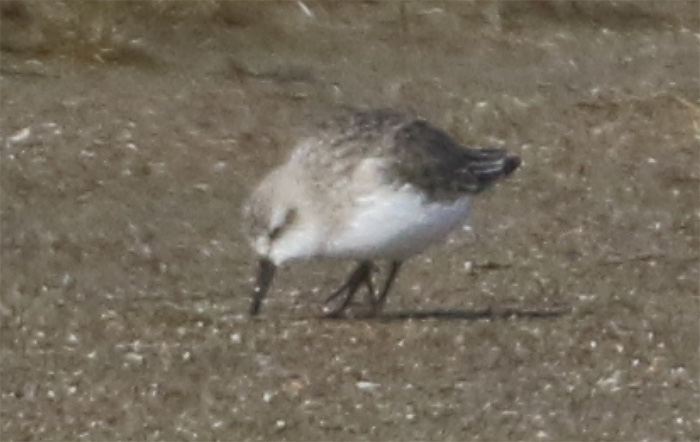
The following evening I returned to Tacumshin hoping for a better look at the bird at a time of day when I would not have to contend with heat-haze. There was no sign of it until quite late on, a little before 20.00, when the low sun bathed the birds in warm, yellowish light. I did not immediately notice anything that made me question the identity of the bird as a Semipalmated, but at this point I was concentrating more on trying to get closer to the bird, than studying it.
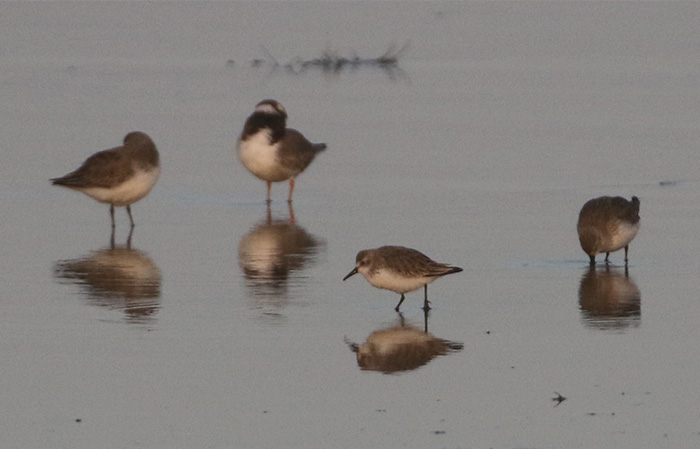
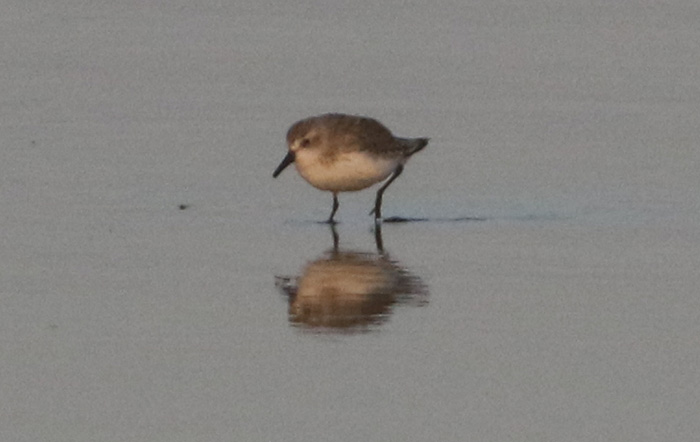
I could sense that the flock was nervous, so my approach was slow, but when I was still 150m away they all took off and flew out toward the beach, where the smaller waders often avail of the of the accumulated seaweed for shelter and concealment. I approached the ridge of the beach cautiously, anxious not to spook the birds when I would suddenly come into view. Luckily, I quickly located a small group of birds and the stint was on the left end of the group.
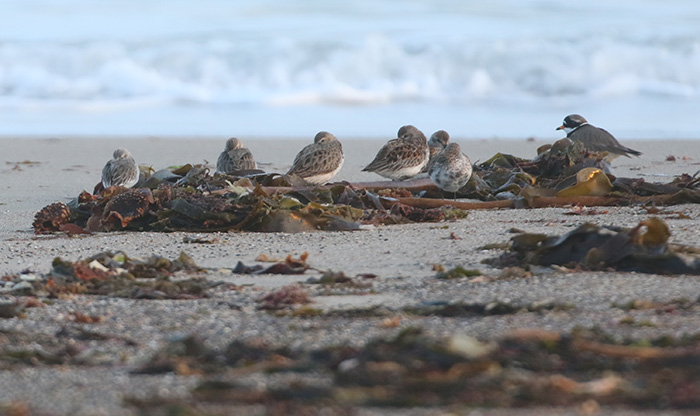
Initially, I was getting a ¾ view from behind, but when the bird turned its head and looked toward me I was shocked at how different it looked; surely, with such a fine-tipped bill and whitish face, this was a Western Sandpiper, not a Semipalmated as I had thought! After a few minutes the bird walked a short distance into the open and turned to give me a more front-on view, from which position its Western-like appearance was even more evident. The bill, though short, was noticeably more slender and fine-tipped than I had perceived it to be the previous day, and the ‘masked’ appearance was much less evident in the sunless, flat light conditions. I thought I could discern a very faint hint of warmth developing in the ear coverts and on the side of the crown, but in all other respects the bird was in winter plumage, with no hint of summer plumage in the upperparts, tertials or wing coverts. Given the apparent fresh condition of the neatly white-tipped mantle and scapular feathers and what looked like largely juvenile faded wing coverts I concluded that the bird was probably a second calendar-year, a considerable number of which are said to acquire new winter plumage-like feathers in their pre breeding season moult (O Brien et al 2006). The comparatively short bill (for a Western) indicates a male.
I watched the bird for the last ten minutes of light, grateful that I had, in the end, managed to get views that enabled me to correctly identify it. It was humbling to consider how complacent I might have been with my initial identification, had I not had the benefit of a good, close view.
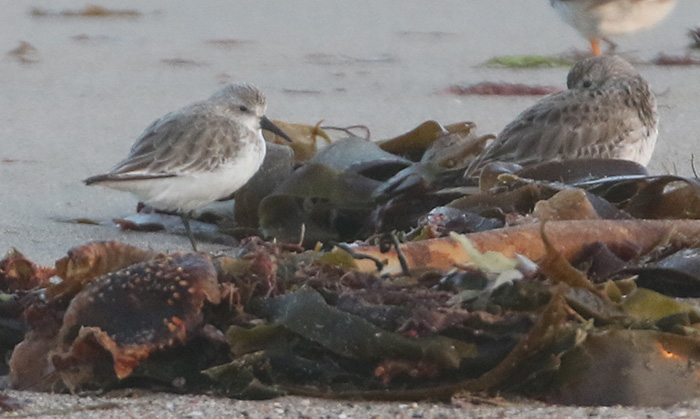
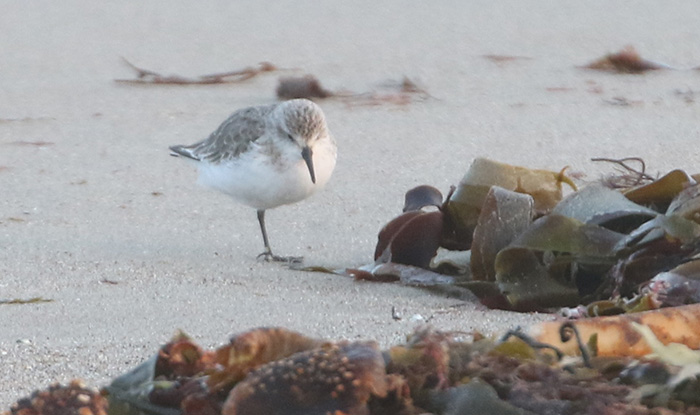
I was very happy to obtain a sound-recording the following morning, the calls being higher-pitched and sharper than the usual call of Semipalmated Sandpiper, exactly matching the calls I have heard from Westerns in the US.
If accepted by the IRBC this will become the sixth Irish record of Western Sandpiper, and the fourth for County Wexford where previous records occurred in September 1992, August 1996 and July 2016.
Killian Mullarney
14 April 2020
Reference: O’Brien M., Crossley, R. and K. Karlson (2006) The Shorebird Guide, Houghton Mifflin
POSTSCRIPT - The Tacumshin ‘Western Sandpiper'
I don't know if it is actually true, that "everyone makes mistakes" (in bird-identification), but I know that I certainly do, and not infrequently. However, I usually realise when I have done so pretty quickly, and if nothing else, these errors serve as regular reminders of my own fallibility. When it comes to making public pronouncements on the identification of rare birds, either ones I have found myself or ones I that I've been invited to comment upon, I am cautious, and try not to get it wrong, but that is exactly what I did a month ago, when I re-identified a stint I had initially believed to be a Semipalmated Sandpiper, as a Western Sandpiper. I feel it may be helpful now to correct my error, in as clear a manner as I made it.
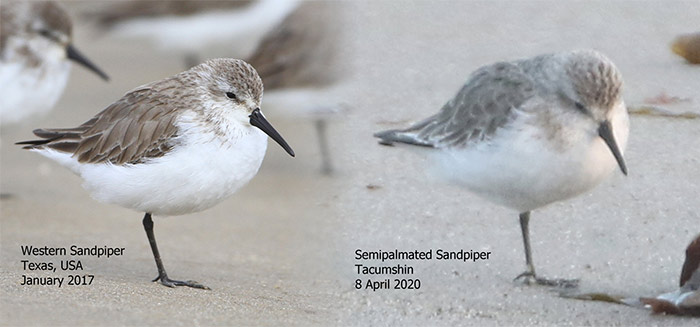
With the benefit of hindsight and several subsequent observations of the bird in question, I can see that the genesis of my mistake was to allow the strongly Western-like impression I gained on that second evening effectively obliterate the more Semipalmated-like impression I perceived initially, and which gradually reasserted itself with subsequent observations. With the bird being apparently a first-winter, there was little in the way of plumage detail that helped in the identification process, but what disturbed me most in the course of subsequent observations was the bird's ‘jizz’, in particular its shape and proportions. Often, it appeared to have a rather long, chunky and somewhat oval-shaped body and a proportionately small-looking head, rather than the more front-heavy pear-shaped body and proportionately big head that I associate with Western.
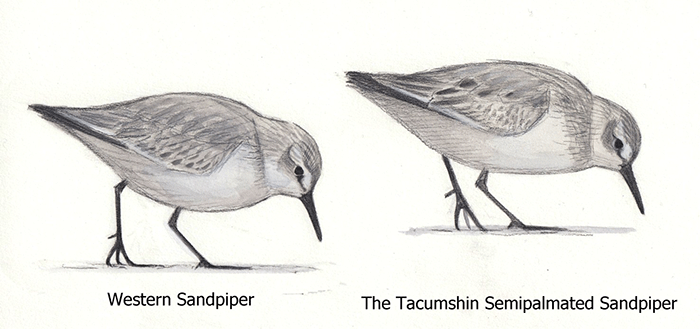
Of course, assessments of body-shape are highly subjective and a lot of the time I couldn't decide whether it looked one way or the other, but on balance it seemed to me more like that of a Semipalmated than a Western, despite my really wanting to see it otherwise. With the growing uncertainty as to what I was dealing with I realised also that I had perhaps been too simplistic in my interpretation of the consistently rather high-pitched 'chip' notes I had recorded on 9 April as being diagnostic of Western. My efforts to obtain further recordings yielded nothing new, just a few more squeaks and chips that differed little from the homogeneous Calidrid chatter being produced by the many Dunlin and Sanderling with which the bird was associating, but then I wasn't hearing any distinctive Semipalmated "chrkk" calls either, so there was still hope... There was no sign of the bird after 26 April, and a few days later the entire flock, disappeared, so I assumed that was it; I was not going to get a chance to gather more evidence, and would have to do with more critical analysis of what I already had. On the morning of 6 May I was delighted to hear from another birder that the "Western was back", along with a much increased arrival of up to 4,000 Dunlin. Even though it had now moulted quite a bit since I first saw it, its appearance had not changed a great deal, but I reasoned to myself that I would not expect a Western to necessarily acquire rufous colour in its moult to first-summer plumage (though this is precisely what I hoped would develop if the bird stayed long enough!). What was interesting however was the bird had now selected a particular patch of mud as its feeding territory, and was vigorously chasing away Dunlin that encroached on 'its patch', apparently calling at the same time, though it was much too distant to be audible.
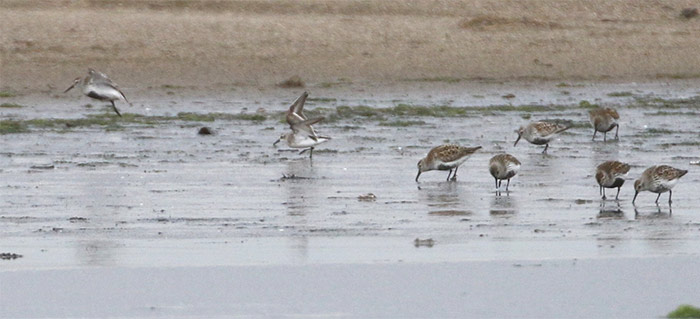
With the very calm conditions on the morning of 8 May I took up position, parabola at the ready, close to the spot. It did not take long for the large congregation of Dunlin to relax, and start working their way toward me, but I had to wait a while for the 'Western' to gain confidence. When it did, it came running ahead of the pack, and started feeding within 30m of me. As soon as the first Dunlin arrived on its patch the pugnacious behaviour commenced, and with it, a lot of vocalisation; no high-pitched squeaks or chips now, but a variety of grunts and deep 'chrks' that reminded me more of a Turnstone than a Western Sandpiper! While the adverse light from my position was not ideal , I could now see that the newly moulted greater coverts and tertials had pale ginger fringes, not a hint of rufous....
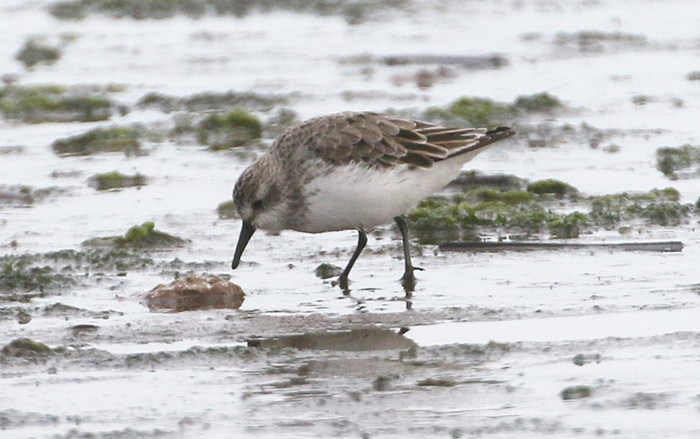
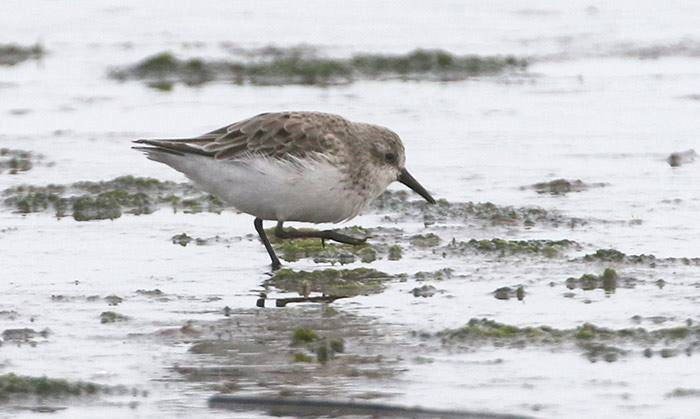
It was now so undeniably a Semipalmated, I wondered how I had ever managed to convince myself otherwise. I guess that sometimes all it takes is that dangerous combination of over-excitement, over-confidence, and a touch of wishful thinking. So, while I am cross with myself for not having exercised due rigour with a bird in this notoriously tricky plumage, I am very glad to have had the chance to rectify the error while the bird was still present, and learn a few things in the process of doing so.
Killian Mullarney
15 May 2020
Share this story