


Dunwich Heath wildfire burns through key bird habitat
A wildfire covering around 100 hectares has spread from Dunwich Heath into parts of RSPB Minsmere, threatening nationally important habitat for heathland birds.
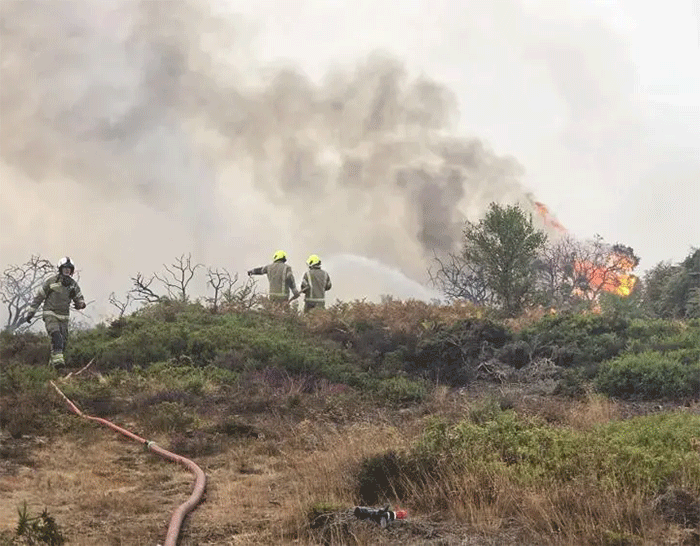
A major wildfire on the Suffolk coast has burned across an estimated 100 hectares of heathland, woodland and surrounding countryside, raising serious concerns for birds at Dunwich Heath and neighbouring RSPB Minsmere.
The fire began shortly after 5.30pm on Wednesday 29 July and spread rapidly through exceptionally dry vegetation. By 1pm on Thursday, Suffolk Fire and Rescue Service said 18 fire engines and supporting resources were at the scene, with a major incident remaining in place.
Firefighters expected to continue working for at least another 24 to 48 hours. Homes, National Trust holiday accommodation and Cliff House Holiday Park were evacuated, while road closures were introduced to keep access clear for emergency vehicles.
Crews were met with what is a large-scale, wind-driven forestry fire.
Dan Davis, Suffolk Fire and Rescue Service station manager
The fire began on and around Dunwich Heath, the last large area of coastal heathland on the Suffolk coast. The National Trust site contains around 95 hectares of lowland coastal heath, one of Britain's rarest habitats, and forms part of a wider protected landscape stretching towards Minsmere and Walberswick.
RSPB area manager Adam Rowlands confirmed that the blaze had spread into parts of Minsmere. He described its scale as unprecedented in living memory and the damage as quite devastating. The reserve was closed to visitors and is expected to remain shut until further notice.
Once this fire took off it spread dramatically and quickly.
Adam Rowlands, RSPB area manager
The precise extent of the damage to individual habitats and bird territories will not be known until the fire is safely extinguished and conservation staff can enter the affected area. There was no confirmed count of birds killed or nests destroyed at the time of publication.
Even so, the timing is particularly concerning. Dunwich Heath supports a nationally important community of heathland birds, including Dartford Warbler, Nightjar and Woodlark, together with Stonechat, Skylark and Whitethroat.
Although mobile adult birds may escape an approaching fire, eggs, nestlings and recently fledged young are far more vulnerable. Dartford Warblers build low nests in dense gorse and heather and can produce two or three broods. Nightjars lay directly on the ground and can still have eggs or dependent young in late July and August, while Woodlarks also nest on the ground in open heathland.
The most immediate losses may therefore involve nests and young birds that cannot escape. Longer-term effects are likely to depend on how much mature heather and gorse has been burned, whether unburned refuges remain within the fire area and how quickly the insect life on which many of the birds depend recovers.
The fire has struck just as Dunwich Heath's birdlife was recovering from the severe heat and drought of 2022. National Trust surveys recorded 30 pairs of Dartford Warblers that year, but the total fell to 17 pairs in 2023 as damaged vegetation and reduced invertebrate numbers affected the habitat. Numbers recovered to 25 pairs in 2024 and 29 pairs in 2025.
They're able to find the food sources they need, not just to survive, but to actually thrive as a species.
Sam Cooper, National Trust area ranger, speaking about the Dartford Warbler recovery before the fire
That recovery depended on the return of healthy heather, gorse and the insects living within it. A severe burn can remove the dense vegetation used by Dartford Warblers for nesting and shelter, while also reducing spiders, caterpillars and other invertebrate prey.
Nightjars and Woodlarks can sometimes benefit in later years from a varied landscape containing open ground and vegetation of different ages, but an uncontrolled summer wildfire is very different from carefully planned habitat management. Its intensity, speed and timing can destroy active nests and leave large areas without the vegetation structure needed by breeding birds.
The National Trust had already been carrying out work to remove dead heather, retain moisture and reduce wildfire risk following the 2022 drought. Countryside manager Matt Wilson had warned visitors that ignition in dry vegetation could cause rapid and destructive spread.
Fire can spread rapidly and destroy these special and rare habitats.
Matt Wilson, National Trust countryside manager
Incident commander Christopher May said crews were trying to minimise the impact on the local environment while bringing the fire under control. Specialist drones, all-terrain vehicles and quad bikes have been used to monitor the fire and reach difficult ground.
The cause of the blaze had not been confirmed. Suffolk Fire and Rescue Service has urged people to stay away from Dunwich Heath and Minsmere, keep roads clear and close windows and doors where they are affected by smoke.
Once the site is safe, surveys will be needed to establish which parts of the heath and Minsmere have burned, how many known bird territories were affected and what emergency management will be required to protect surviving habitat and support its recovery.
30 Jul 2026
Get Breaking Birdnews First
Get all the latest breaking bird news as it happens,
download BirdAlertPRO
for a 30-day free trial. No payment details required and get exclusive first-time subscriber offers.
Share this story




